NOVA CAPILLAIRE · PARIS
Hair transplants for women.
Care centered on your hair.
A changing hairline, a widening part or changing density: in Paris, our team takes time to assess your hair and your plans for a hair transplant using Sapphire FUE HD.
Initial online assessment · Response within 72 business hours.
YOUR HAIR, YOUR STORY
Understand the hair loss.
Plan what comes next.
Before considering a hair transplant, it is important to understand what is changing. Your history and a medical assessment help guide a discussion of suitable options.
Steps to understand your situationBefore making a decision
01
Describe what has changed
When did you first notice hair loss? Is your part widening or your density changing? These details help trace how your hair loss has progressed.
02
Investigate the cause
A medical assessment examines your scalp, medical history and possible contributing factors. It helps clarify the cause and which tests may be useful. Our guide to telogen effluvium explains one form of diffuse shedding.
03
Choose the right next step
Depending on the findings, discuss treatments, follow-up or a possible transplant. If a transplant is considered, candidacy criteria, the donor area and areas to treat are assessed.
A transplant is not suitable for every type of hair loss. Its suitability is discussed after a medical assessment.
OUR PACKAGES
Let’s also talk about pricing.
Explore the plans. Clear pricing. A quote tailored to your hair.
01Choose your hair type
4 plans
Essential
€2,750 incl. VAT
500 to 1,000 grafts
1 mesotherapy session
1 phototherapy session
Straight and wavy
Balance
€3,700 incl. VAT
1,100 to 1,900 grafts
1 mesotherapy session
1 phototherapy session
Straight and wavy
Signature
€4,700 incl. VAT
2,000 to 3,000 grafts
1 mesotherapy session
1 phototherapy session
Straight and wavy
Custom
On request
3,100 or more grafts
2 mesotherapy sessions
2 phototherapy sessions
Straight and wavy
Over two consecutive days
Essential
€2,750 incl. VAT
500 to 1,000 grafts
1 mesotherapy session
1 phototherapy session
Afro and coily
Signature
€3,700 incl. VAT
1,100 to 2,000 grafts
1 mesotherapy session
1 phototherapy session
Afro and coily
Custom
On request
2,100 or more grafts
2 mesotherapy sessions
2 phototherapy sessions
Afro and coily
Over two consecutive days
What your plan includes
- TechniqueSAPPHIRE FUE HDFollicles are extracted individually using the FUE technique. Sapphire blades are used to create the small recipient sites for the grafts.
- Mesotherapy1 sessionSmall injections into the scalp before the procedure, as part of the practitioner’s preparation plan. The product used and the reason for treatment are explained during your consultation.
- Phototherapy1 sessionA session of LED light exposure for the scalp, following the practitioner’s chosen protocol. It supports your care without replacing prescribed treatments.
- Post-transplant follow-up12 monthsSupport for 12 months after your procedure to monitor progress and answer your questions. Arrangements are discussed with the center.
- Meals and snacksIncludedMeals and refreshments during your stay at the center on the day of your procedure are included.
The Custom plan includes two mesotherapy sessions and two phototherapy sessions.
To watch during your procedure
- Netflix

- YouTube
 Netflix
 YouTube
Your exact graft count and quote are determined after assessment.
Select a card to view its price.
01Choose your plan
PLAN 01
SAPPHIRE FUE HDEssential
€2,750incl. tax
Number of grafts500 to 1,000
Approximately 1,200–2,400 hairs, calculated at 2.4 hairs per graft. An estimate; the actual number varies.
Hair typeStraight and wavy
Your exact graft count and quote are confirmed after an assessment of your hair.
PLAN 02
SAPPHIRE FUE HDBalance
€3,700incl. tax
Number of grafts1,100 to 1,900
Approximately 2,640–4,560 hairs, calculated at 2.4 hairs per graft. An estimate; the actual number varies.
Hair typeStraight and wavy
Your exact graft count and quote are confirmed after an assessment of your hair.
PLAN 03
SAPPHIRE FUE HDSignature
€4,700incl. tax
Number of grafts2,000 to 3,000
Approximately 4,800–7,200 hairs, calculated at 2.4 hairs per graft. An estimate; the actual number varies.
Hair typeStraight and wavy
Your exact graft count and quote are confirmed after an assessment of your hair.
PLAN 04
SAPPHIRE FUE HDCustom
Your project, your quote
On requestincl. tax
Number of grafts3,100 or more
Approximately 7,440+ hairs, calculated at 2.4 hairs per graft. An estimate; the actual number varies.
Hair typeStraight and wavy
Your exact graft count and quote are confirmed after an assessment of your hair.
PLAN 01
SAPPHIRE FUE HDEssential
€2,750incl. tax
Number of grafts500 to 1,000
Approximately 1,200–2,400 hairs, calculated at 2.4 hairs per graft. An estimate; the actual number varies.
Hair typeAfro and coily
Your exact graft count and quote are confirmed after an assessment of your hair.
PLAN 02
SAPPHIRE FUE HDSignature
€3,700incl. tax
Number of grafts1,100 to 2,000
Approximately 2,640–4,800 hairs, calculated at 2.4 hairs per graft. An estimate; the actual number varies.
Hair typeAfro and coily
Your exact graft count and quote are confirmed after an assessment of your hair.
PLAN 03
SAPPHIRE FUE HDCustom
Your project, your quote
On requestincl. tax
Number of grafts2,100 or more
Approximately 5,040+ hairs, calculated at 2.4 hairs per graft. An estimate; the actual number varies.
Hair typeAfro and coily
Your exact graft count and quote are confirmed after an assessment of your hair.
To watch during the procedure
- Netflix
- YouTube
{"plans":{"lisses":[{"summaryGrafts":"500 to 1,000 grafts","hairEstimate":"Approximately 1,200\u20132,400 hairs, calculated at 2.4 hairs per graft. An estimate; the actual number varies.","name":"Essential","grafts":"500 to 1,000","price":"\u20ac2,750","custom":false,"color":"#146ef5"},{"summaryGrafts":"1,100 to 1,900 grafts","hairEstimate":"Approximately 2,640\u20134,560 hairs, calculated at 2.4 hairs per graft. An estimate; the actual number varies.","name":"Balance","grafts":"1,100 to 1,900","price":"\u20ac3,700","custom":false,"color":"#b77646"},{"summaryGrafts":"2,000 to 3,000 grafts","hairEstimate":"Approximately 4,800\u20137,200 hairs, calculated at 2.4 hairs per graft. An estimate; the actual number varies.","name":"Signature","grafts":"2,000 to 3,000","price":"\u20ac4,700","custom":false,"color":"#b66f85"},{"summaryGrafts":"3,100 or more grafts","hairEstimate":"Approximately 7,440+ hairs, calculated at 2.4 hairs per graft. An estimate; the actual number varies.","name":"Custom","grafts":"3,100 or more","price":"On request","custom":true,"color":"#65839d"}],"afro":[{"summaryGrafts":"500 to 1,000 grafts","hairEstimate":"Approximately 1,200\u20132,400 hairs, calculated at 2.4 hairs per graft. An estimate; the actual number varies.","name":"Essential","grafts":"500 to 1,000","price":"\u20ac2,750","custom":false,"color":"#146ef5"},{"summaryGrafts":"1,100 to 2,000 grafts","hairEstimate":"Approximately 2,640\u20134,800 hairs, calculated at 2.4 hairs per graft. An estimate; the actual number varies.","name":"Signature","grafts":"1,100 to 2,000","price":"\u20ac3,700","custom":false,"color":"#b66f85"},{"summaryGrafts":"2,100 or more grafts","hairEstimate":"Approximately 5,040+ hairs, calculated at 2.4 hairs per graft. An estimate; the actual number varies.","name":"Custom","grafts":"2,100 or more","price":"On request","custom":true,"color":"#65839d"}]},"copy":{"for":"for","view":"View this plan","selected":"Selected plan","graftsLabel":"grafts","hairTypes":{"lisses":"Straight and wavy","afro":"Afro and coily"},"custom":"Your project, your quote","one":"1 session","two":"2 sessions","explore":"Explore all %d plans"}}
PREPARING FOR YOUR PROCEDURE
Partial shaving. Explained in pictures.
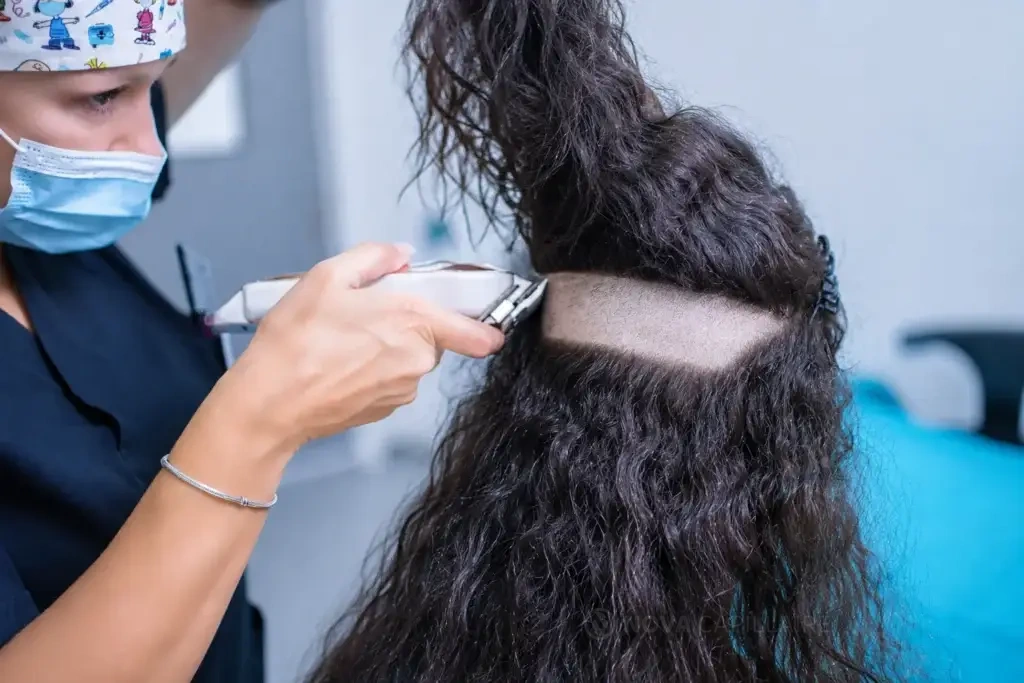
Partial shaving exposes the donor area to make precise graft harvesting easier and faster; harvesting long hair remains possible, but takes more time and may increase the cost of the procedure.
Three details to understandAn individual preparation
01
Plan the procedure
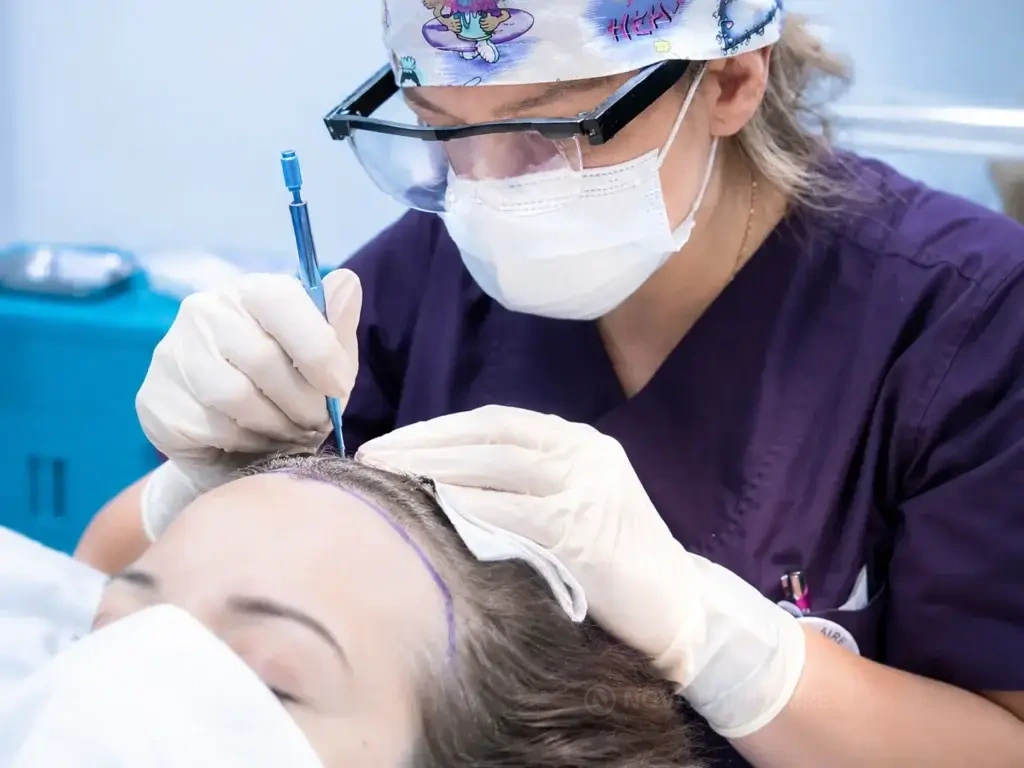
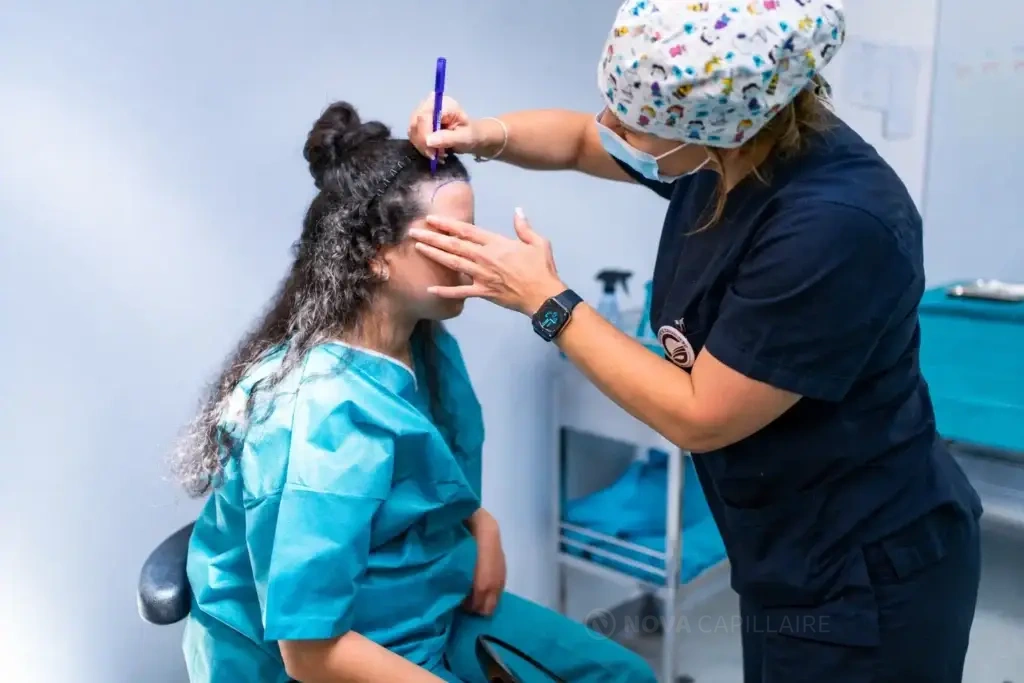
The hairline design is discussed with the patient. The area used for graft collection is at the back of the head.
02
Trim a targeted area
The hair is lifted to show the shaved area. At this stage, only the hair is shortened: no strip of skin is removed.
03
See the hair lowered
The video shows the surrounding hair lowered over the area. Coverage depends on its length and density.
The extent of shaving and how it looks with your hairstyle are explained before the procedure. These images illustrate one individual preparation.
YOUR CONSULTATION IN PARIS
Let’s take time to listen to you.
Your hair, your daily life, your expectations: a personal conversation to plan what comes next.
Your consultationParis Montparnasse
01
Your experience, your priorities
Talk about what has changed, your hairstyle and what you hope to gain from care.
02
Understand your options
Discuss the assessment, suitable options and your quote. If a transplant is considered, its preparation is explained to you.
03
Support over time
After a transplant, follow-up for 12 months allows you to review your progress and ask questions.

BEFORE YOU DECIDE
Your questions
are welcome.
Your situation, the technique, the budget: answers to help you understand what matters and prepare for your conversation with the team.
All questionsThe essentialsQuestions / answers
Your situationIs a hair transplant suitable for every type of hair loss?
No. Similar-looking hair loss can have different causes. A medical assessment helps identify the cause, examine the donor area and discuss suitable treatments before considering a transplant.
Hair densityCan a widening part or thinning crown be treated?
A transplant may be considered in some situations following a medical assessment. Sufficient hair must be available in the donor area. When thinning also affects the back and sides of the head, harvesting options may be limited.
Partial shavingDoes all my hair need to be shaved?
No: the protocol shown here involves partial shaving of the donor area at the back of the head. The surrounding hair is kept and may cover the shaved area, depending on its length and density.
Shaving makes it easier to access the follicles for harvesting. The extent of shaving and how it looks with your hairstyle are explained before the procedure.
View the two photos and video explaining partial shaving in the section above: the hairline design, the shaved area and the hair lowered over it.
Your hairlineCan my hairline be treated?
The plan may include the hairline, depending on your situation. Its design takes your features, existing hair and donor resources into account. The consultation allows you to discuss your expectations and the limits of what can be achieved.
Your hair typeWhat about Afro-textured or tightly curled hair?
Hair texture is considered during the assessment. Explore our page on hair transplants for Afro-textured and tightly curled hair.
RegrowthWhen will I be able to see regrowth?
Regrowth after a transplant develops gradually over several months. Follow-up appointments allow your progress to be reviewed and your questions to be answered.
Caps and helmetsWhen can I wear a cap, hat, beanie, or helmet again?
At NOVA, wait until the first ten days after your final transplant day have passed before wearing a cap or hat: from day 11, choose a loose-fitting one that does not rub the treated areas. Wait three weeks before wearing a beanie or helmet. Keep items clean and dry, especially after sweating: follow their cleaning instructions and let them dry fully. Do not modify a helmet’s safety components. If an item presses on an area that is still sensitive or has not healed, ask for advice before wearing it.
Procedure durationHow long does a hair transplant take?
At NOVA, these are the time guidelines for one transplant day:
- 500–1,000 grafts: up to 6 hours.
- More than 1,000 and up to 2,000 grafts: up to 8 hours.
- More than 2,000 and up to 3,000 grafts: up to 10 hours maximum.
These are approximate guidelines, not a guaranteed duration. The procedure and breaks needed for your comfort may affect the schedule.
For straight and wavy hair, allow one day for up to 3,000 grafts and two days above that. For Afro and tightly curled hair, allow one day for up to 2,000 grafts and two days above that. For a two-day procedure, the time guidelines apply to the grafts planned for each day; the team confirms the allocation and schedule.
Your procedure dayWhat happens during a transplant day at NOVA?
You arrive in the morning to complete your paperwork. The team draws the planned hairline or treatment outline, which you approve before proceeding. Local anesthesia is followed by graft extraction. The grafts are organized and kept cool in an appropriate preservation solution.
After extraction, you have about an hour to rest and enjoy a hot meal ordered for you. Implantation follows, usually while you lie on your back. You can watch TV or use your phone, covered with protective film according to the center’s hygiene procedures.
Snack and bathroom breaks are available. Let the team know when you need a break; an assistant accompanies you to the bathroom. The schedule takes the procedure and your comfort into account.
Every head of hair is different. A consultation helps clarify what is appropriate for your situation.
THE FIRST STEP
Let’s discuss your project.
Tell us about your situation and add your photos. The team will review your request before the consultation.
Start My Hair Assessment
Response within 72 business hours.
- 01
Tell us about your project.
Your situation, expectations, and photos.
- 02
The team reviews your request.
An initial conversation to prepare for the next steps.
- 03
A consultation clarifies your options.
Your care plan and quote are discussed with you.