
A small diameter is useful when it matches the unit being harvested.
What do we mean by fine hair?
Fine hair has a small shaft diameter. This does not automatically mean low density: someone can have many fine hairs, or fewer hairs with thicker shafts. Progressive thinning caused by miniaturization is a different situation. Assessment before transplantation distinguishes these characteristics, including in the donor area. [1]
Three questions help explain the plan: how thick are the hairs, how many units are available, and what area needs coverage? The figure “3,000 grafts” does not answer all three on its own. Our article about a 3,000-graft transplant discusses how to think about their distribution.
A punch harvests a unit, not just a hair
A punch is a small hollow instrument that works around a follicular unit to release its attachments. At NOVA, the graft is then removed with micro-forceps. Recipient-site preparation is a separate stage. [2]
A unit may contain several hairs and associated tissues. The visible hair shaft diameter is therefore not the width of the whole graft. Follicles can also spread apart beneath the skin: a group that looks compact at the surface may occupy more space deeper down. This arrangement affects instrument selection and handling. [3]
The takeaway: fine hair calls for a precisely matched instrument; it does not allow a punch diameter to be selected from a photograph alone. See hairs, follicles and grafts for more about this distinction.
Our approach to very fine hair
At NOVA, we use punches labeled 0.6, 0.7 or 0.8 mm for these harvesting procedures. We do not select one diameter for every patient: we adapt the instrument to the units observed and to the course of harvesting.
In our practice, diameters from 0.8 to 1 mm may notably be used for Afro-textured hair, depending on the curve beneath the skin and the width of the units being harvested. These are not separate categories: a 0.8 mm punch can also suit fine hair. Diameter and tip shape are selected together; visible hair texture alone does not determine the size.
The aim is not to use the smallest tip at any cost. We seek enough clearance for the unit while avoiding unnecessary removal of surrounding tissue. Graft inspection complements this choice: a small diameter does not replace accurate centering, orientation or handling.
These dimensions describe our practice for very fine hair. They are not a limit applicable to every hair transplant. The general guidelines reviewed favor a diameter below 1 mm and emphasize limiting follicular injury; they do not set a universal 0.8 mm ceiling for every patient with fine hair. [1]
Diameter and tip: two differences to examine
Two punches carrying the same size label are not necessarily identical. Their edge, wall thickness and tip geometry may differ. To compare numbers, distinguish the internal diameter, external diameter and cutting-edge diameter. These are different measurements, and manufacturers do not all use the same labeling convention. [5]
The comparison below shows one tip shape at different diameters without changing the angle or scale. The close-up views focus on the working tip and its metal collar. They explain a difference in size rather than establish clinical performance.


Read the sizes at a common scale
Geometric size references, not drawings of a punch or a scar.
An internal diameter, an external diameter and a cutting-edge diameter are different measurements. Check which one is stated before comparing instruments.
Compare the working openings
The same tool shape, shown at a common scale. Different diameters must not be confused with different magnification.
Model details
The metal collar stays the same size; only the illustrated tip opening changes.
Diameter of the illustrated opening: 0.6 mm. Explanatory geometry, not a certified manufacturer dimension.
Model details
The metal collar stays the same size; only the illustrated tip opening changes.
Diameter of the illustrated opening: 0.7 mm. Explanatory geometry, not a certified manufacturer dimension.
Model details
The metal collar stays the same size; only the illustrated tip opening changes.
Diameter of the illustrated opening: 0.8 mm. Explanatory geometry, not a certified manufacturer dimension.
Model details
The metal collar stays the same size; only the illustrated tip opening changes.
Diameter of the illustrated opening: 1.0 mm. Explanatory geometry, not a certified manufacturer dimension.
Illustrative geometry based on NOVA’s tool shape. The same angle and scale are used throughout.
A more magnified photograph does not mean a wider tip. Size comparisons require a common scale; an uncalibrated close-up can show shape, but cannot measure diameter.
Finding the right harvesting balance
A tip with insufficient clearance for a unit may encounter or cut a follicle. An unnecessarily wide tip removes more surrounding tissue. Selection must therefore account for the entire unit, not just the apparent diameter of its hairs. [3] [4]
| What to examine | Why it matters |
|---|---|
| Hair shaft caliber | It describes the shaft, not the whole follicular unit. |
| Hair grouping | A multi-hair unit may need different clearance from a single-hair unit. |
| Follicular spread and direction beneath the skin | Surface direction does not describe the complete arrangement below it. |
| Tip edge and geometry | The size label does not fully describe how the instrument works. |
| The harvested units | Observation during the procedure helps assess whether harvesting is appropriately adapted. |
Hair shaft caliber
- Why it matters
- It describes the shaft, not the whole follicular unit.
Hair grouping
- Why it matters
- A multi-hair unit may need different clearance from a single-hair unit.
Follicular spread and direction beneath the skin
- Why it matters
- Surface direction does not describe the complete arrangement below it.
Tip edge and geometry
- Why it matters
- The size label does not fully describe how the instrument works.
The harvested units
- Why it matters
- Observation during the procedure helps assess whether harvesting is appropriately adapted.
A 1 mm diameter alone cannot establish the quality of a procedure. The useful question is why that size was chosen for those units. For very fine hair, our approach is to adapt this choice rather than systematically use one size.
Donor preservation goes beyond diameter
In the donor area, FUE harvesting leaves tiny, dot-like scars that are generally discreet and concealed by surrounding hair. Their visibility varies with punch diameter, harvesting distribution, individual healing and hair length, particularly when closely shaved. [1] [4]
Planning must protect the appearance of the back and sides of the head as well as prepare the area receiving grafts. A small-punch claim does not compensate for overly concentrated harvesting. Our donor-area guide discusses this further.
After harvesting: where do sapphire blades fit in?
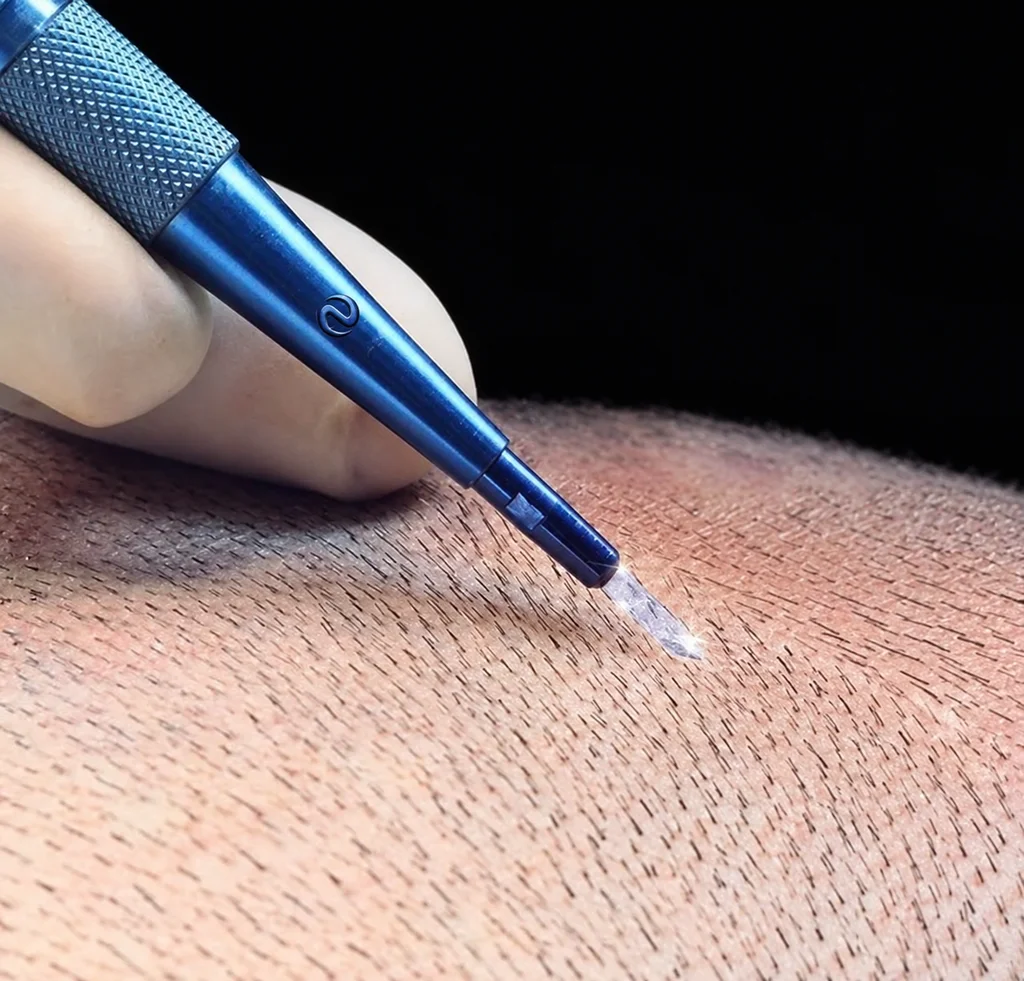
At NOVA, we first prepare recipient sites as narrow slit incisions with sapphire blades, planning their direction, depth and distribution. Grafts are then positioned with micro-forceps. The harvesting punch diameter does not, by itself, determine recipient-site preparation.
For fine hair, our team uses the smallest sapphire blade sizes in its range, as well as the next size up when the graft requires it. Selection remains adapted to the unit being implanted; it cannot be inferred from punch diameter alone.
With fine hair, we also pay attention to an even skin surface around the implanted hairs. Our preference for sapphire-prepared sites is informed in part by our clinical experience: in some patients previously treated with a Choi implanter, we have observed small persistent marks where the hairs emerge.
After implantation, the small recipient incisions usually heal with little visible marking; early crusting and redness are temporary. The final appearance also depends on precise technique and each patient’s healing response.
For fine hair, planning combines unit preservation with appropriate distribution across the area requiring coverage. Harvesting does not turn a fine hair shaft into a thick one. Sapphire FUE and hairline planning should be understood as parts of this process, rather than a promise of density based on an instrument name.


Read the sizes at a common scale
Blade-width references shown at a common scale. They do not represent channel depth.
Sapphire blade width is selected for the graft to be implanted. It is neither the harvesting punch diameter nor recipient-site depth.
Compare sapphire blades
The same blade shape, framing and magnification: only the illustrated width changes.
Model details
Only blade width changes; the holder, framing and magnification remain identical.
Illustrated blade width: 0.7 mm. Illustration of available sizes, not a measurement of NOVA’s instrument.
Model details
Only blade width changes; the holder, framing and magnification remain identical.
Illustrated blade width: 0.8 mm. Illustration of available sizes, not a measurement of NOVA’s instrument.
Model details
Only blade width changes; the holder, framing and magnification remain identical.
Illustrated blade width: 0.9 mm. Illustration of available sizes, not a measurement of NOVA’s instrument.
Model details
Only blade width changes; the holder, framing and magnification remain identical.
Illustrated blade width: 1.0 mm. Illustration of available sizes, not a measurement of NOVA’s instrument.
Illustrative sapphire blade dimensions. These views do not certify NOVA instrument measurements or define surgical settings.
From harvesting to placement, in pictures
For fine hair, precision continues at every step: releasing the follicular unit, extracting and preserving it, preparing its recipient site and placing it.

FUE harvesting
The Punch Contour incision.
The punch makes a circular incision around the graft in the donor area.
- A hollow tube
- The punch is centered around the emerging hair.
- A graft kept in place
- The hair and its surrounding tissue remain in place during this step.
Next Extraction with micro-forceps.


On a touch screen, swipe the illustration or text to move between steps.
Fine hair: a before-and-after journey
This journey shows overall hair restoration on fine hair. Compare the before-and-after views and check the graft count and follow-up time in the case card. The photographs and details come from our main gallery.
Journey 33
Mega sessionOverall hair restoration on fine hair
- Grafts implanted
- 6 000
- Result observed at
- 10months


Frequently asked questions
Can you have a transplant with fine hair?
Yes. Naturally fine hair does not rule out transplantation. Natural caliber must be distinguished from miniaturization, and available donor units assessed. Planning then considers the treatment area and coverage sought, rather than a graft count alone.
Is a 0.6 mm punch always preferable to a 0.8 mm punch?
No. A smaller instrument is useful only if it suits the unit being harvested. Switching to 0.6 mm solely to advertise a lower number is not a quality objective.
Can two punches be compared from photographs?
Visible tip details can be compared. Comparing actual size requires knowing the stated measurement and using a common scale. Different magnifications can create a misleading impression.
Does a small punch allow more grafts to be harvested?
It does not, on its own, justify harvesting more. Available supply, distribution and the appearance to preserve in the donor area remain decisive.
Does punch diameter determine the thickness of regrowing hair?
No. The punch is a harvesting instrument; it does not thicken hair. Coverage needs to be discussed in terms of hair characteristics and distribution.
Are FUE micro-scars visible?
They are generally discreet and concealed by surrounding hair. Close shaving can reveal some small, lighter dots. An appropriately sized punch and well-distributed harvesting aim to maintain sufficient coverage; skin characteristics and individual healing also affect appearance.
Sources and references
References accessed November 3–4, 2026.
Further reading
Sapphire FUE hair transplant: technique, results, and reviews
How does Sapphire FUE work, and might it suit your hair loss? We explain the method, its benefits and limitations, healing, and how results develop month by month.
Read the article
Afro-textured hair transplants: from Punch Contour harvesting to sapphire implantation
When transplanting Afro-textured or coily hair, we adapt harvesting to follicle curvature and plan graft placement. Here is how Punch Contour, sapphire blades, and micro-forceps are used in our method.
Read the article
Smoking and hair loss: understanding the evidence without jumping to conclusions
Smoking is associated with some forms of pattern hair loss, but it does not explain every case of shedding. We examine the studies, what quitting may change, and what to discuss before a transplant.
Read the article
Coily hair: why graft count does not tell the whole story
With coily hair, a graft count needs to be considered alongside texture, the area to cover, and the donor supply. Our before-and-after cases help explain how these factors shape a plan.
Read the article