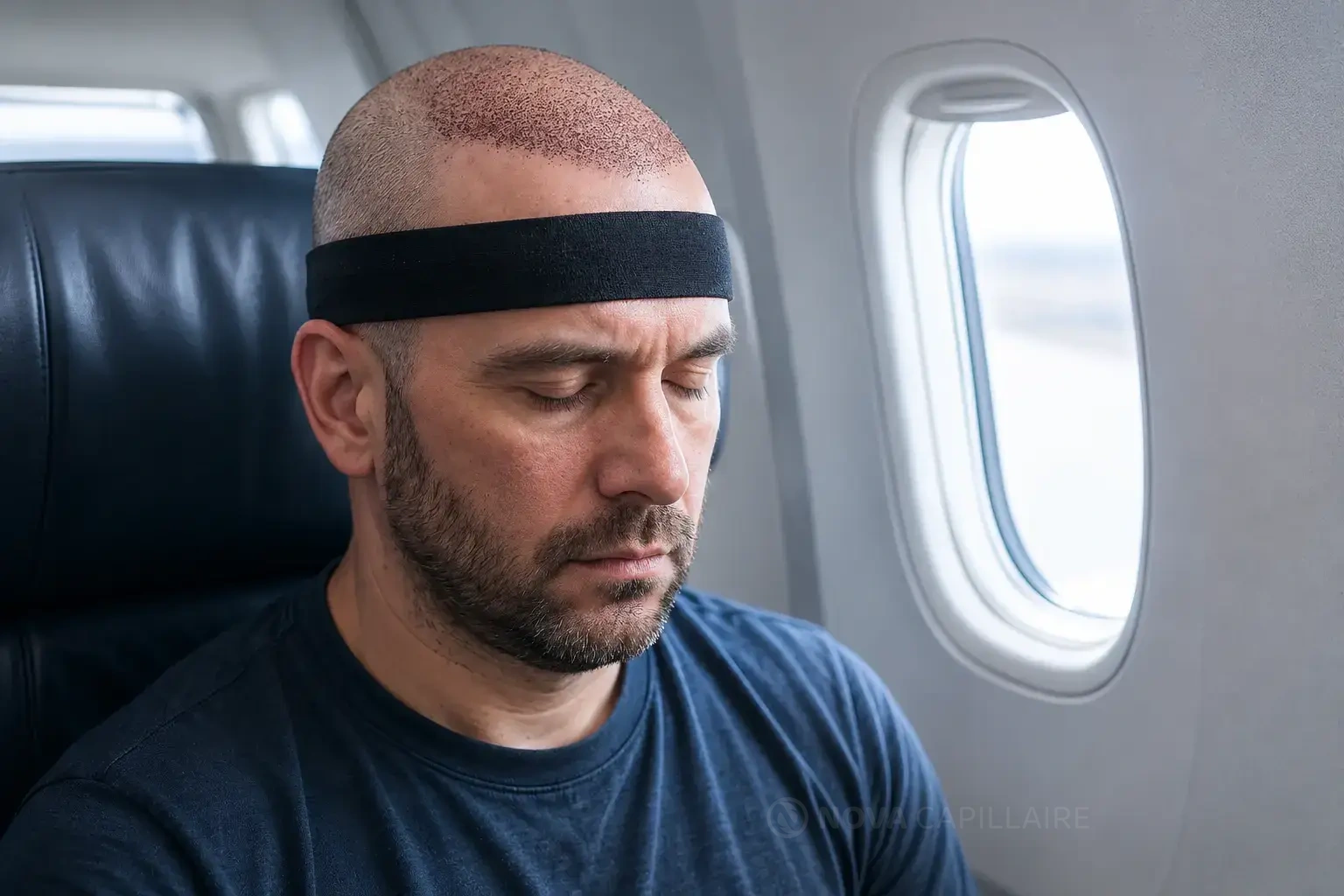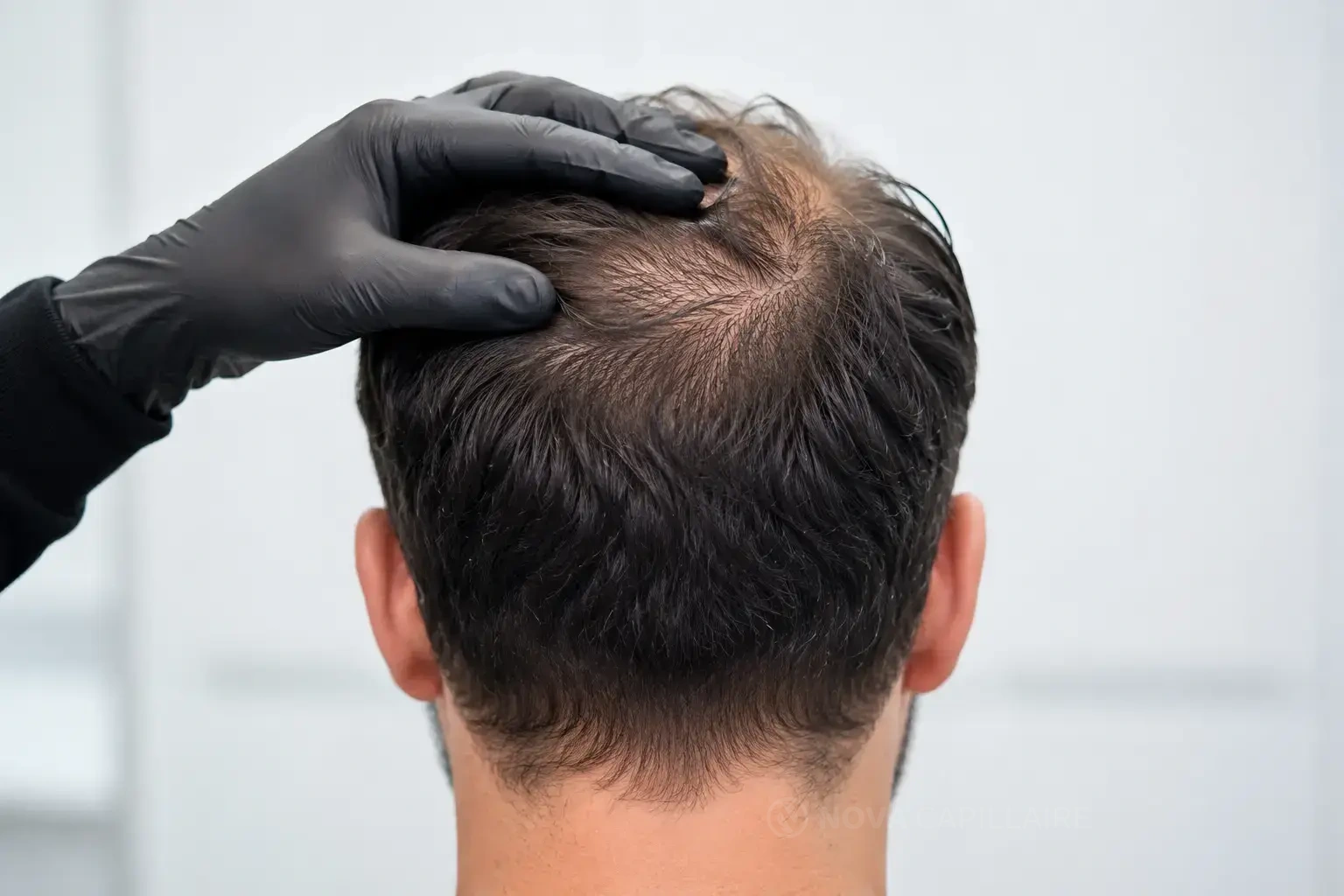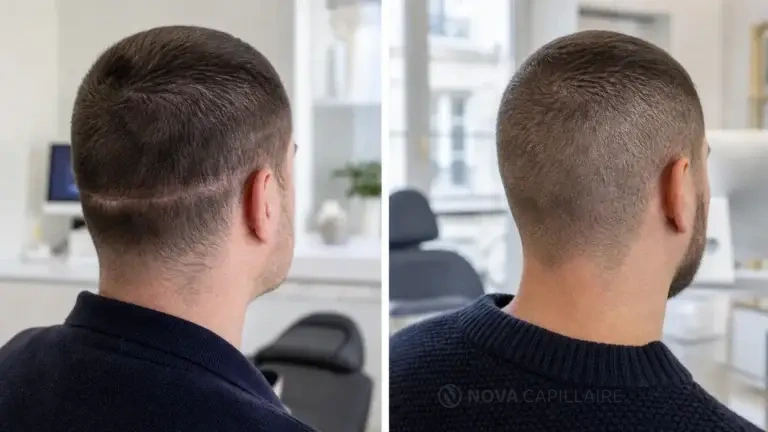
FUE and FUT are two techniques used to harvest hair from the donor area before implanting them in thinning areas.
The difference is simple:
- FUE harvests follicular units one by one;
- FUT removes a strip of scalp.
This difference has significant consequences on scarring, recovery, the ability to wear short hair, and the way to preserve the donor area.
At NOVA Capillaire, we use FUE and Sapphire FUE. We do not perform FUT.
What is the difference between FUE and FUT?
FUE
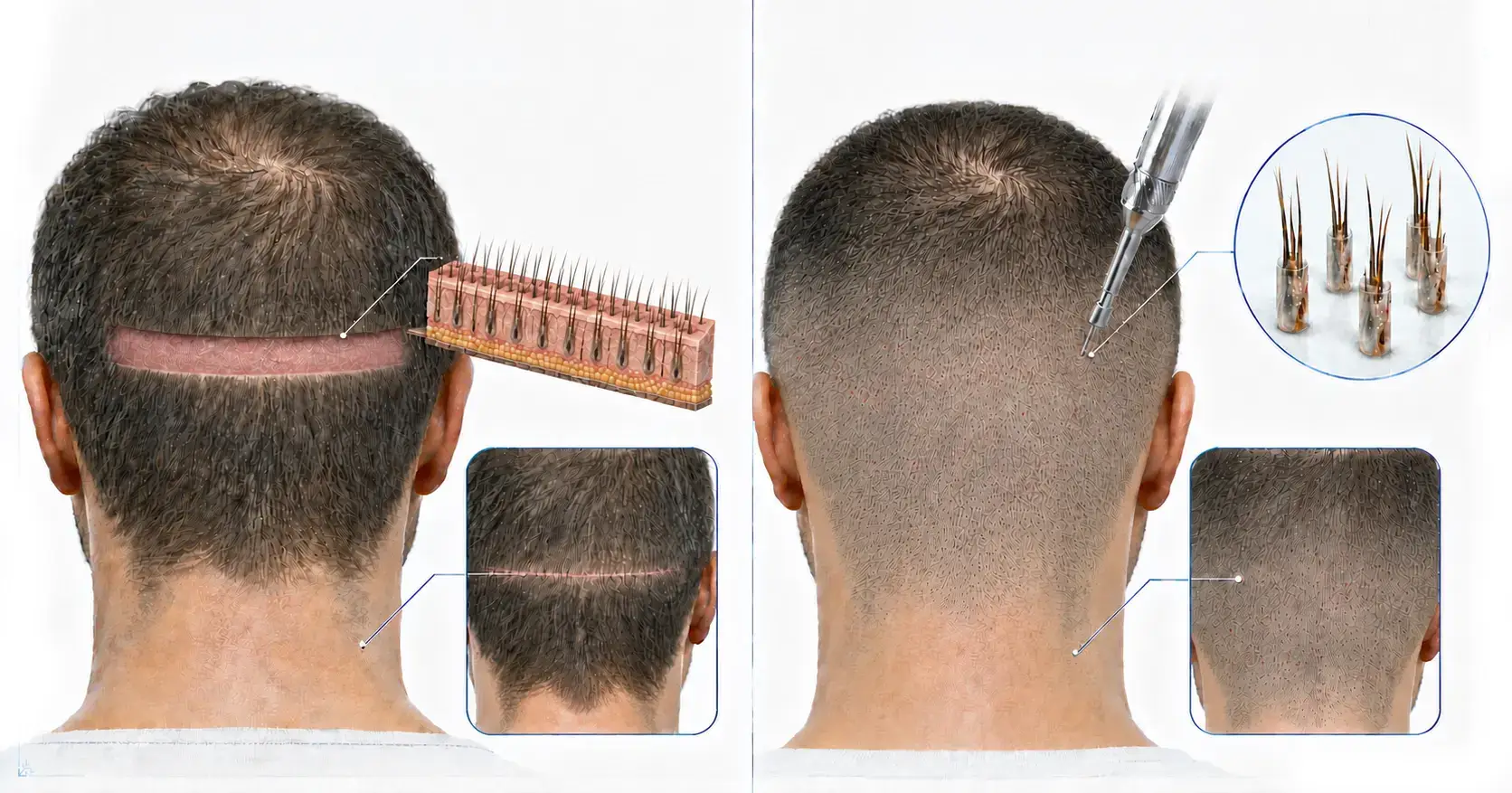
FUE consists of extracting follicular units individually with a specialized harvesting tool.
The grafts are then prepared and implanted in thinning areas. Individual harvesting allows distributing extractions across the donor area and avoids a linear scar.
FUE may leave small healing points, generally discreet after recovery. Shaving of the donor area is often necessary for precise harvesting.
FUT
FUT, also called the strip technique, involves removing a strip of scalp at the back of the head.
This strip is then cut to obtain the follicular units. The harvested area is closed with sutures, leaving a permanent linear scar.
FUT is therefore more invasive at the donor area than FUE. It involves an incision, suture closure, and a scar that can be visible with short haircuts.
The scar: the main difference between FUE and FUT
The scar is often the first criterion to understand the difference between the two techniques. With FUT, the scar is linear. It extends over part of the back of the scalp and can become visible when the hair is short.
After strip removal, the donor area shows a linear wound that is then closed. The scar evolves during healing. With FUE, there is no linear scar. The harvests are distributed as small points in the donor area.
FUE is not scar-free. Like any surgery, it can leave small, dot-shaped scars. These scars are spread out and are generally much less noticeable than a linear scar.
| Criterion | FUE | FUT |
|---|---|---|
| Harvest | Extraction of follicular units one by one. | Removal of a scalp strip. |
| Scar | Small healing points spread across the donor area. | Permanent linear scar. |
| Short hair | Possible to keep a short haircut after healing. | The scar can become visible with a short haircut. |
| Donor area | Progressive and distributed harvesting. | Harvest concentrated on a scalp strip. |
FUE or FUT: which technique allows better density?
Density does not depend solely on the technique name.
It notably depends on:
- the available density in the donor area ;
- the number of grafts harvested;
- the quality of the follicular units (grafts);
- the design of the hairline ;
- the angle and direction of implantation;
- the strategy chosen to preserve existing hair.
- the handling and storage of grafts.
FUT does not automatically guarantee better density. It allows removal of a strip containing follicular units, but the outcome then depends on dissection, preparation, and implantation of grafts. FUE allows selection of follicular units one by one and distribution of the harvests evenly at the back and sides of the scalp.
In NOVA Capillaire’s Sapphire FUE protocol, channels are precisely prepared to control the direction, angle, and distribution of grafts.
When the donor area and treatment plan allow, a Sapphire FUE session at NOVA Capillaire may involve about 3,000 grafts in one day for straight or wavy hair. This number is not a given: it depends on the assessment, available density, graft quality, and long-term plan.
For afro or coily hair, NOVA plans a maximum of 2,000 grafts per day and organizes larger projects over two days.
Why do some people still choose FUT?
Some people still consider FUT mainly because it allows keeping the hair of the donor area longer at the time of the procedure.
However, this option means accepting a permanent linear scar, an incision at the back of the scalp, sutures, and a more demanding recovery. The scar may also become visible with a short haircut. The number of grafts that can be harvested cannot be the same fixed figure for everyone. It depends on the density of the donor area, scalp laxity, the size of the strip, and the surgical strategy.
Graft survival depends mainly on the quality of dissection, handling, time spent out of the body, and team experience. No technique alone guarantees survival of all grafts.
At NOVA Capillaire, we do not perform FUT. Our protocol relies on FUE and Sapphire FUE. When diagnosis and donor area allow, our team can plan up to about 3,000 grafts in one day for straight or wavy hair, with harvest spread at the back and sides of the scalp.
This number is never automatic. The number of grafts must be determined after analysis of the donor area, the area to be covered, and the predictable progression of hair loss.
Which technique is less painful?
Both procedures are performed under local anesthesia. The first injections can be the most sensitive phase.
After anesthesia, the person usually mainly feels pressure, vibrations, or manipulations. FUE is often associated with less painful recovery than FUT because it does not require a long incision or linear suture.
After FUE, the donor area may remain tender or feel tight for a few days. After FUT, discomfort may be related to the incision, closure of the strip, and tension on the sutured area.
No technique should be presented as completely painless. Strong, persistent, or increasing pain should be reported to the medical team.
Why does NOVA use Sapphire FUE?
Sapphire FUE combines individual harvesting of FUE with opening micro-channels using sapphire blades.
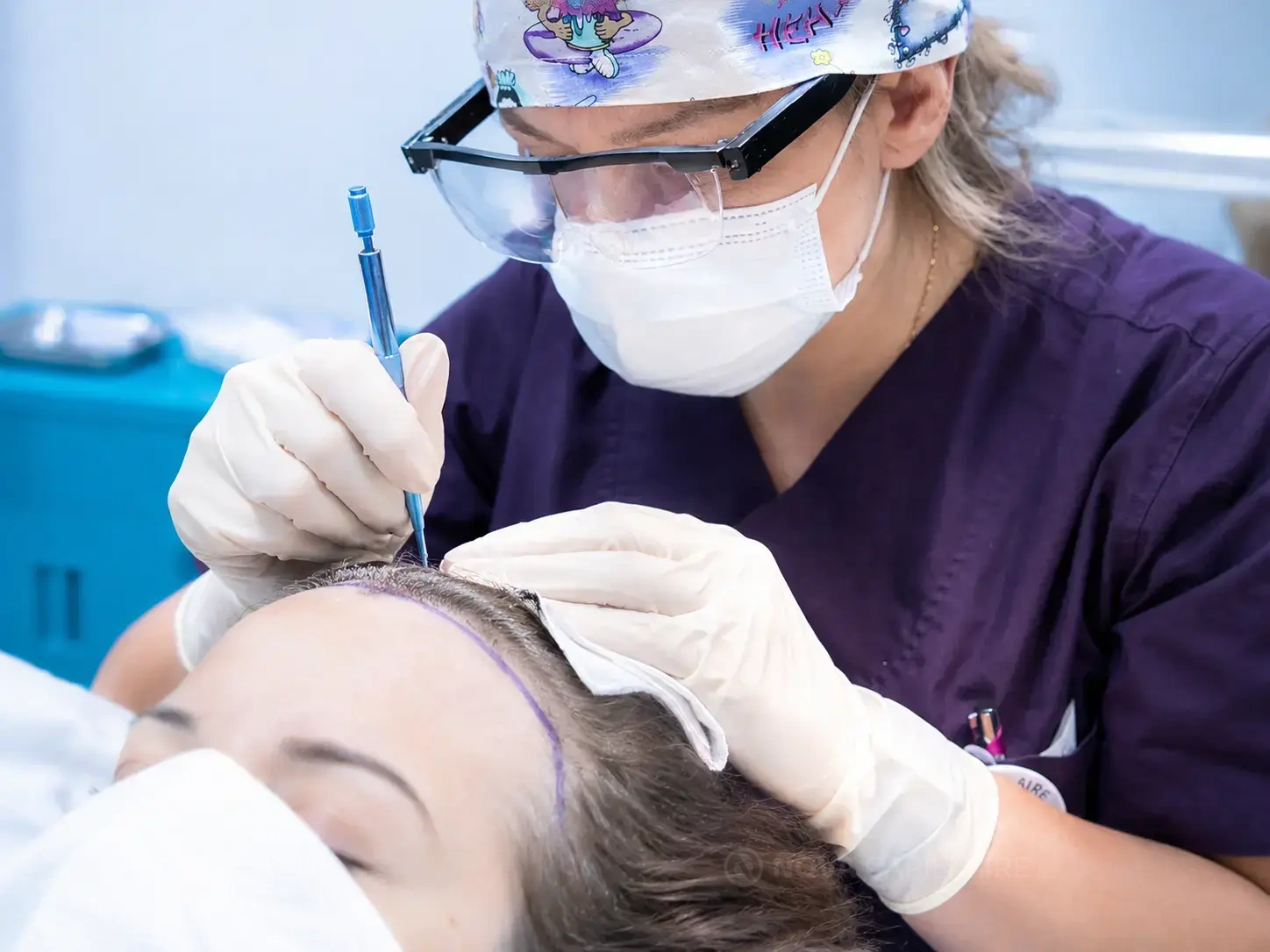
This technique allows precise control of:
- implantation angle;
- hair direction;
- channel depth;
- graft distribution;
- construction of the hairline.
For the indications managed at NOVA Capillaire, Sapphire FUE represents our reference protocol.
For our team and the indications we treat, it offers the best balance between preserving the donor area, avoiding a linear scar, controlling density, and seeking a natural result.
However, the result always depends on the diagnosis, the quality of the donor area, the team’s experience, and follow-up.
No instrument alone can guarantee a precise density or result.
Conclusion: FUE or FUT, what to choose?
FUT can notably be considered to limit visible shaving of the donor area and accepting a permanent linear scar.
But it is more invasive at the donor area and less suited for those wishing to wear short hair.
FUE avoids the linear scar and allows more progressive and distributed extraction at the back and sides of the scalp. It is the technique used at NOVA Capillaire.
Sapphire FUE is then our preferred protocol to control graft orientation, depth, and density.
The final choice must always be confirmed after a complete hair assessment, taking into account the cause of hair loss, the donor area and the aesthetic goal.