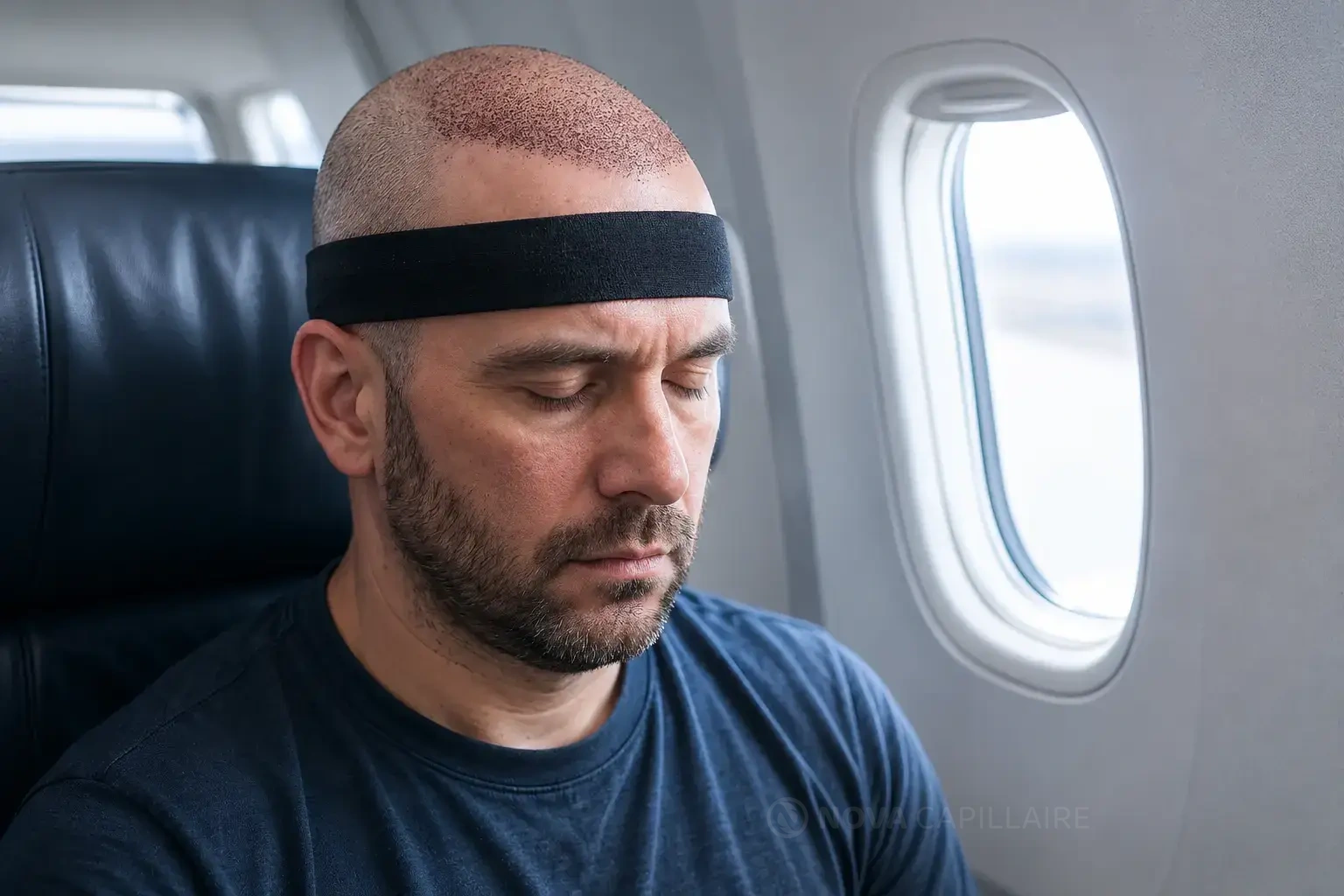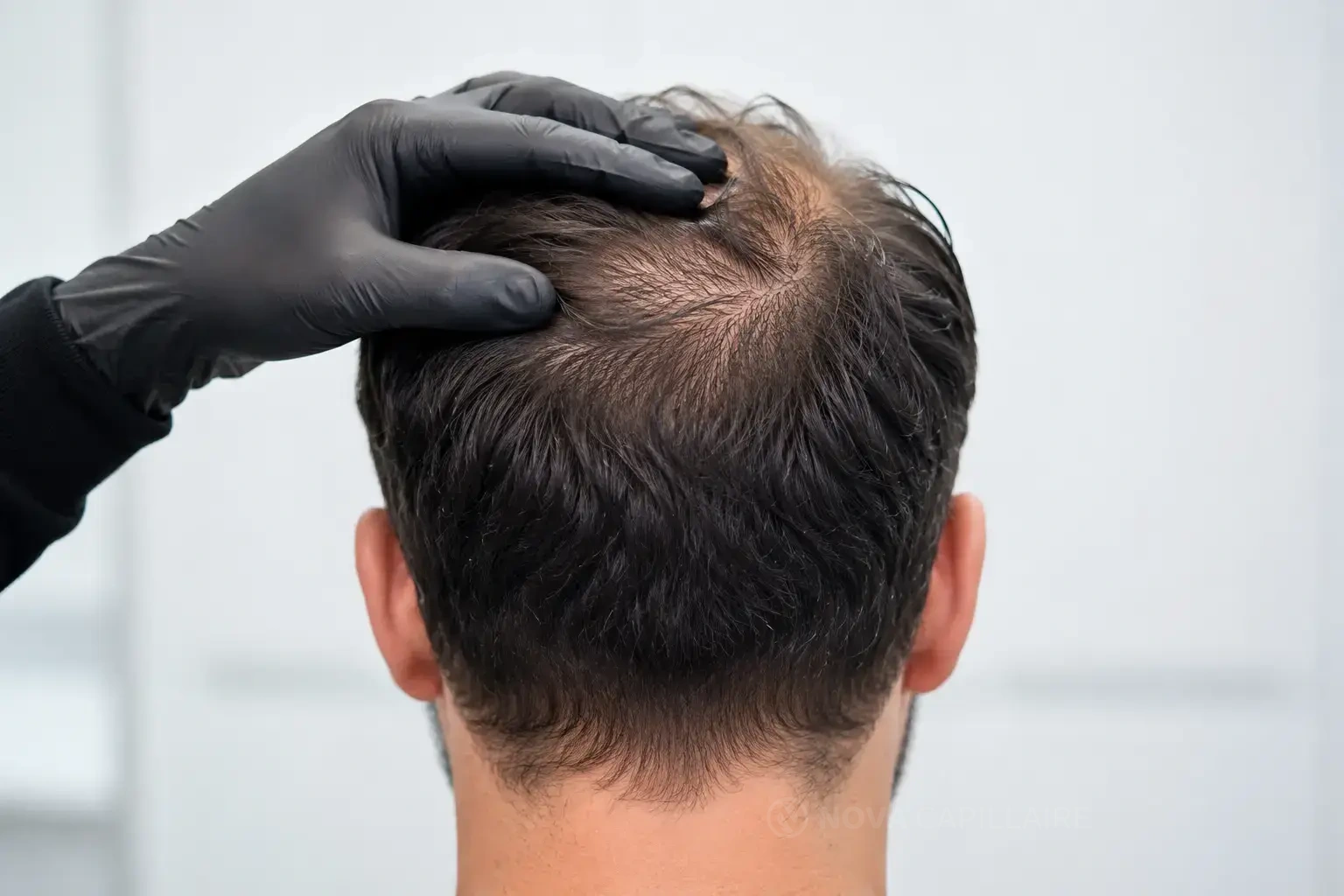
Sapphire FUE hair transplant is a hair restoration technique aimed at restoring a denser, more natural, and more harmonious hair, without a visible linear scar. It is based on the FUE principle, that is, individual extraction of follicular units in the donor area, followed by implantation into thinning areas.
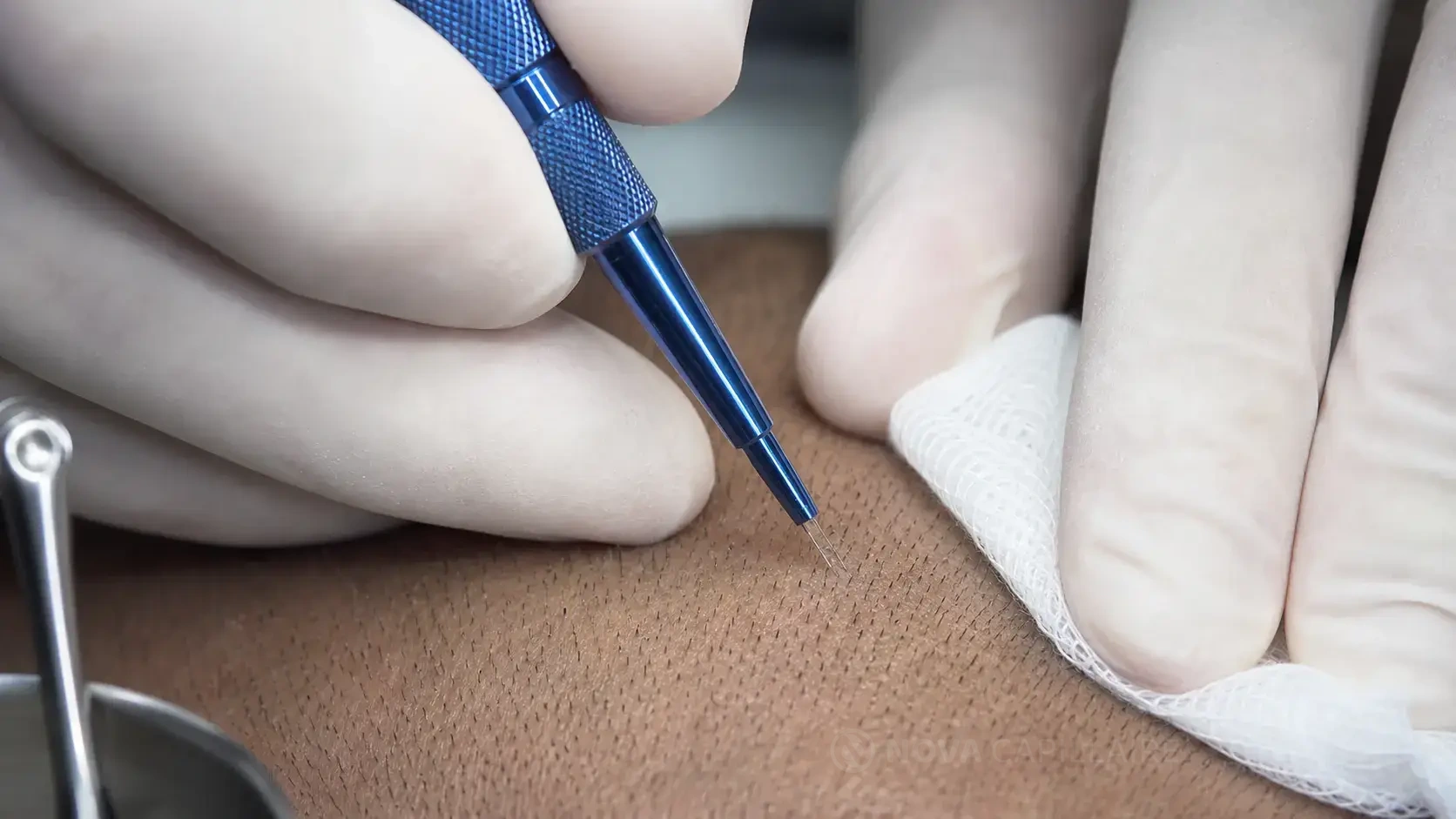
The distinguishing feature comes when the implantation channels are opened: practitioners use sapphire blades designed to create fine, precise micro-incisions. This precision may help improve control over the angle, depth, and distribution of grafts, three essential factors in achieving a natural result.
But the result never depends solely on the instrument used. A successful Sapphire FUE transplant first relies on a serious diagnosis, a good assessment of the donor area, a hairline suited to the face, implantation that respects the natural direction of the hair, and thorough postoperative follow-up.
At NOVA Capillaire, the goal is simple: offer a natural, lasting hair transplant adapted to each patient, with a hair strategy designed for the long term.
What is the Sapphire FUE hair transplant?
FUE, or "Follicular Unit Extraction," consists of harvesting hair follicles one by one in a donor area, usually located at the back and sides of the scalp. These hairs are generally less sensitive to androgenetic alopecia, which makes them particularly useful for hair transplantation.
In a Sapphire FUE transplant, the grafts are then implanted into microchannels opened with sapphire blades. These blades allow precise work, particularly to respect the natural direction of the hair and optimize the distribution of grafts.
The technique does not create a linear scar like FUT. The micro-harvest points in the donor area usually become very discreet after healing, provided that extraction is performed carefully and the donor area is preserved.
Who is Sapphire FUE for?
Sapphire FUE may be indicated for men and women with stabilized or sufficiently analyzed hair loss, notably at the hairline, temples, vertex, or a thinning area.
It can be adapted when:
- the donor area is sufficiently dense;
- hair loss has been diagnosed;
- the patient’s expectations are realistic;
- the hairline can be naturally reconstructed;
- the patient understands the regrowth timeline and postoperative care.
Conversely, a transplant is not always the best first solution. In cases of active hair loss, scalp disease, donor area that is insufficient, or unrealistic expectations, a diagnosis must first be established. This is why the initial consultation is an essential step.
Sapphire FUE: a procedure in 6 steps
A Sapphire FUE hair transplant follows a precise protocol. Before the procedure, a hair assessment evaluates hair loss, the quality of the donor area and the number of grafts needed. On the day of the transplant, each step directly influences the natural appearance, density, and durability of the result.
Our method, in 6 steps.
An overview of how we work.
Explore the steps at your own pace.
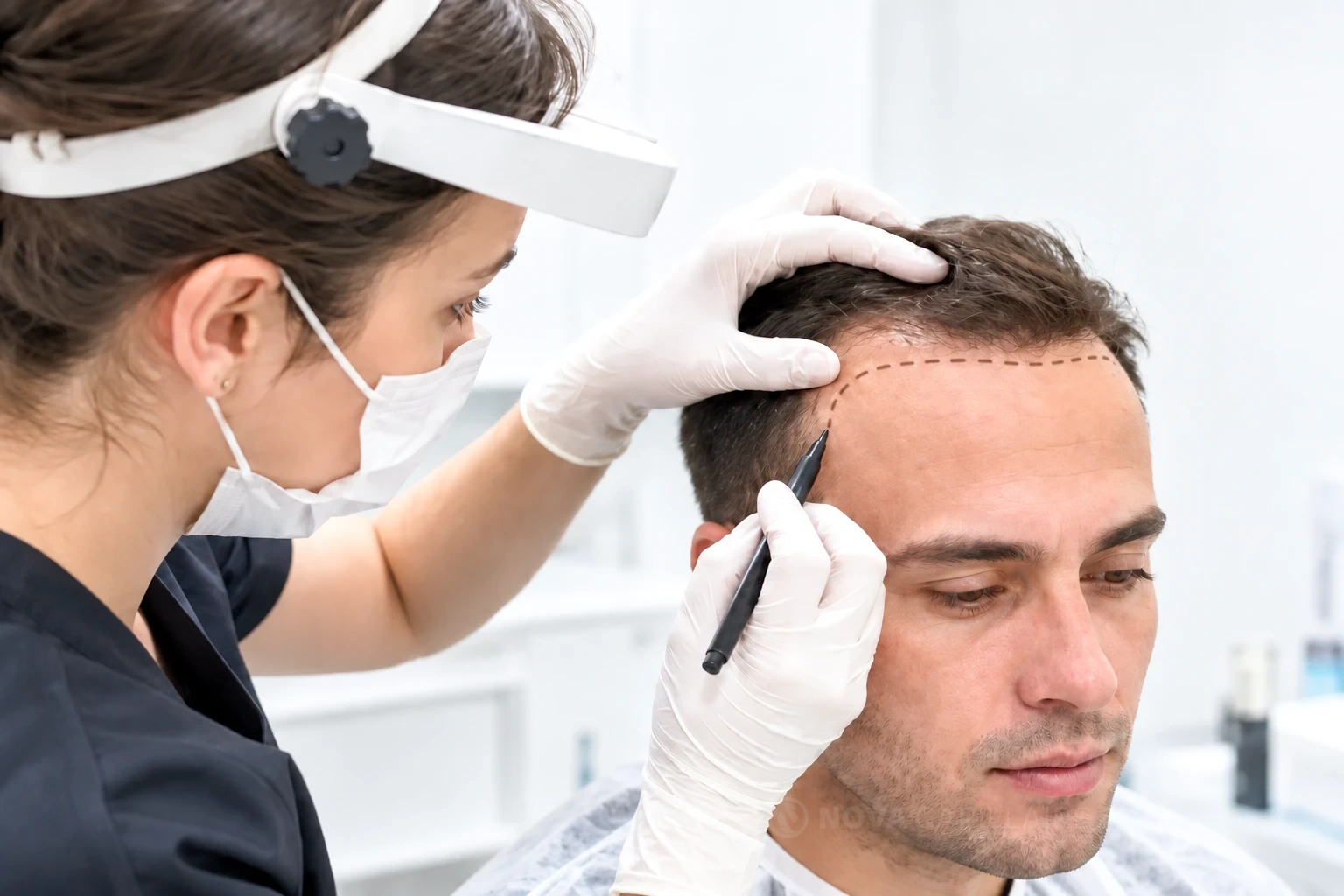
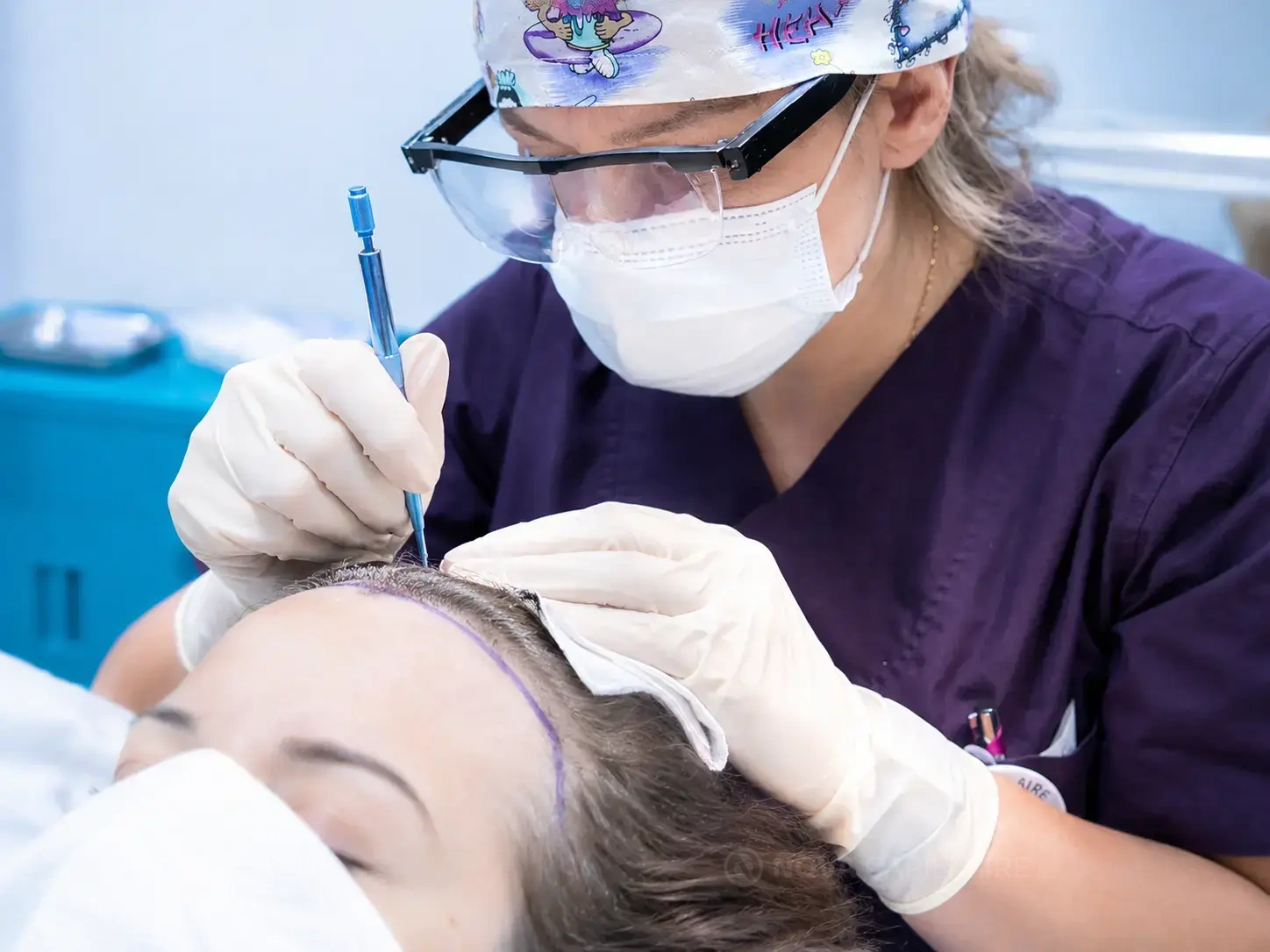
Draw the hairline
The outline considers your face and hair. It serves as a guide to prepare implantation.
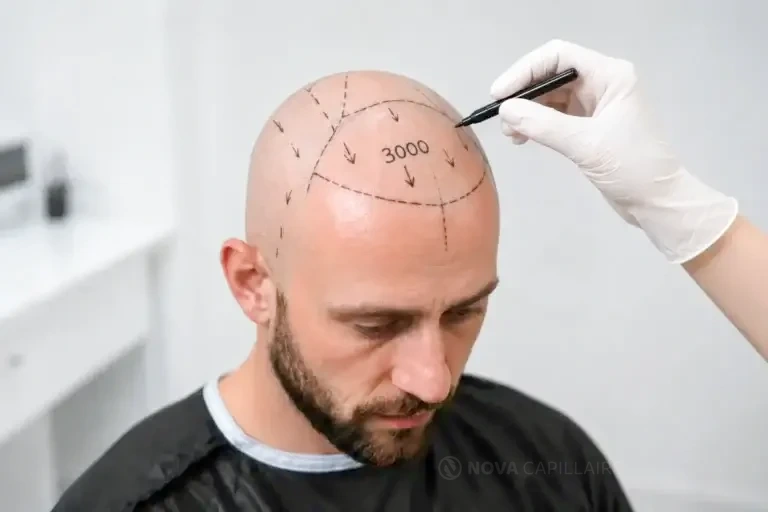
Plan distribution
The areas to cover and donor resources guide the number of grafts. Their distribution is planned before extraction.
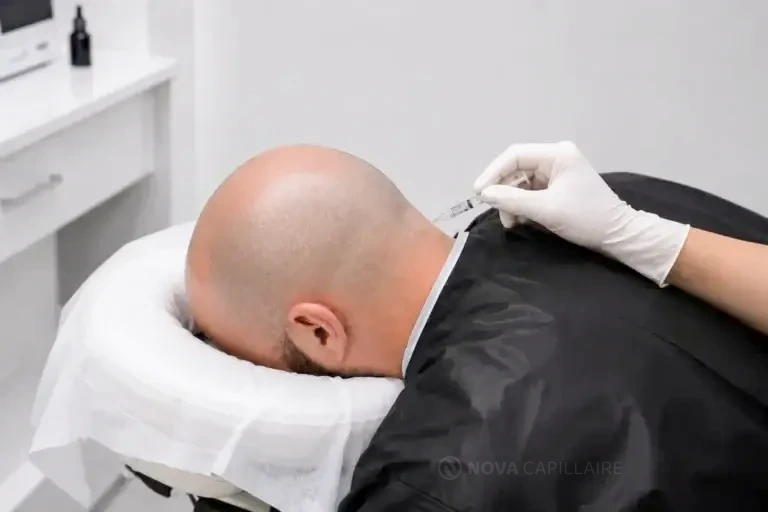
Prepare your comfort
Local anesthesia is administered before transplant steps. Your comfort is monitored during the session.
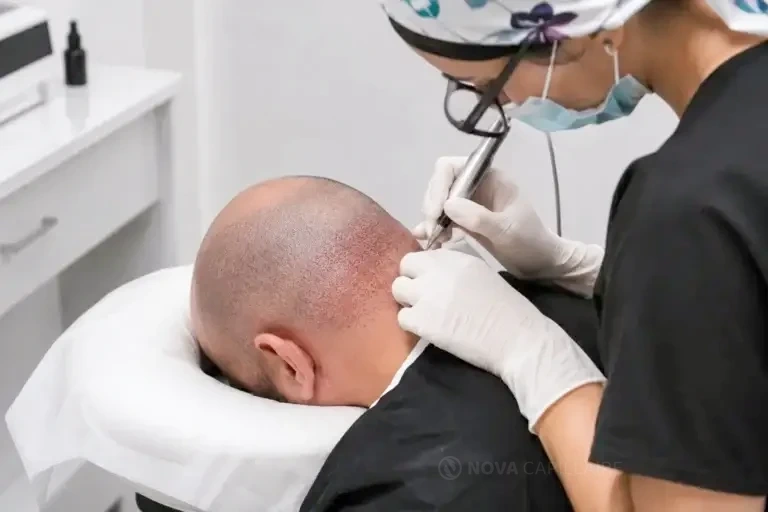
Extract grafts
Follicular units are extracted one by one from the donor area. The amount extracted takes the available donor hair into account.
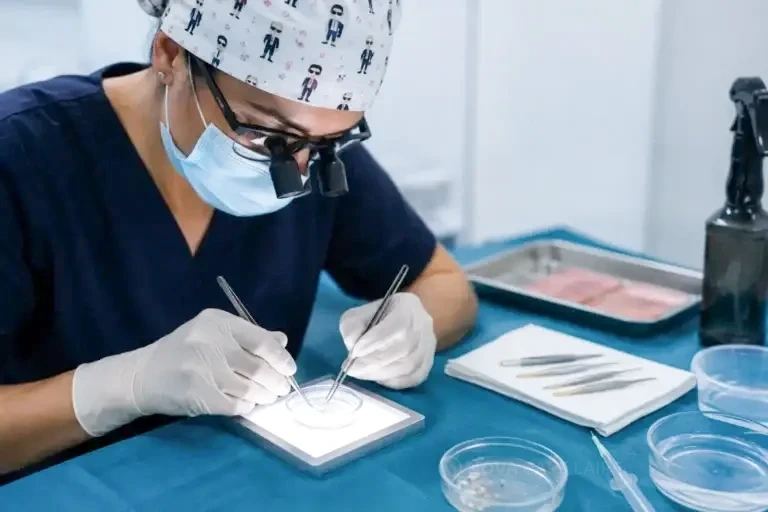
Prepare grafts
Grafts are checked and sorted after extraction. They are preserved under appropriate conditions before implantation.
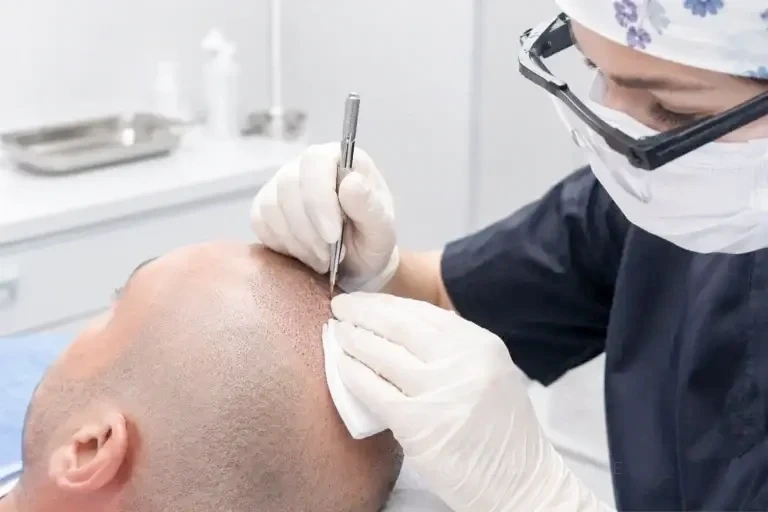
Place the grafts precisely
Grafts are placed in planned areas. Their orientation and distribution match hair movement.

Sapphire FUE, classic FUE, Choi Pen, and FUT: what differences?
Sapphire FUE is an evolution of traditional FUE but should not be confused with other techniques.
| Technique | Principle | Advantages | Limits |
|---|---|---|---|
| Sapphire FUE | FUE extraction then channel opening with sapphire blades | Method preferred by NOVA: precision, density, flexibility, no linear scar, and natural result | Strongly dependent on the team's expertise |
| Classic FUE | FUE extraction then channel opening with microblades or needles | Recognized method, natural if well performed | Variable precision depending on the instruments and practitioner |
| Choi Pen | FUE extraction then implantation with implanter pen | May be useful in some very targeted small areas | In its protocol, NOVA considers the Choi Pen less flexible for large areas, given graft size, pen caliber, and desired density. |
| FUT | Scalp strip harvesting | May allow harvesting many grafts in some cases | Linear scar; indication and postoperative course to be discussed individually |
The right choice depends on indication, area to cover, quality of the donor area and the aesthetic goal. A method should therefore not be chosen solely for its name: choose a strategy.
Advantages of Sapphire FUE
A natural look when implantation is well mastered
Sapphire FUE allows fine tuning of hair angle and direction. This is essential to avoid an artificial effect and obtain a credible hairline, even up close.
No linear scar.
Unlike FUT, FUE does not remove a strip of scalp. The extraction marks are pinpoint and generally become discreet when healing proceeds correctly.
Often rapid healing
Micro-incisions can promote a more comfortable recovery than a more invasive technique. Scabs usually progressively disappear in the days that follow, according to the instructions given by the medical team.
Density suited to your treatment plan
Density does not mean placing as many grafts as possible. It must be calculated according to donor area, age, possible progression of alopecia, and priority areas. A good transplant must remain natural today and coherent tomorrow.
Limits and risks to be aware of
A hair transplant remains a medical procedure. Even with a modern technique, results can vary depending on the patient.
- growth requires time;
- a temporary "shock loss" may appear;
- redness, scabs, or scalp sensitivity may occur after the procedure;
- final density depends on the quality of the donor area ;
- progressive alopecia may require a long-term strategy;
- poor orientation of grafts can yield an artificial result.
A good center must therefore explain the benefits, but also the limits. This transparency is a sign of professionalism.
Healing and results: month-by-month timeline
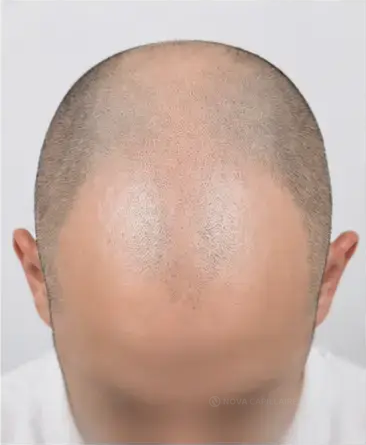
Before the procedure
Starting point
This view shows the situation before the transplant. It serves as a reference for follow-up, not a prediction of results.
1 / 8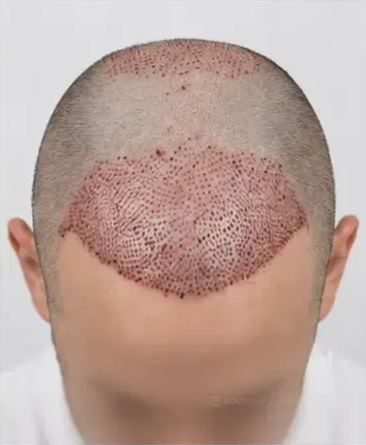
Day 2
The first days
The implantation areas are visible in this example. The appearance varies; this photo alone does not allow you to judge your own healing.
2 / 8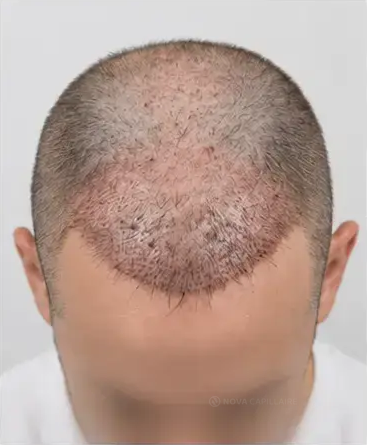
Week 2
A transitional phase
The scalp’s appearance changes during healing. Implanted hair shafts may begin to fall out: do not pull on the hair or scabs.
3 / 8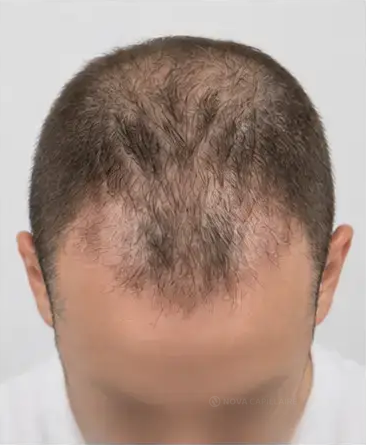
Month 1
Appearance may fluctuate
The visible hair here does not correspond to the density expected for all patients. Shedding of shafts may still occur.
4 / 8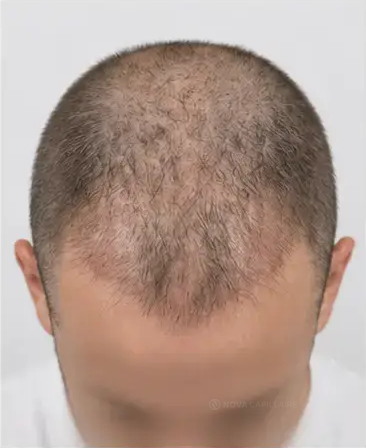
Month 3
Patience remains important
In this example, coverage seems less dense than in the first month. Progress is not linear; regrowth may become visible later.
5 / 8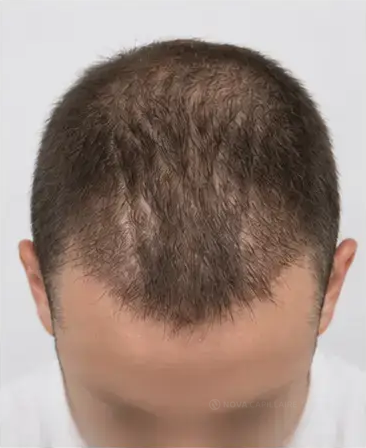
Month 6
Progressive development
Coverage changes over the months. Only your clinical follow-up allows you to appreciate your own evolution.
6 / 8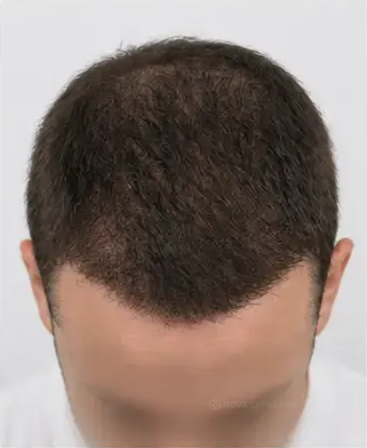
Month 9
Density and texture evolve
This example shows greater coverage. Hair length and styling also influence the photographic appearance.
7 / 8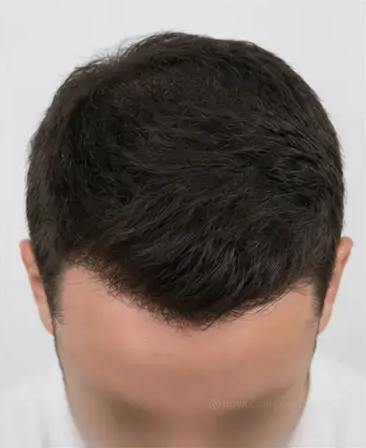
Month 12
Discuss your situation with your clinician
This image illustrates this case at twelve months, without guaranteeing a similar result. Evaluation of maturation can continue up to eighteen months.
8 / 8Illustration photos: your result depends on your situation. In case of unusual symptoms, contact your team without waiting for the next step.
The first 10 days
Scabs are visible on the recipient area. The donor area heals progressively. The washing instructions, sleep, physical activity, and sun exposure guidelines must be followed precisely.
From 2 to 8 weeks
The implanted hairs may fall out: this is a frequent and expected phase. The follicle remains in place, then gradually enters a new growth cycle.
From 3 to 4 months
The first new hairs begin to appear. They are often fine at first, then thicken over time.
Between 6 and 9 months
Density becomes more visible. The hairline and implanted areas begin to better define themselves.
Around 12 months and beyond
The final result is generally appreciated around 12 months, sometimes more depending on the treated area, hair quality, and patient physiology.
Before/after Sapphire FUE: how to recognize a good result?
A good before/after should not only show more hair. It must show a result coherent with the face, hairline, age, and available density.
To analyze a before/after photo, look at:
- the naturalness of the hairline;
- hair direction;
- the transition between grafted and existing hair;
- the density, without a row effect;
- the donor area after healing;
The best before/after cases are those which provide clear information: number of grafts, treated area, regrowth timing and technique used.
Individual results. See all before/after.
How much does a Sapphire FUE transplant cost?
A CLEAR BUDGET
Let's also talk about pricing.
Packages to help set your budget, then an estimate adapted to your hair.
Your care includes
 1 mesotherapy session
 1 phototherapy session
- Sapphire FUE technique
 Follow-up for 12 months
 Meals during the procedure
 Snacks during the procedure
 Netflix
 Disney+
 YouTube
Essential
1 day procedure
About 1,200 to 2,400 hairs, based on an indicative average of 2.4 hairs per graft.
Explore my options
Compare all packages and prices
| Package | Grafts | Price incl. tax |
|---|---|---|
| Essential | 500 to 1,000 | 2 750 € |
| Balance | 1,100 to 1,900 | 3 700 € |
| Signature | 2,000 to 3,000 | 4 700 € |
| Custom | 3,100 and more | On estimate |
| Package | Grafts | Price incl. tax |
|---|---|---|
| Essential | 500 to 1,000 | 2 750 € |
| Signature | 1,100 to 2,000 | 3 700 € |
| Custom | 2,100 and more | On estimate |
The estimate is personalized after study of your hair. Care includes the Sapphire FUE technique, 12-month follow-up, meals and snacks during the procedure, plus one mesotherapy session and one phototherapy session (two sessions each for the Custom package).
Straight and wavy hair: one day up to 3,000 grafts, two days beyond. Afro and coily hair: one day up to 2,000 grafts, two days beyond. The plan is confirmed in consultation.
Find the details and pricing options on the pricing page.
Why choose NOVA Capillaire in Paris?
NOVA Capillaire supports patients seeking a natural, precise hair transplant adapted to their profile. The approach is based on three priorities: analysis of the donor area, the design of a harmonious hairline, and a sustainable long-term hair strategy.
The center emphasizes:
- a personalized evaluation before the procedure;
- planning adapted to the face and possible hair loss progression;
- special attention to graft management;
- a rigorous hygiene protocol;
- follow-up after the transplant to support regrowth.
Sapphire FUE can yield excellent results when properly indicated and performed. The first step remains confirming that this method truly suits your situation.
Frequently asked questions about Sapphire FUE
Is Sapphire FUE painful?
The procedure is performed under local anesthesia. The patient may feel discomfort during anesthesia or after the procedure, but the treated area is numb during the transplant. Sensations vary by patient.
How long does a Sapphire FUE transplant take?
Duration depends on the number of grafts and case complexity. A procedure may last much of the day, as extraction, sorting, and implantation require precision.
When is the final result seen?
The first signs of regrowth often appear from 3 to 4 months. Density becomes more visible between 6 and 9 months. The final result is generally assessed around 12 months, sometimes more.
Does Sapphire FUE leave scars?
FUE does not leave a linear scar like FUT. However, it may leave small extraction points in the donor area. They are usually discreet when extraction is evenly distributed and healing progresses well.
Sapphire FUE or Choi Pen: which method to choose?
Sapphire FUE is NOVA Capillaire's reference method. Our team favors it for the precision sought in channel preparation, freedom of graft distribution, and its suitability for large areas to cover.
In our protocol, micro-channel preparation allows planning the angle, depth, and direction of implantation. We prefer this organization to the constraints of Choi Pen loading, whose caliber must be adapted to graft size.
Preserving grafts containing multiple hairs is one of our priorities. Our team particularly highlights the difficulty of loading a large graft into an inadequately sized needle and the risk of damaging it during this manipulation. This is one of NOVA's arguments in favor of its Sapphire FUE protocol to seek natural density and flexible implantation.
Rebuilding a hairline, densifying the temples, or covering an extended area: we make Sapphire FUE our first choice, after individual assessment. This comparison explains NOVA’s choice; it does not mean that every use of the Choi Pen produces a worse result.
Can a Sapphire FUE transplant be done without shaving the hair?
In some cases, a partially or completely non-shaved technique may be considered. It depends on the number of grafts, the area to treat, and technical feasibility.
Do transplanted hairs fall out after the procedure?
Yes, and this is completely normal. In the weeks following a Sapphire FUE transplant, some implanted hairs may fall out: this is part of the natural regrowth cycle. The graft is not lost. The follicle remains implanted under the skin and gradually enters a new growth phase. After this temporary phase, new hairs begin to grow over months. These hairs come from the donor area and are intended to last permanently, provided the transplant was correctly performed and post-operative instructions are followed.
How many grafts are needed?
The number of grafts depends on the area to cover, the desired density, hair type, and the capacity of the donor area. It must be calculated during the assessment.
Conclusion
A Sapphire FUE hair transplant is a modern technique that can offer a natural, dense, and discreet result when well indicated and precisely planned.
Its main interest lies not only in the sapphire blades but in the entire protocol: diagnosis, hairline, extraction, graft preservation, implantation, and post-operative follow-up.
Want to know if Sapphire FUE suits your situation? Get a personalized hair diagnosis with NOVA Capillaire.