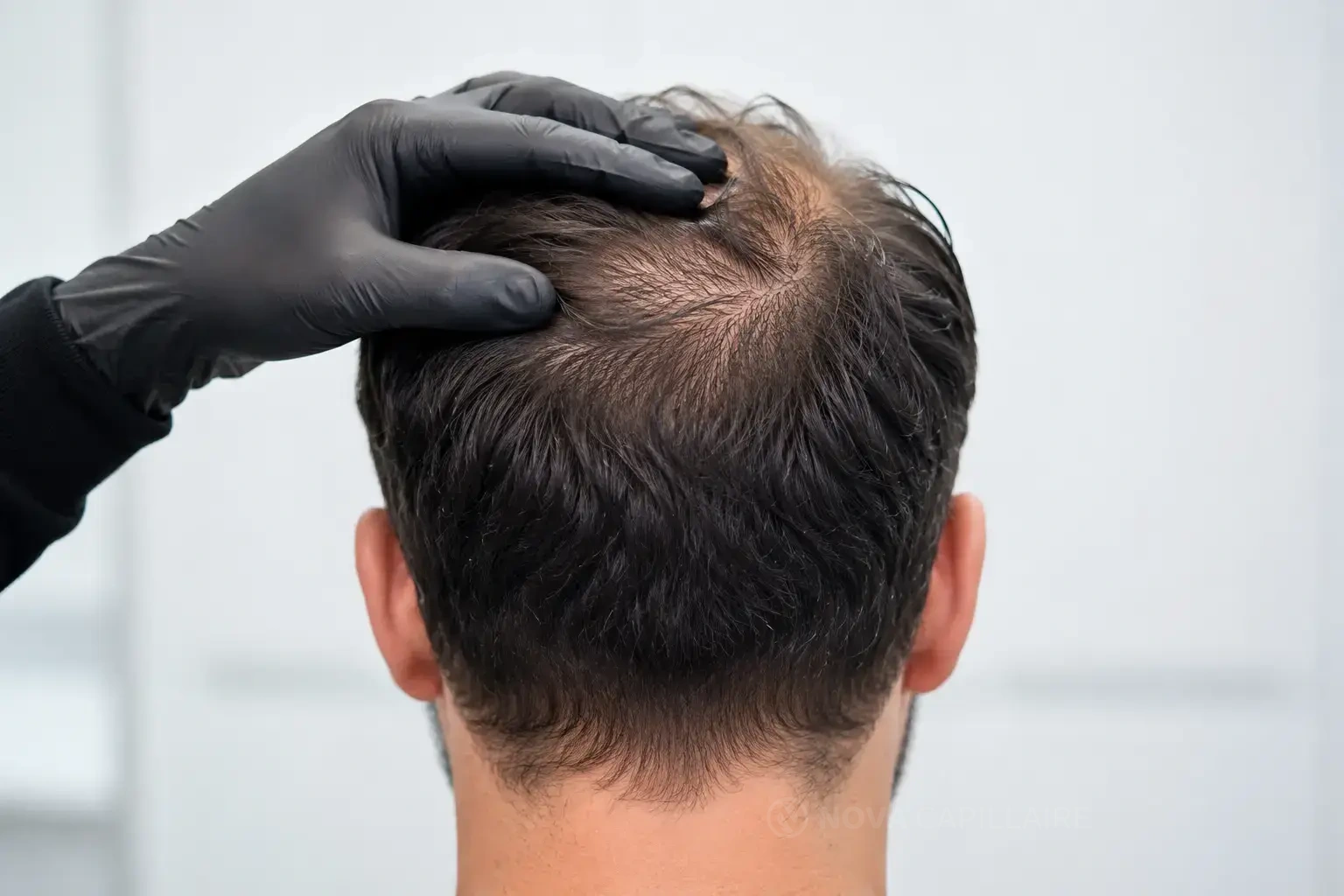
Being a candidate for a hair transplant does not depend solely on the amount of hair lost. The diagnosis, donor area reserve, progression of hair loss, and your expectations must form a coherent plan. A Norwood stage VI or VII does not automatically exclude a transplant; it makes the discussion about its limits especially important.
Criteria to be a candidate for hair transplant
The evaluation focuses on the cause of hair loss, the scalp condition, and the mobilizable hair reserve. Age or a photo from above the scalp are not sufficient. An examination, sometimes supplemented by targeted investigations, allows discussing the real interest of the procedure. AAD guidelines.
| Criterion | Question to solve | Why it matters |
|---|---|---|
| Diagnosis | What is the cause of hair loss? | A transplant does not address all forms of hair loss. |
| Evolution | Is the hair continuing to thin? | The plan must take into account non-transplanted hair in the long term. |
| Donor area | Which follicles can be harvested without excessively thinning the back of the scalp? | The available amount is limited and specific to each person. |
| Expectations | Which area do you want to improve as a priority? | An improvement in coverage does not equal regaining the original density. |
These criteria are read together, not as a point-scoring test that would automatically give a green light. NHS · ISHRS.
Norwood 6 or 7: is it necessarily too late?
No. The Norwood scale describes the extent of male baldness; it alone does not measure transplant possibilities. Stage VII corresponds to a very advanced loss, with a remaining crown of hair. See ISHRS classification guidelines.
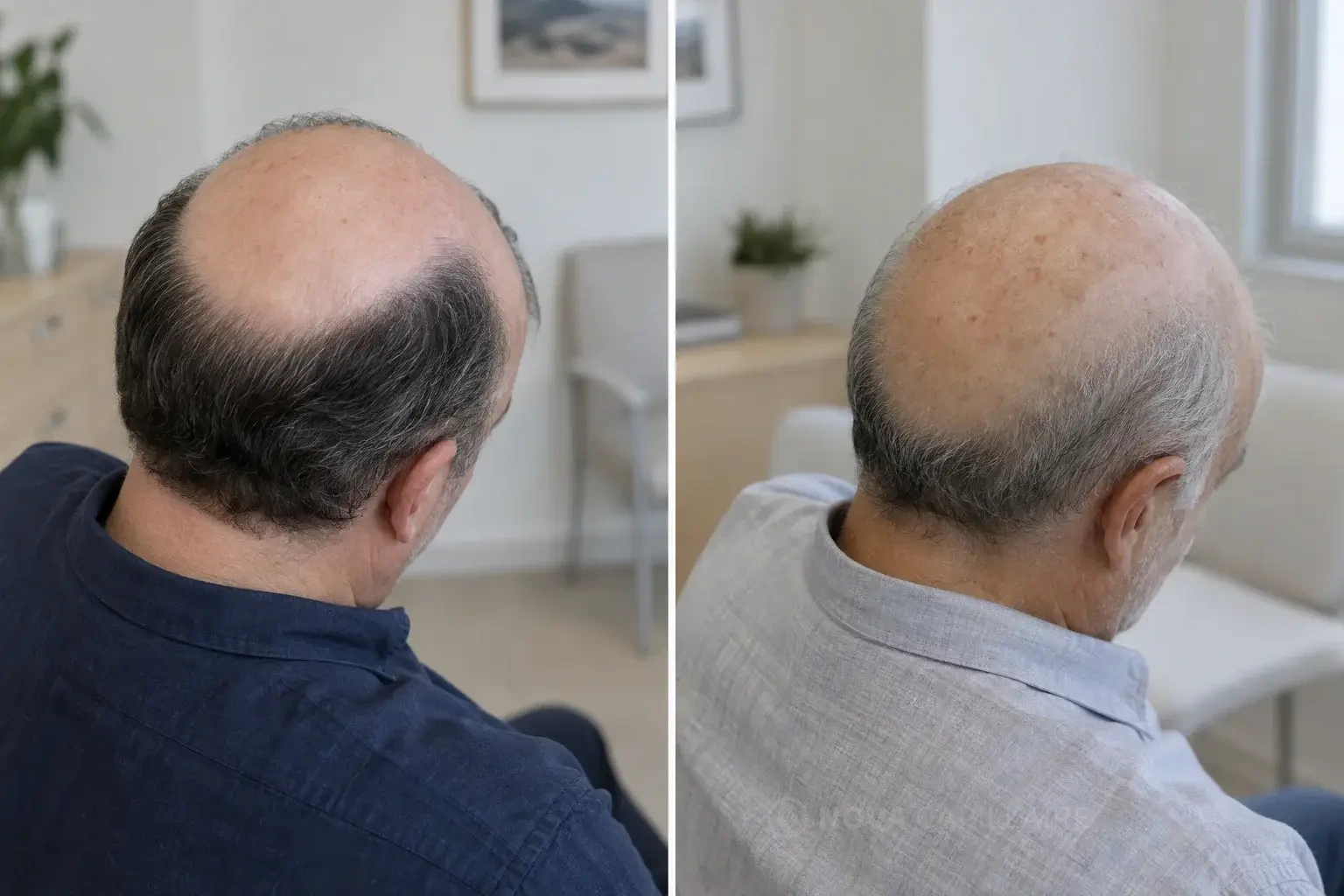
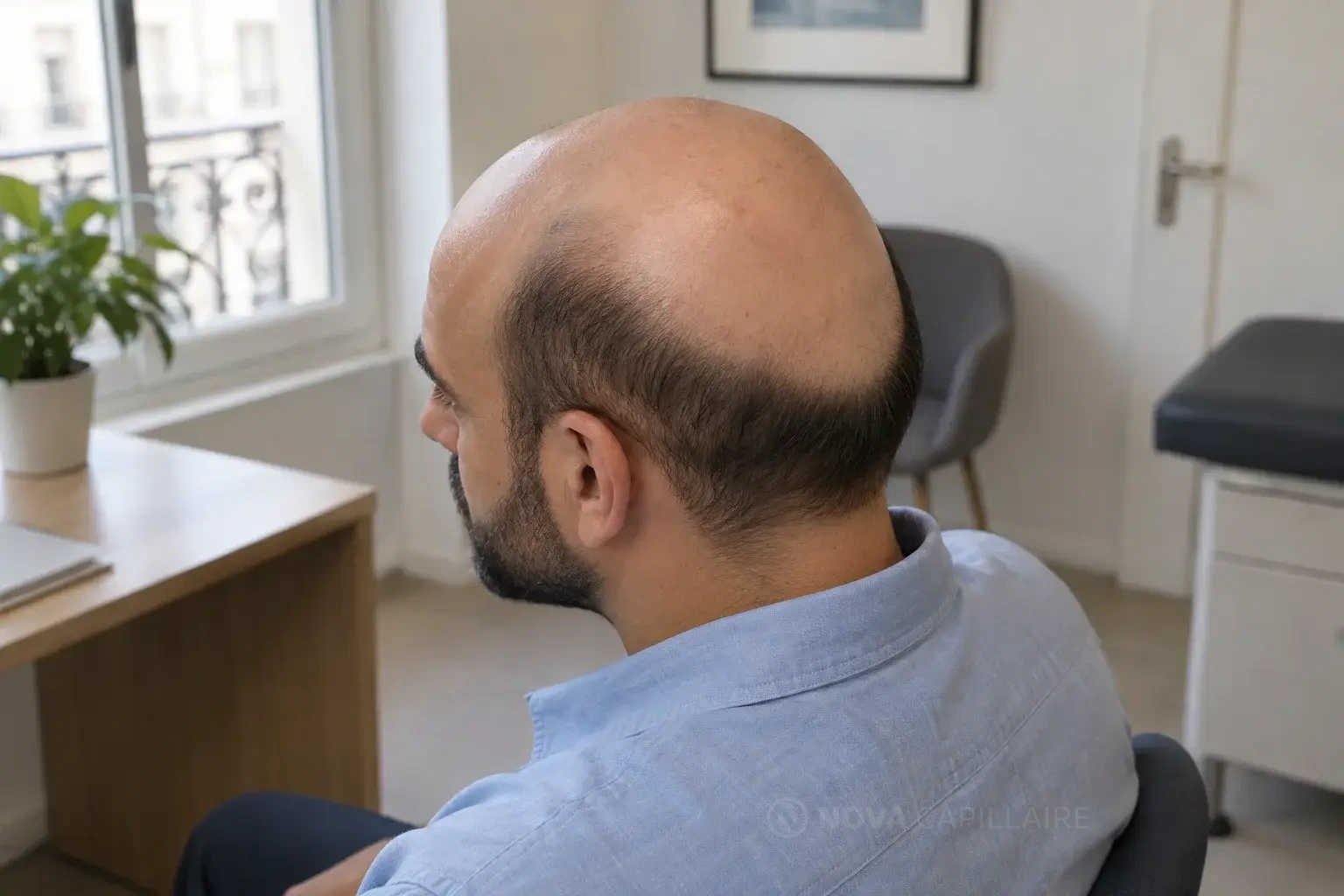
Indicative illustrations: appearance varies from person to person. A photo does not determine transplant eligibility.
Why does stage VII require more caution?
The bald area is very large, while the crown available for harvesting may be narrow. A transplant redistributes follicles; it does not create new ones. Seeking full and dense coverage may exceed available reserve and excessively thin the back. Depending on evaluation, certain areas must be prioritized, moderate density accepted, or surgery declined. The goal is to preserve remaining hair and build a realistic plan, not promise a full head of hair.
The right question becomes: "What plan remains coherent with my reserve?" Priorities among front, top, and vertex, and areas that may remain thin, must be discussed. The name of a technique does not guarantee that the entire surface can be densified.
ISHRS describes surgical indications for some Norwood VI/VII patients, notably in its FUT presentation: these stages are therefore not a universal exclusion. This observation is neither a recommendation of FUT in your case nor confirmation of eligibility for FUE. Read the reference.
When should the plan be adapted or the transplant declined?
The situations below are educational examples, not NOVA patient files. They show how the same request can lead to different decisions after examination.
| Typical situation | Difficulty in examination | Decision to discuss |
|---|---|---|
| Norwood VII, very low reserve | The requested plan exceeds reasonably available grafts. | A transplant may be discouraged; consider nonsurgical options. |
| Norwood VI, desire for uniform density | Expectations cover the entire surface, with no tolerance for less dense zones. | Redefine priorities; do not operate if the potentially achievable result remains unacceptable to the person. |
| Previous transplants, already thinning back | Remaining capital must be reassessed before any new harvest. | Request a specialized evaluation; do not promise a new session solely on demand for grafts. |
This table illustrates the donor reserve preservation principle described by ISHRS; it is not a diagnostic tool. Understanding the donor area’s role.
A reasoned negative answer can avoid unnecessary harvesting and lasting disappointment. Always ask what motivates the refusal: impossibility of the requested plan, identified risk, or need for another opinion. Refusal of a technique in one center is not necessarily refusal of all options.
When dermatological evaluation precedes the transplant
Recent, unusual, or symptomatic hair loss should not be assumed immediately as baldness. Androgenetic alopecia can coexist with another cause of hair loss. ISHRS guidelines.
The Folliculitis decalvans is, for example, an inflammatory disease that can cause scarring hair loss. Management is not replaced by a transplant. DermNet describes its characteristics.
Similarly, seborrheic dermatitis should be noted during evaluation. Do not conclude definitive exclusion or authorization to operate based solely on symptom improvement.
Prepare a useful consultation in France
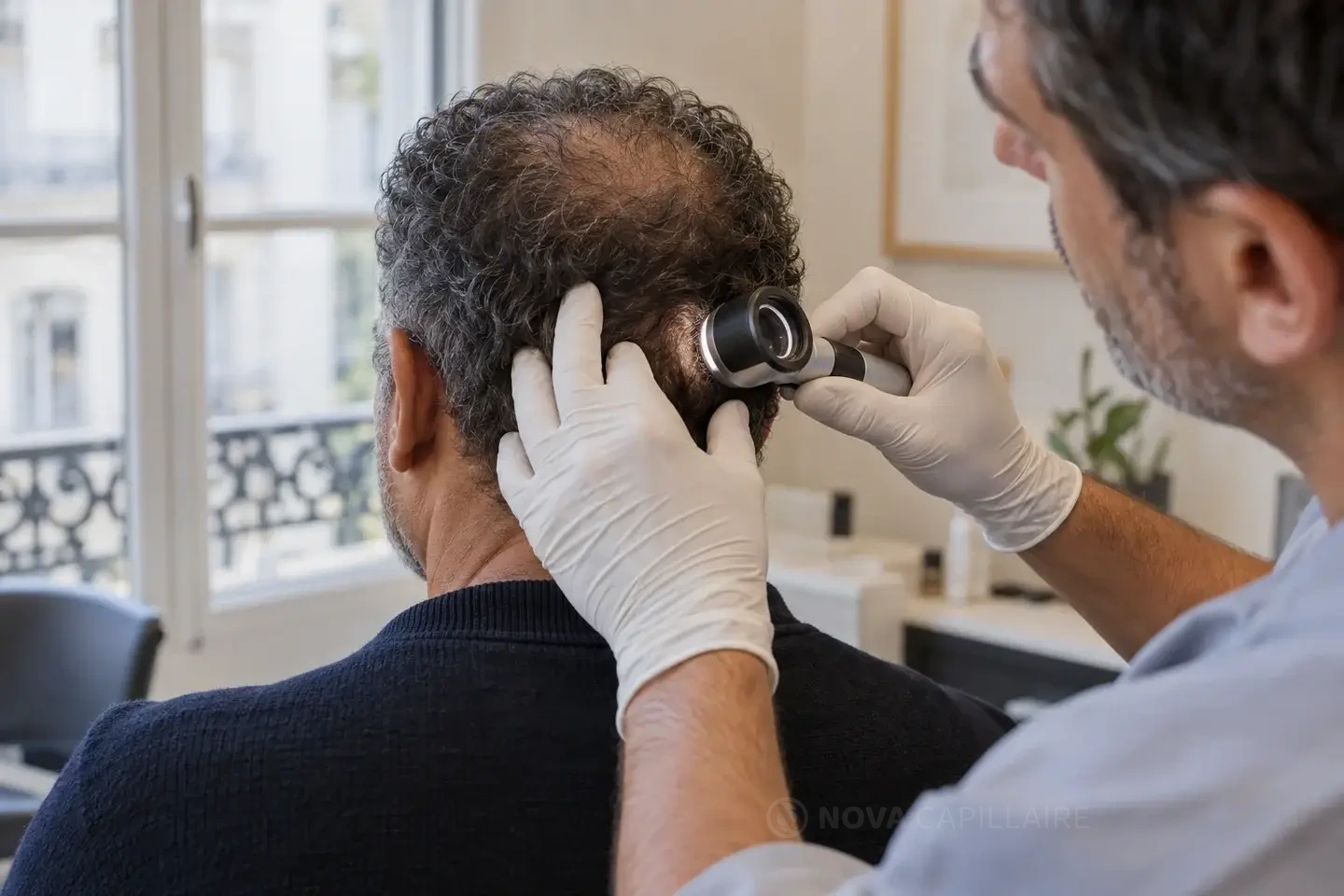
To start the discussion based on your situation rather than a package, prepare your history and priorities. You do not need to decide in advance on the number of grafts.
- Note hair loss progression and gather dated old photos if you have them.
- Bring reports of previous transplants and your list of treatments; do not change them before the appointment without medical advice.
- Explain what you want to improve but also what you do not want: shaving, insufficient density, or new procedures.
- Ask who performs the steps, which risks are discussed, and how follow-up is organized.
Ask about the expected limitations as well as the benefits. Risks to discuss with your clinician include infection, bleeding, poor healing, and unsatisfactory results. General NHS guidelines.
At NOVA, the Sapphire FUE is the reference technique. This choice does not replace indication evaluation. You can prepare your consultation in Paris ; an initial inquiry alone does not confirm transplant feasibility.
Questions to ask before deciding
Is a transplant impossible at Norwood stage 7?
Not automatically. Some plans can be discussed, but an advanced stage requires careful analysis of reserve and coverage possibilities. No graft number applies to all patients at this stage.
Can my eligibility be confirmed from photos?
Images may prepare the exchange but do not replace scalp examination. Remote estimation must not be confused with diagnosis or operative decision.
Should I wait for a specific age?
Reaching a certain birthday does not automatically make you a candidate. For a young adult, the clinician may recommend waiting to better understand how the hair loss is progressing. The decision is individual.
What to do if a clinic refuses to operate on me?
Request a written explanation and, if needed, a qualified second opinion. Only seeking someone to accept the largest number of grafts does not resolve donor reserve limits. Alternatives must suit the cause of hair loss.
Sources and guidelines
Written by: NOVA Capillaire. References consulted on September 14, 2026. General information synthesis; examples do not constitute diagnosis or individual validation.
International references clarify medical principles; their administrative or reimbursement rules do not transfer to France.