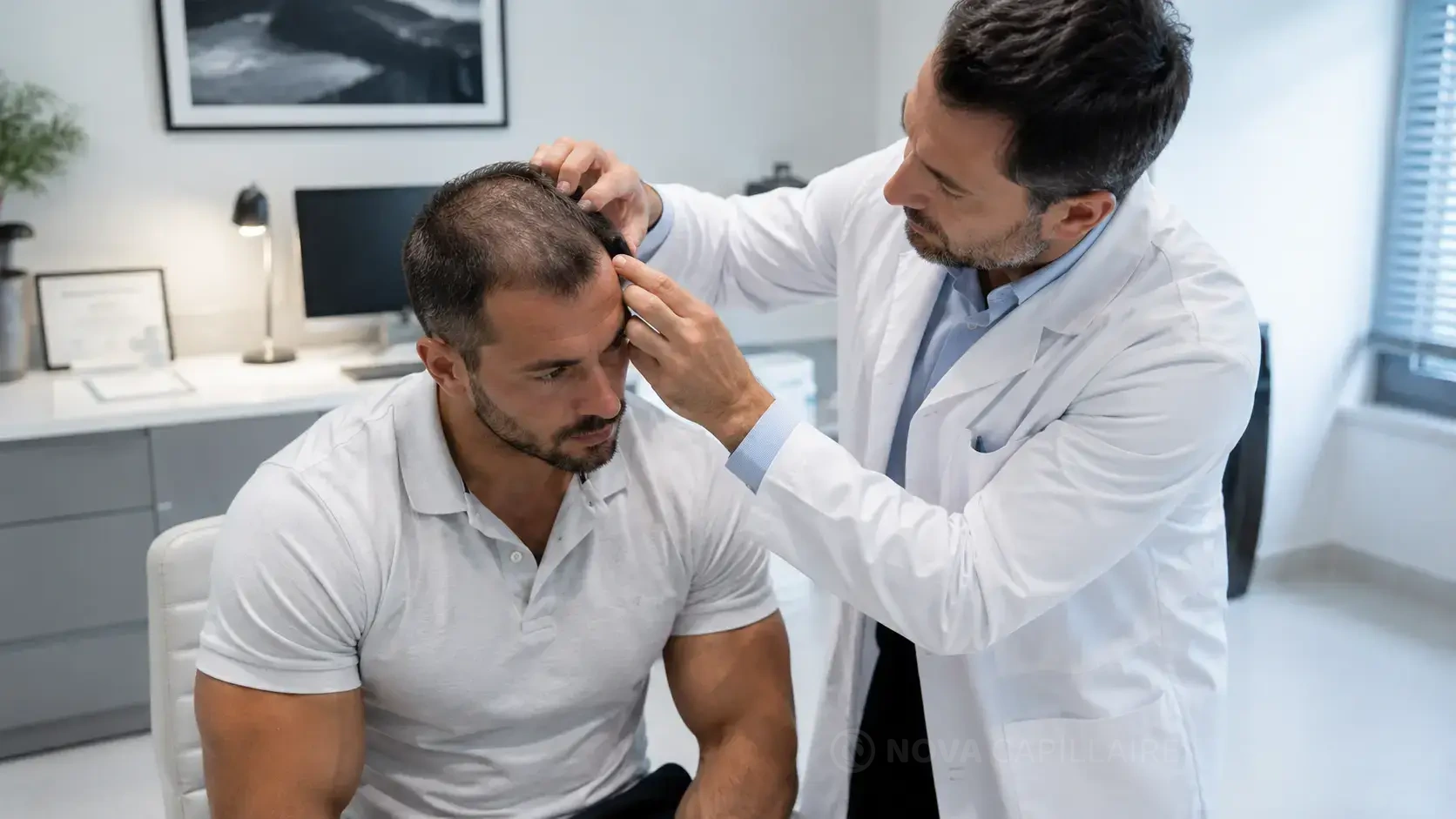
Does creatine cause hair loss? No causal link demonstrated. Concern stems from a 2009 hormonal study. A 2025 trial, which directly measured hair, found no significant difference versus placebo after twelve weeks.
Creatine, DHT, and Hair: Don’t Confuse Everything
Creatine: Energy for the Muscle
Present in the body and certain foods, creatine contributes to the regeneration of ATP during short and intense efforts. The monohydrate form is the most studied in sports supplements.
DHT: A Hormone, Not a Diagnosis
DHT comes from testosterone. It contributes to the miniaturization of genetically sensitive follicles. An isolated blood level cannot predict hair loss for an individual.
Starting a supplement before noticing hair loss therefore is not enough to establish a cause-and-effect link. To learn more, see our article on DHT and Nutrition.
Two Studies, Two Different Questions
A Hormonal Observation
A small crossover trial with placebo: three weeks of supplementation, including a loading phase. An increase in DHT was observed.
The Essential Limitation No hair parameters were measured: this result did not demonstrate hair loss.
See the 2009 StudyHair Directly Evaluated
45 men recruited, 38 participants completed the trial: 5 g per day for 12 weeks versus placebo.
The Result No significant difference in DHT, density, follicular units, or cumulative hair thickness.
See the 2025 StudyWhat Can Be Concluded — and What Remains to Be Studied
A hormonal increase and visible loss are not the same. The 2025 trial provides direct reassuring measurement without proving absence of risk in all circumstances.
Available Data
No causal link established between creatine and baldness. The 2009 DHT observation alone is insufficient to conclude an effect on follicles.
Limitations of the Data
Long-term hair effects, effects in women, and with other doses remain less documented. The 2025 trial does not resolve these.
Your Hair Is Falling Out: Look for the Cause Before Blaming Creatine
Observe the distribution, speed of onset, and scalp signs. The situations below are leads to discuss, not a diagnosis to make alone.
| What You Observe | Possible Lead | Next Step |
|---|---|---|
| Progressive thinning at the temples or vertex | Androgenetic alopecia | Have hair density and miniaturization examined. |
| Diffuse loss after a significant event | Telogen effluvium after fever, stress, illness, or weight loss | Note events from the past two to four months. |
| Patches, pain, redness, or scales | Scalp condition requiring examination | Seek medical advice promptly. |
| Persistent diffuse loss | Deficiency, thyroid, medication, or other cause | Have evaluation to determine if an appropriate workup is needed. |
A simple follow-up, without monitoring every hair
Comparable photos
Once a month: face, temples, top, and vertex, with the same light, distance, and comparable hair style.
A clear timeline
Note the start of creatine, other supplements, medications, recent illnesses, and changes in weight or diet.
An examination if necessary
If hair loss persists or worsens, consult. Daily selfies and informal counts do not replace scalp examination.
Changing several products and habits at once makes progression difficult to interpret. Discuss any change with a professional without delaying the search for another cause.
Supplements and Transplant: Seek Advice at the Right Time
Before supplementation, ask for advice in cases of kidney disease, pregnancy, breastfeeding, minority, chronic illness, or multiple treatments.
A transplant planned? Disclose all your supplements to the medical team and follow their instructions for stopping or resuming. The 2025 hair trial did not evaluate patients who had a transplant.
After surgery, a transient loss of transplanted hair may accompany the postoperative cycle: it should not be automatically attributed to creatine. To understand this cycle, see our article on grafts and their regrowth.
Questions You Might Have
Should I stop creatine if my hair falls out?
Not automatically based on coincidence alone. Document the timeline and seek advice if loss persists, worsens, or is accompanied by symptoms. A possible pause does not replace a diagnosis.
Are people predisposed to baldness more affected?
Genetic predisposition increases the risk of androgenetic alopecia. This does not prove that creatine accelerates this process in them.
What do we know about women?
The 2025 trial involved men; it does not allow direct conclusions on hair parameters in women.
Do results apply to all doses?
No. The 2025 trial used 5 g daily for twelve weeks without a loading phase. One cannot automatically extrapolate to other doses or durations.
Can creatine be taken after a transplant?
Ask your medical team’s approval. The decision depends on your file, timing of resumption, and other products used.
Sources for Further Reading
References distinguish hormonal observation, hair measurement, and result limitations.