
Thinning temples: look at where the pulling happens
A part that looks wider beside a braid, temples you try to cover, a thinner hairline: loss does not always begin with a large bare patch. Sometimes a tighter style is used to hide the change. Breaking that cycle matters.
Traction alopecia is hair loss associated with repeated pulling. It can affect any ethnicity. For Black women, styling habits deserve attention without assuming that every type of hair loss comes from styling. The relevant questions are where tension occurs and how often it returns.
The priorities are to preserve existing hair and determine whether the thinning area can recover or whether surgical restoration makes sense. A photograph alone cannot answer both questions.
Signs that mean your hairstyle needs to change
Short broken hairs, thinning edges and small bare areas can occur with traction. Discomfort, itching or small bumps near attachments should also be reported. You should not have to wait for a painful style to loosen.
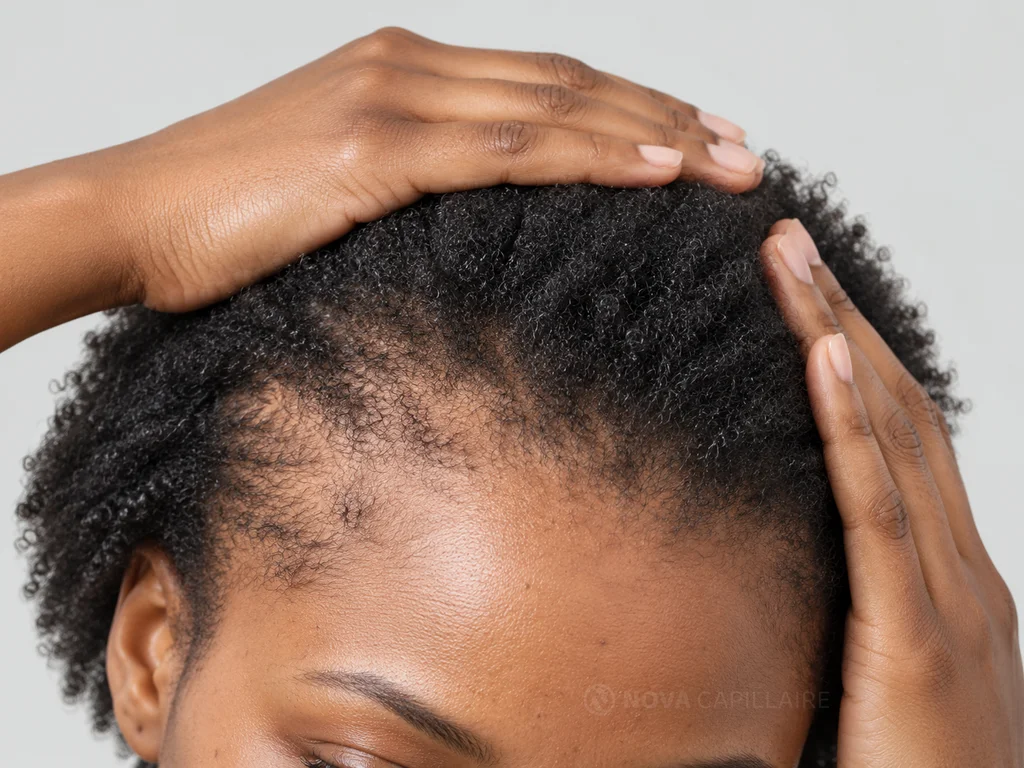
Traction alopecia: thinning at the frontal hairline and temples.
Look at your temples and attachment points, not only the center of your hairstyle. If the area changes, arrange an assessment to distinguish broken shafts from loss of density or damage to follicles.
Braids, extensions and buns: changes you can make
You do not need to abandon your personal style. Talk through the installation with your stylist and identify the areas that must be spared tension. Ask for the style to be loosened immediately if it hurts or causes a headache.
A protective style is not automatically free of pulling. Heavy extensions or very tight braids can keep stressing the same roots. Moving tension from one temple to the other is not a solution.
At your next appointment, point to the area and explain: “My edges are thinning here; I need a style that does not pull on this border.” If the requested design cannot accommodate that, choose another design.
Keep a gentle washing and conditioning routine between installations. Caring for the hair shaft does not replace removing tension. Check the attachments of wigs or camouflage accessories as well: covering a thinning area should not mean pulling on it again.
Can the hair grow back?
It depends on the condition of the follicles. Recent loss may improve after pulling stops, while long-standing traction can leave permanent loss. Thinning temples do not all have the same outlook.
Do not choose a regrowth deadline based on someone else’s story. Establish a baseline with your clinician and compare photographs under similar conditions. Assessment may lead to treatment, observation or discussion of transplantation for permanent loss.
Minoxidil or treatment for inflammation should be discussed with a dermatologist. A social-media comparison is not a personal treatment plan. Oil does not recreate a destroyed follicle, and adding products does not cancel ongoing pulling.
Hair loss in Black women is not always traction
Loss beginning at the crown may reflect another condition, including central centrifugal cicatricial alopecia, or CCCA. Diffuse shedding, a widening part or sudden patches also have other possible causes. Conditions can coexist.
An assessment should therefore go beyond asking whether you wear braids. The dermatologist considers the pattern, course and symptoms, and may request further tests. Persistent pain, inflammation or rapid progression warrants assessment rather than repeated cosmetic trials.
When a hair transplant can be a very good option
For permanent traction alopecia that has been correctly diagnosed and stabilized, transplantation can offer a meaningful cosmetic solution. It places follicles into a hairline or temples that no longer recover on their own.
The causes of pulling must be addressed, active inflammatory disease considered and the donor area assessed first. Operating while the same tension continues is not a durable plan. Scarred skin also needs assessment before implantation.
The project is more than a large graft count. Where should the hairline begin? What area needs coverage? How will implanted hair blend with existing hair? Consultation defines a coherent design while preserving the donor reserve.
Tightly curled follicles require particular technical attention during harvesting. The planned count and coverage are discussed after examination. Transplantation leaves scars, even when subtle; graft survival and density cannot be guaranteed.
Regrowth is assessed over months, and styling advice remains important afterward. Restoring hair does not make the hairline resistant to renewed pulling.
A NOVA before-and-after to explain the project
This comparison comes from our existing gallery. The center has confirmed that the patient had traction alopecia. Frontal and profile views show the hairline restoration project.
The photographs show two angles, first a frontal view and then a profile. They help you assess the transition of the hairline and temples into the rest of the hair.
Look at the continuity of the hairline and its transition into existing hair. Styling, lighting and angle can affect perceived density. This journey illustrates a restoration possibility, not a promise of the same result for every patient.
Understanding these comparisons
Two views of the same patient, front and profile.
Individual outcome, not a guarantee. Graft count and interval not recorded.
- Grafts
- Not recorded
- Result shown at
- Not recorded
- Technique


- Grafts
- Not recorded
- Result shown at
- Not recorded
- Technique
Results vary by individual and are not a guarantee.
What to bring to your consultation
Prepare a short timeline: when you first noticed the area, whether it changed and which styles you wore. Older photographs showing the hairline can help describe its course.
List products and treatments already tried, together with symptoms. Ask: “Is this traction? Can some hair recover? Does anything else need treatment before surgery? What donor area is available?”
You should leave understanding the working diagnosis and next step. A quotation or graft count alone does not answer those questions.
Frequently asked questions
Do braids always cause alopecia?
No. Repeated pulling matters, rather than the name of the style. Painful or pulling installations need modification.
Can temples be restored with a transplant?
Sometimes, for stable permanent loss, after assessment of the diagnosis, skin and donor reserve.
Can I resume the same styles afterward?
Follow postoperative instructions first. Avoiding renewed tension remains necessary afterward.
How do I know whether my hair will regrow?
Examination assesses follicles and the course of loss. A photograph alone cannot predict recovery.
Sources and references
Sources consulted October 12, 2026. BAD and DermNet leaflets carry the older dates shown below. The NOVA case comes from the center gallery; it does not establish a success rate.
Further reading

Am I a good candidate for a hair transplant?
Donor area, hair loss progression, and expectations: understanding what makes a transplant plan feasible, adaptable, or discouraged, including at Norwood stages VI and VII.
Read the article
Androgenetic Alopecia: Causes, Signs and Options to Discuss
Androgenetic alopecia: understand common patterns, prepare for an assessment, and compare options without self-diagnosing.
Read the article
Do helmets cause hair loss? Myths and facts
Discover whether helmet use really causes hair loss. Analysis of factors, myths and practical advice to protect your scalp.
Read the article
How to lower DHT to limit hair loss
DHT blockers, natural remedies, shampoos and minoxidil: understand the differences before choosing what to do.
Read the article