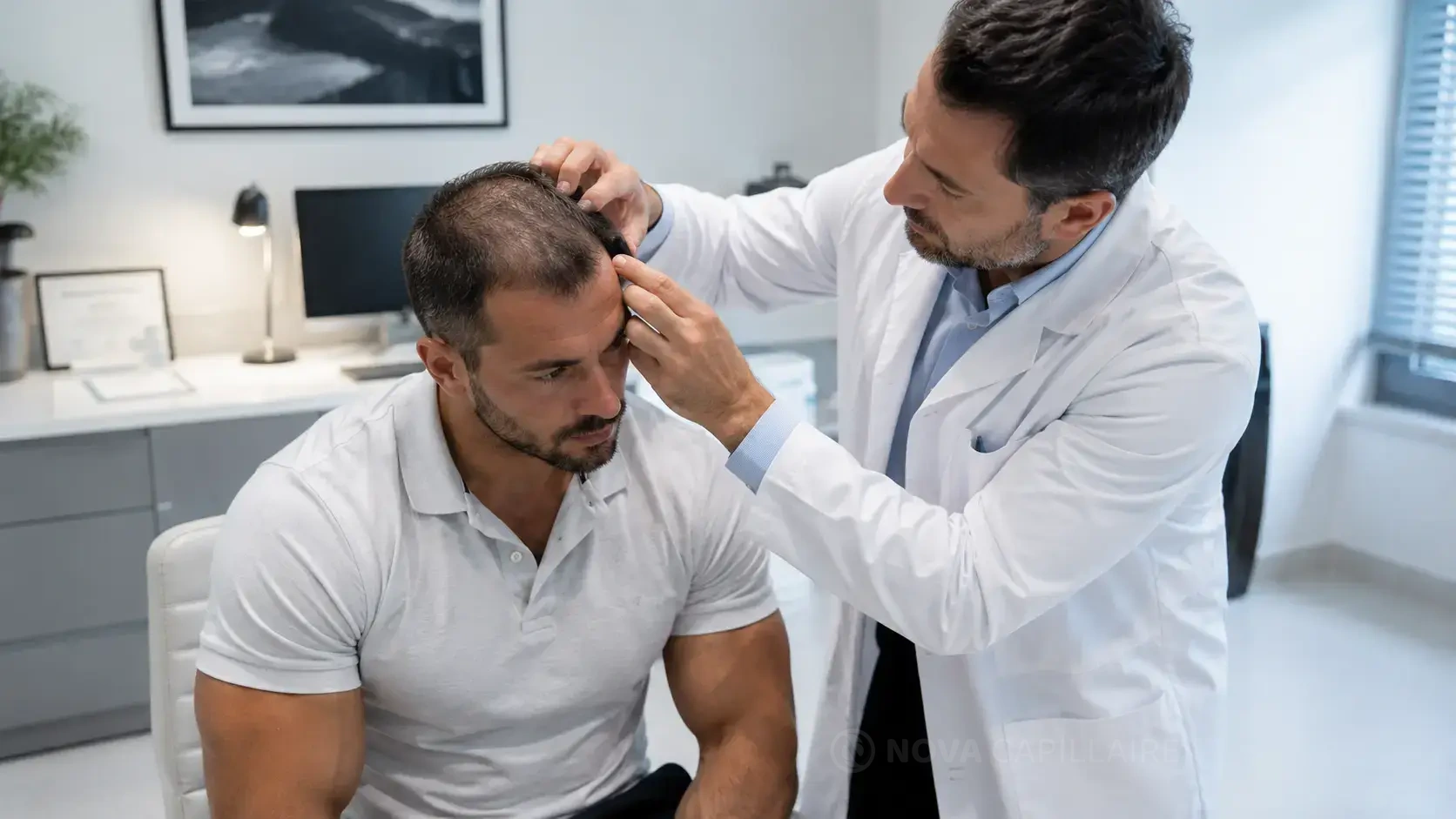

Androgenetic alopecia often progresses gradually, but reduced hair density alone does not diagnose it. To take a useful first step: note what is changing and when it began, compare a few photographs taken under similar conditions, and get an assessment before choosing treatment or surgery. One photograph cannot confirm the cause or predict what will happen.
The practical answer: what should I do first?
Start by noting the area involved, roughly when the change began, and how quickly it is progressing. The table below can help you choose a next step without turning an appearance into a diagnosis.
| What you notice | A useful next step |
|---|---|
| Gradual thinning at the temples, hairline, or crown | Note when it began and arrange an appointment with a doctor or dermatologist. This pattern can suggest androgenetic alopecia, but does not prove it. |
| A widening center part or reduced density over the top of the scalp | Take photographs under comparable conditions and arrange an assessment. Diffuse thinning can have several causes. |
| Round patches that appear quickly or sudden hair loss | Do not assume inherited pattern hair loss: ask a clinician to assess possible causes. |
| Diffuse shedding after illness, childbirth, weight loss, or a medicine change | Record the context and dates, then discuss them with a clinician. Do not stop a prescribed medicine on your own. |
| Pain, redness, marked itching, scale, pustules, or skin that seems scarred | Have the scalp examined; these signs should not automatically be attributed to androgenetic alopecia. |
To prepare for an appointment, gather older photographs if available, taken with dry hair, similar lighting, and a comparable part. Note recent events (illness, childbirth, weight loss), medicines that were started or changed, and any scalp symptoms. You do not need to count every shed hair; describe persistent changes and their timeline instead.
What androgenetic alopecia means
In this form of hair loss, some follicles gradually become more sensitive to androgens. They produce finer, shorter hairs; this miniaturization can slowly reduce scalp coverage. Genetics plays a part, and the explanation is not simply a high testosterone level. 12
In many men, change develops at the temples or hairline and/or crown. In many women, the center part becomes more visible and thinning may be more diffuse over the top of the scalp, while the frontal hairline is often preserved. These patterns vary and can overlap; they do not allow self-diagnosis. 234
Why a medical assessment changes the next step
A clinician starts by asking when the loss began, how quickly it is changing, where it occurs, and about family history, medicines, and symptoms. They examine the hair and scalp and may assess hair breakage or shedding based on the findings. Blood tests or a biopsy are not automatic; they may be considered if the history or examination suggests a deficiency, hormonal imbalance, infection, or another condition. 1
This distinction matters because diffuse shedding can happen alongside gradual thinning. Telogen effluvium is another possible cause. Sudden patches, a painful or inflamed scalp, marked scale, or pustules are also reasons to look beyond androgenetic alopecia.
Compare options without confusing their goals
The choice depends on the cause, progression, medical history, contraindications, and what matters to you. There is no single option that fits everyone. 123
| Option | What it may offer and its limit |
|---|---|
| Monitoring and comparable photographs | Help describe progression. They do not identify the cause or replace an examination. |
| Medical treatment discussed with a clinician | May aim to slow hair loss, depending on the diagnosis. The choice is individual; some benefits last only while treatment continues. |
| Camouflage: fibers, styling, or a hairpiece | Can change appearance without acting on follicles or treating the cause. |
| Hair transplantation | Redistributes follicles taken from an assessed donor area. It does not automatically stop changes in nontransplanted hair and is not suitable for every plan. 67 |
For medication information, see our guide to finasteride and minoxidil, including uses and precautions. NOVA does not prescribe either medicine. Do not start, stop, or change treatment based on this article; speak with the clinician who knows your situation. Medicine approvals and suitability differ by country and person.
What a transplant can — and cannot — do
A transplant redistributes follicles from an assessed donor area to selected areas. That supply is limited. Surgery does not directly treat the cause of alopecia and does not automatically stop miniaturization in hair that remains in place. 67 A sound plan accounts for possible progression, donor supply, and cosmetic priorities rather than promising the same density everywhere.
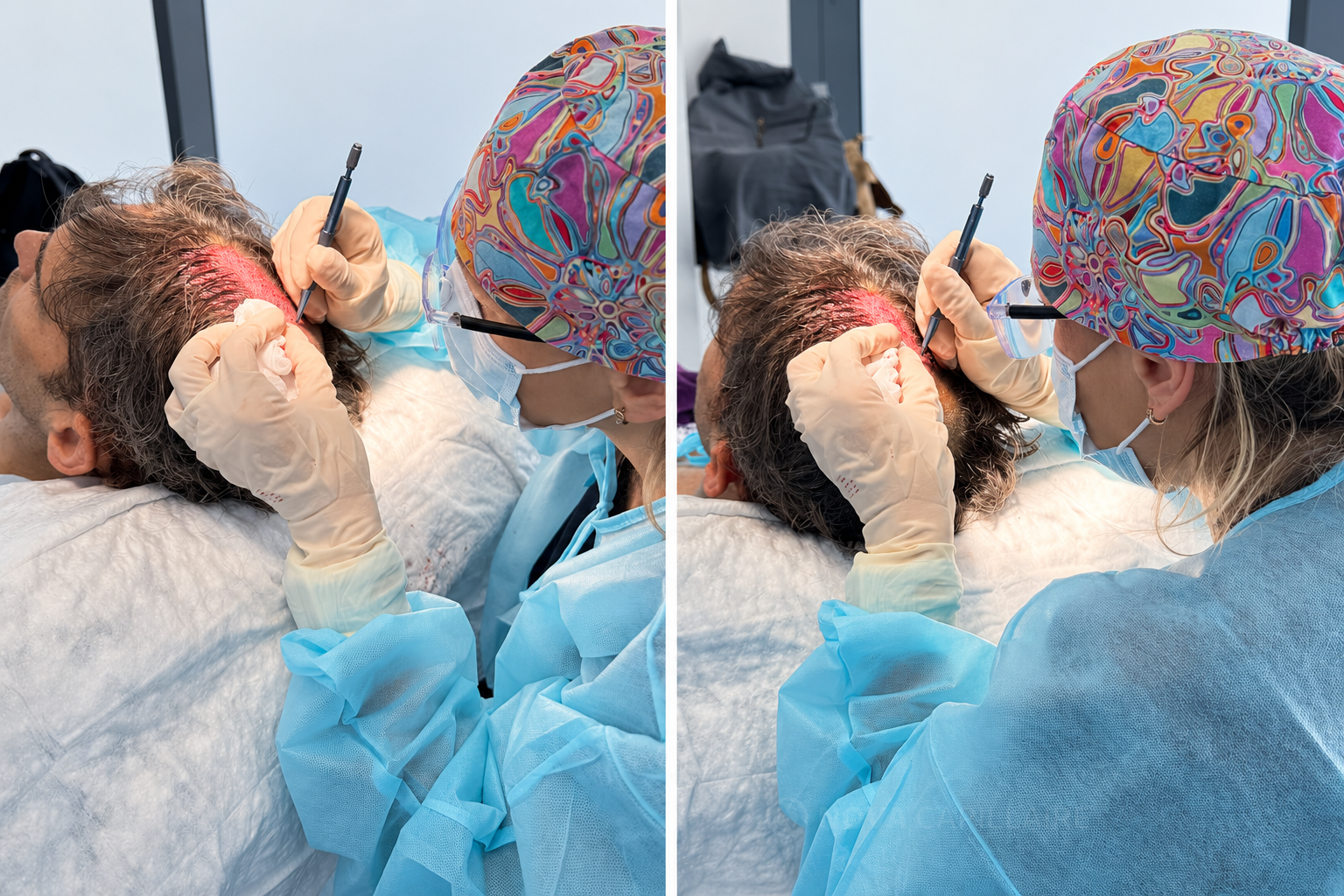
The hairline and crown have different needs in terms of area and direction. Candidacy depends on an individual assessment; see our guide to being a good hair-transplant candidate. A consultation does not commit you to surgery: it should also clarify alternatives and limitations.
When to seek an assessment rather than wait
Arrange an appointment if hair loss is sudden, patchy, clearly accelerating, or accompanied by pain, redness, marked itching, scale, pustules, or areas that seem scarred. These signs can have other explanations, and some need a focused assessment. If you are unsure, start with a doctor or dermatologist rather than a treatment chosen from an advertisement. 15
Frequently asked questions
Does a widening part confirm androgenetic alopecia?
No. It is one possible sign, especially in women, but other causes can look similar. Diagnosis considers the history and examination of the scalp. 34
If my mother or father did not lose their hair, am I in the clear?
No. Family history is useful to mention, but it cannot confirm or rule out this type of hair loss. Predisposition can come from different sides of a family. 24
Can a photograph tell me whether I need a transplant?
No. Comparable photographs help describe change, but they cannot determine the cause, activity of hair loss, or donor supply on their own. A surgical decision requires an individual examination.
Does everyone need blood tests?
No. Tests are selected based on the information gathered; some people do not need them. A clinician decides whether a blood test or another examination is appropriate. 1
Are vitamins or hair-loss shampoos enough?
They do not identify the cause. A shampoo may improve how hair feels or looks, but it does not replace assessment of persistent hair loss. Supplements are not a universal answer; ask for advice if you think you may have a deficiency. 3
Can I start or stop minoxidil or finasteride?
Do not make that decision from an article. Options, expected benefits, risks, and duration should be discussed with the prescriber or a dermatologist. Our finasteride and minoxidil guide provides general information.
Will a transplant prevent loss in the surrounding hair?
Not automatically. It moves selected follicles while nontransplanted hair may continue to change. Planning needs to account for that possibility and for donor supply. 67