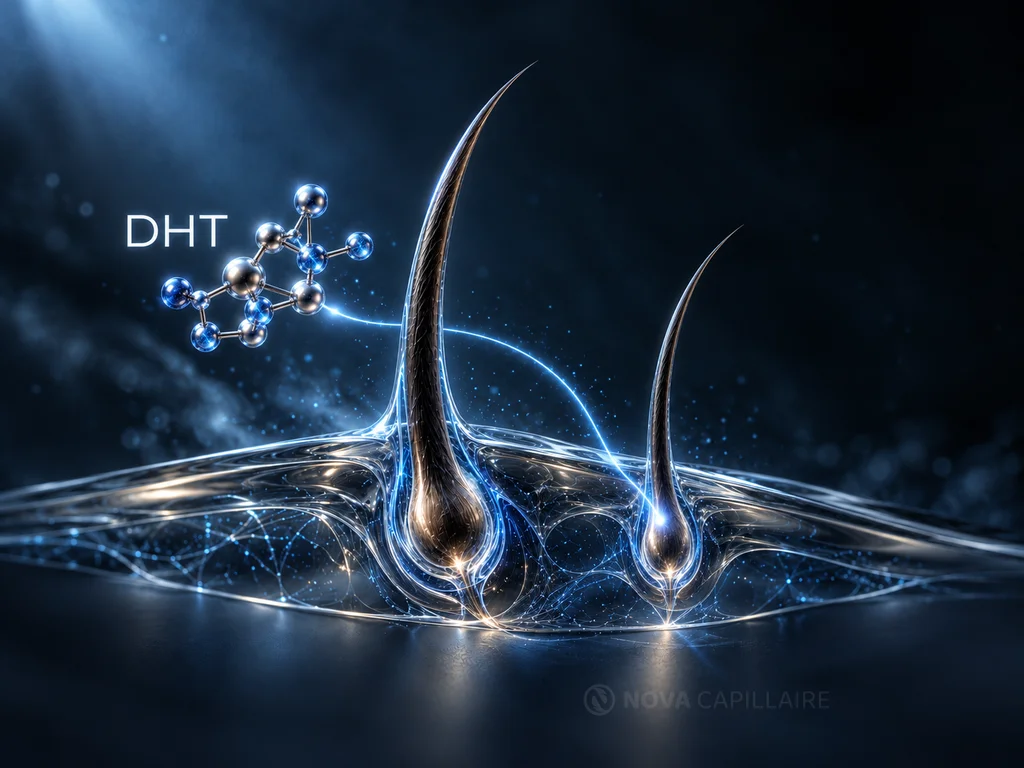
Can lowering DHT really help you keep your hair?
You may have come across DHT after noticing receding temples or a crown that looks thinner in photographs. A search quickly produces the same promises: DHT-blocking shampoo, natural supplements and foods to favor. They can sound like different versions of one solution. They are not.
Some medicines can reduce DHT formation. Lowering a hormone and improving a head of hair, however, are different endpoints. Diagnosis, follicle sensitivity, the course of hair loss and treatment risks also matter. Eliminating DHT at any cost is not a care plan.
The useful question is whether your hair loss is androgenetic alopecia and which options make sense for you. This article helps you prepare that discussion, rather than providing a hormone-lowering routine or shopping list.
| Option | Role | What to remember |
|---|---|---|
| Finasteride | Targets DHT formation | Medical discussion; not prescribed by NOVA |
| Minoxidil | Different action on hair growth | Not a DHT blocker |
| Saw palmetto | Limited hair-loss evidence | Not a proven replacement |
| Diet | Nutritional support | Not a DHT-blocking treatment |
| Anti-DHT shampoo | A label is not clinical evidence | Assess the finished product |
Finasteride
- Role
- Targets DHT formation
- What to remember
- Medical discussion; not prescribed by NOVA
Minoxidil
- Role
- Different action on hair growth
- What to remember
- Not a DHT blocker
Saw palmetto
- Role
- Limited hair-loss evidence
- What to remember
- Not a proven replacement
Diet
- Role
- Nutritional support
- What to remember
- Not a DHT-blocking treatment
Anti-DHT shampoo
- Role
- A label is not clinical evidence
- What to remember
- Assess the finished product
What DHT does—and what a blood result cannot tell you
Dihydrotestosterone, or DHT, is an androgen formed from testosterone through an enzyme called 5-alpha-reductase. It has normal functions in the body. In androgenetic alopecia, androgen-sensitive follicles may gradually produce finer, less visible hairs; genetic predisposition matters.
This does not mean that everyone losing hair has too much DHT. A blood value alone does not describe the pattern of thinning or the condition of follicles on your scalp.
Do not order a hormone test to choose a product yourself. An examination, history and timeline guide the assessment, and the clinician decides whether testing is useful. Recent diffuse shedding after illness or weight loss is not assessed in exactly the same way as a slowly receding hairline.
Medicines that target DHT: understand the mechanism first
Finasteride acts on an enzyme involved in DHT formation. That explains why it appears in searches for DHT blockers, but the mechanism does not establish suitability for everyone. Benefits observed in a study do not guarantee your response or tolerance.
Sexual side effects and mood changes require attention. The European Medicines Agency confirmed suicidal ideation as a side effect of finasteride tablets, with unknown frequency. For finasteride 1 mg, its advice is to stop treatment and seek medical advice promptly if mood changes occur.
NOVA does not recommend or prescribe finasteride. Questions about this medicine or an existing prescription belong with your dermatologist or prescriber. The center’s position is distinct from saying that the medicine is banned everywhere.
Dutasteride and topical preparations also appear online. They should not be swapped because a website advertises stronger DHT suppression. Formulations, indications and risks need a separate medical discussion. No dose or substitution regimen is provided here.
Does minoxidil lower DHT?
Minoxidil is not a DHT blocker. It acts on hair growth through a different mechanism. A treatment may therefore be discussed for hair loss without aiming to reduce this hormone.
The distinction matters when a product range groups several ingredients under an anti-DHT label. Read the active ingredients rather than relying on the name. A combined preparation may contain a medicine you did not realize you were buying.
Formulation, indications and precautions depend on the product and the person. A professional should assess suitability. Do not increase an amount or change the route of administration to speed things up. Our article on finasteride and minoxidil explains their different roles.
Can you lower DHT naturally?
Natural does not tell you whether a product has been tested in people with hair loss. An enzyme effect in a laboratory is not proof that a supplement will preserve your density. Ask what was measured: a hormone marker, a photograph or a hair outcome.
Saw palmetto, also called Serenoa repens, is commonly promoted as a natural DHT blocker. NCCIH, part of the U.S. NIH, says the small studies in male-pattern hair loss are too limited to establish usefulness. It is not a proven equivalent to a medicine. Tolerance and interactions still need consideration.
Distinguish foods such as pumpkin seeds, green tea and nuts from concentrated extracts used in research. Sharing an ingredient name does not make the preparations, amounts and results interchangeable.
A sufficient, varied diet has a place. NOVA does not present it as a DHT-blocking treatment. Our food article offers dietary ideas, not an anti-DHT prescription. Supplements should address an assessed need rather than a promise on a box.
Is a DHT-blocking shampoo enough?
A shampoo is generally applied briefly and rinsed away. The anti-DHT wording on a label does not, by itself, demonstrate reduced DHT in follicles or a lasting effect on androgenetic alopecia.
Look for evidence on the finished product: the use tested, duration and participants. An ingredient study or advertising photograph does not answer those questions. Lighting and hairstyle changes can also distort before-and-after comparisons.
An irritated, scaly or painful scalp warrants appropriate assessment. Do not choose a medicated shampoo yourself to lower DHT. Treating a scalp condition and treating androgen-related hair loss are different goals.
Build a plan rather than a collection of products
Write down what you have noticed: a receding hairline, widening part, thinning crown or recent shedding throughout the scalp. Record when it began, recent events and medicines or supplements you already use.
At your appointment, ask what supports the diagnosis and what a realistic goal would be: slowing progression, preserving existing density or seeking a visible improvement. Discuss alternatives, risks and the way the response will be evaluated.
Use comparable photographs, with similar lighting and styling. Starting several products together makes it harder to identify what helps, irritates or adds nothing. Discuss previous purchases before adding something else, and do not change a prescription without advice.
Sudden shedding, bald patches, pain or inflammation should not wait through repeated supplement experiments. Have your scalp examined so the assessment does not remain focused on the wrong target.
What if you are considering a hair transplant?
A transplant redistributes follicles from the donor area. It is not a way to lower DHT throughout the body. Surgery and the management of continuing hair loss address different questions.
The design must consider remaining hair and the donor reserve. If thinning continues around the transplanted area, the appearance needs follow-up. NOVA discusses surgical planning with that perspective; medication options belong with your dermatologist.
The practical answer to lowering DHT is therefore not to find the strongest product. It is to understand your hair loss and choose a strategy whose benefits, limits and risks you can evaluate.
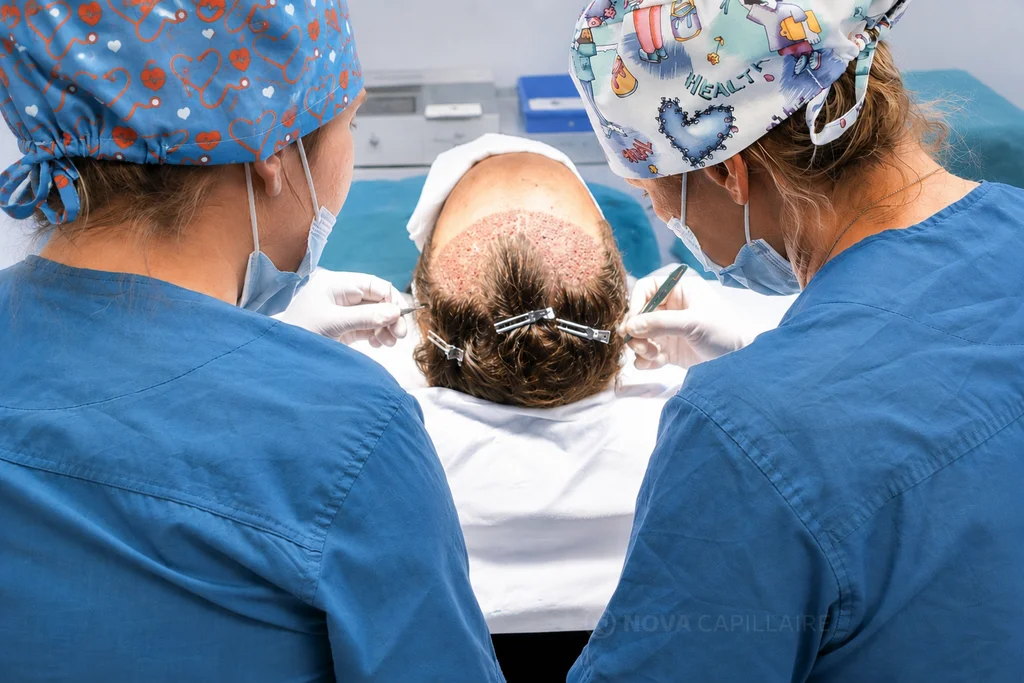
The NOVA team during a procedure. A transplant redistributes follicles; it does not lower DHT throughout the body.
Frequently asked questions
Can I completely block DHT?
Eliminating DHT is not an appropriate self-treatment target. First establish the cause of hair loss and discuss the benefit-risk balance.
Is there an effective natural DHT blocker?
No food or supplement discussed here is established as a universally effective substitute for a medically assessed treatment.
Does minoxidil block DHT?
No. It has a different action on hair growth.
Does NOVA prescribe finasteride?
No. NOVA does not recommend or prescribe it. Discuss existing treatment with your dermatologist or prescriber.
Does a blood DHT test show why my hair is falling out?
Not on its own. The clinician assesses the scalp and history and decides whether tests are useful.
Sources and references
Sources checked October 12, 2026. General medical information is distinct from NOVA’s prescribing position. No product ranking, keyword volume or individual outcome is claimed.
| Source | Reference |
|---|---|
| MedlinePlus | Androgenetic alopecia and genetic factors |
| AAD | Diagnosis and treatment assessment |
| AAD | Medication roles |
| NCCIH | Saw palmetto: limited hair-loss evidence |
| EMA | Finasteride safety review |
Further reading
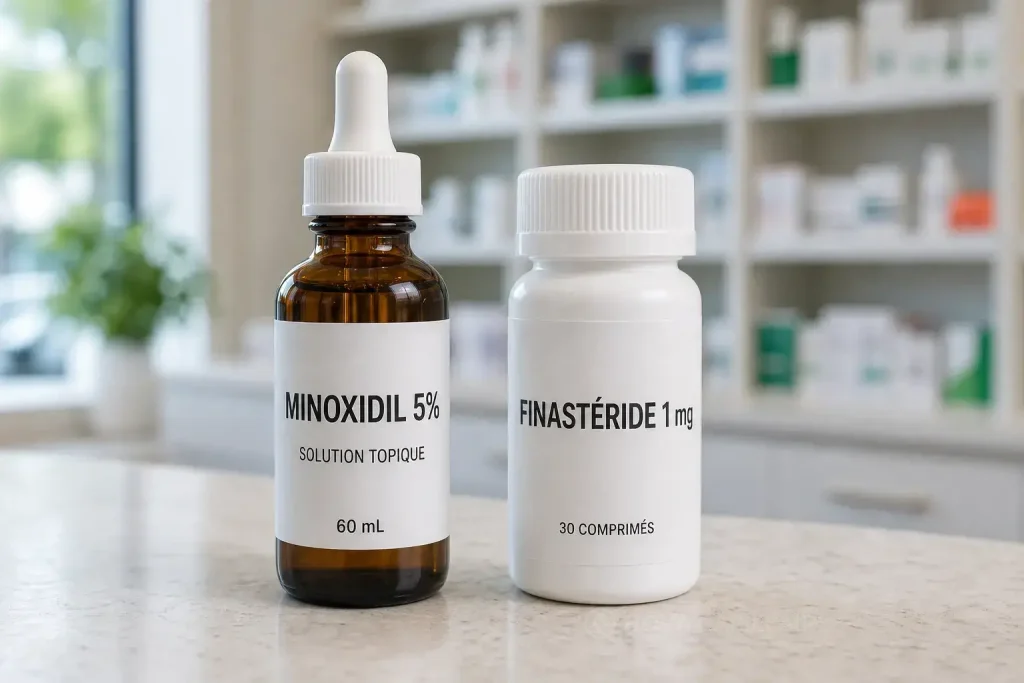
Finasteride and Minoxidil: Efficacy, Risks, and Precautions
Can finasteride and minoxidil be used together? Learn about effectiveness, timelines, side effects, and precautions to discuss before treatment.
Read the article
DHT and hair: 15 foods to know
Certain foods are often cited to support hair against DHT. Here is what diet can provide, and what it cannot do.
Read the article
Folliculitis decalvans: treatment and the role of hair transplants
Why dermatological follow-up is a priority, what treatments can provide, and under what limits a transplant can be considered.
Read the article
3,000-graft hair transplant: cost, coverage and limits
Understand 3,000 grafts, front-versus-crown priorities, donor preservation and NOVA fees.
Read the article