Graft quality starts with harvesting
When you plan a hair transplant, graft numbers and the design of your hairline tend to get most of the attention. How those grafts leave the donor area is easier to overlook. Yet before they can be sorted and placed, their structures need to be preserved during harvesting.
A FUE punch is a hollow instrument positioned around a follicular unit. It separates the tissues holding that unit in place so the graft can be removed. The visible hair provides a reference point, but most of what the team needs to retrieve is beneath the skin. Harvesting is more involved than cutting around a hair.
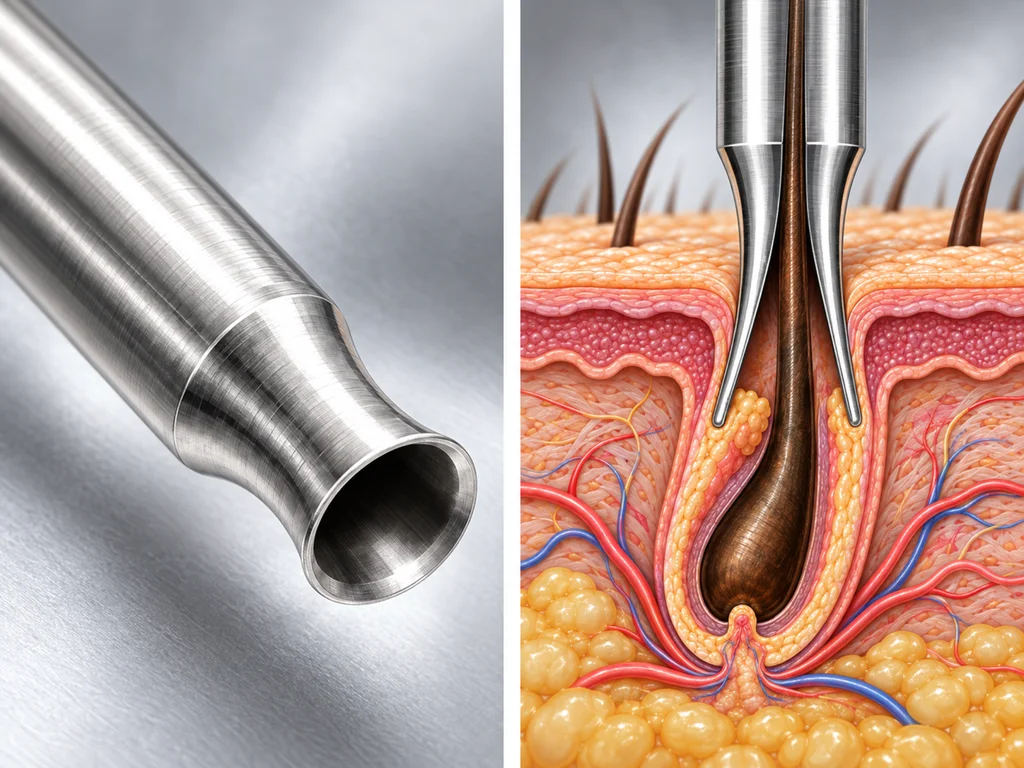
At NOVA, we use Punch Contour, a punch manufactured to our own specifications, informed by our team’s experience. Its flared shape is designed to help preserve graft integrity during harvesting. Here is where it fits into a transplant and what matters beyond the instrument’s name.
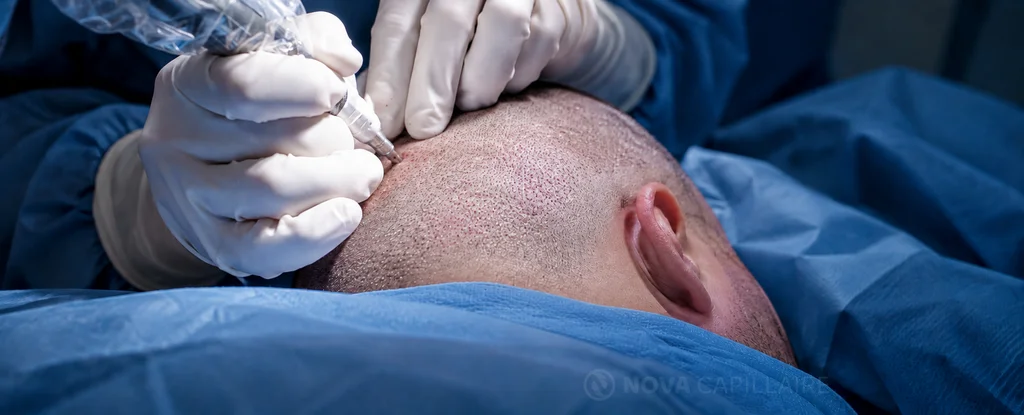
Our team using Punch Contour during FUE harvesting at NOVA.
Why does the shape of a punch matter?
Think of a small opening that needs to surround a group of follicles without cutting through them. Several hairs may emerge close together at the surface while following different paths beneath it. The instrument needs to work around the structures being released.
Punch Contour is manufactured to our specifications. Its progressively flared, bell-shaped opening is designed to accommodate the follicular unit during harvesting. The aim is to help preserve its structures while our team adapts the instrument’s use to the donor area.

Progressively flared opening
A bell-shaped opening designed to accommodate the follicular unit.

Working with follicle curves
Geometry designed to help curved follicles enter the punch.

Respecting the follicular path
A design intended to reduce the constraint of a straight passage.

Preserving graft integrity
Protection of graft structures is the goal during harvesting.

Precision during harvesting
An instrument dedicated to each patient, used with individually adapted settings.
Classic punch / Punch Contour
Two harvesting geometries: the cylindrical opening of a classic punch and the progressively flared opening of Punch Contour. The images below show their shape and how each surrounds the follicular unit.
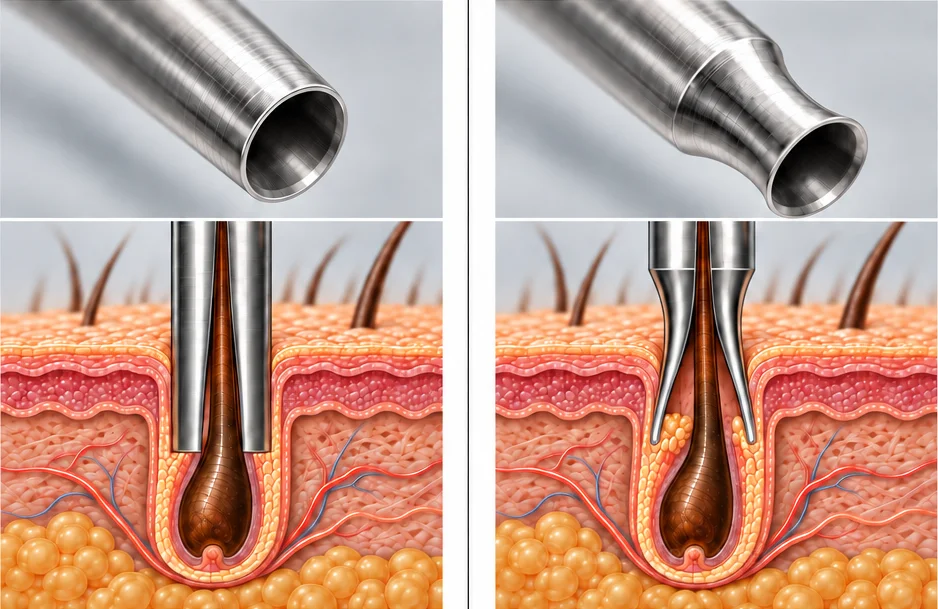
Top: instrument tips. Bottom: their passage around the follicle.
Opening shape
Cylindrical, with straight walls.
Progressively flared, with a bell-shaped opening.

Follicle curvature
Harvesting settings are adapted to the follicular path.
The flared shape is designed to accommodate curved follicles.
Passage around the graft
A cylindrical passage around the follicular unit.
A progressive opening designed to accommodate the follicular unit.
Graft preservation
Technique and settings contribute to graft preservation.
Geometry, technique, and settings work together to preserve graft structures.

Harvesting precision
Angle and working depth are adapted to the donor area.
Adapted settings combined with examination of harvested grafts.
At NOVA, Punch Contour is used for all hair types, including straight, wavy, fine, Afro-textured, and tightly curled hair. Our team adapts harvesting to the individual donor area.
We chose Punch Contour as part of our approach: adapt harvesting to the individual, examine the grafts obtained, and preserve the donor reserve. That connection gives the instrument choice its purpose.
What our team checks during harvesting
The instrument’s shape matters, but its use depends on the donor area. Hair direction, the way the hairs emerge, and the characteristics of the skin all need to be considered. A suitable setting in one area cannot automatically be applied across the entire scalp.
During harvesting, examination under magnification allows our team to assess the grafts obtained, including their composition and visible integrity. This feedback matters because it shows what has actually been retrieved, rather than simply how many harvesting attempts have been made.
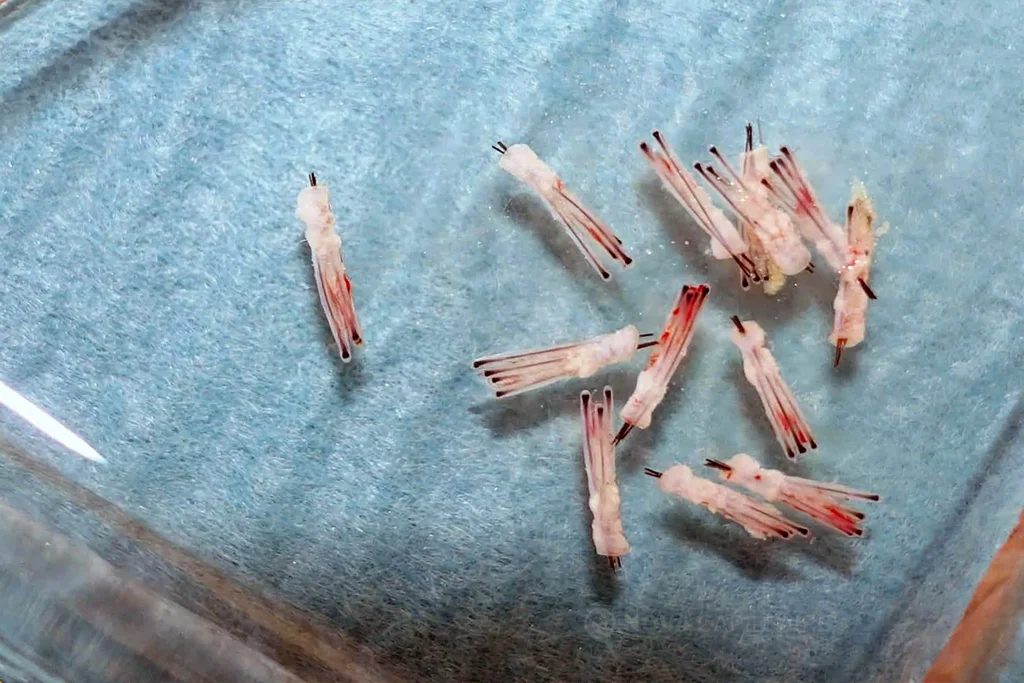
Hair grafts preserved during harvesting with Punch Contour, photographed before implantation.
This close-up shows grafts harvested with Punch Contour. It illustrates the examination of their appearance and the tissues surrounding the follicles before implantation.
Transection means an accidental cut through a follicular structure during harvesting. It can affect part of a graft containing several follicles. A three-hair graft is therefore not necessarily a unit that can only be described as wholly intact or wholly lost. Our article on hair grafts explains what is being counted.
Harvesting more is not always the right answer. The distribution of extractions and the available donor reserve need to fit the plan and the future appearance of the donor area. The punch does not replace that planning.
To understand follicular cuts, see the images of sectioned grafts in our failed hair transplant article.
Punch Contour, sapphire blades, and forceps have different roles
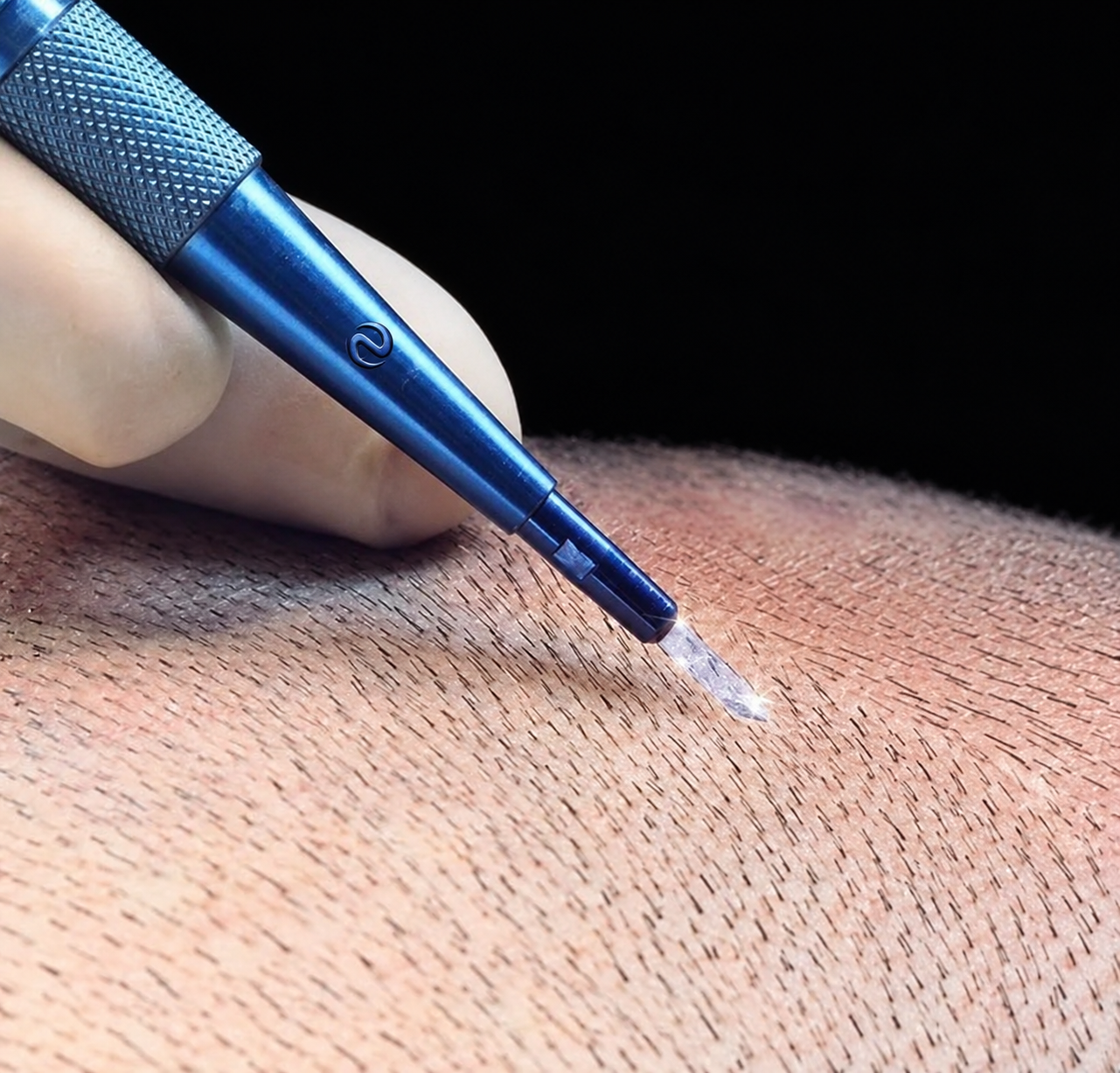
Technical names can be confusing. The punch is used in the donor area. Sapphire blades create recipient sites where grafts will be placed. Forceps are then used for placement. These are separate stages of our Sapphire FUE method.
| Instrument | Role | Where? |
|---|---|---|
| Punch Contour | Harvesting follicular units | Donor area |
| Sapphire blade | Creating recipient sites | Areas to restore |
| Forceps | Placing grafts | Recipient sites |
Punch Contour
- Role
- Harvesting follicular units
- Where?
- Donor area
Sapphire blade
- Role
- Creating recipient sites
- Where?
- Areas to restore
Forceps
- Role
- Placing grafts
- Where?
- Recipient sites
The choice of harvesting punch does not, by itself, establish the quality of recipient sites or placement. Each stage needs careful execution. Our Sapphire FUE and Choi comparison explains the distinction between harvesting and the way grafts are implanted.
Why dedicate a Punch Contour to each patient?
At NOVA, each Punch Contour is reserved for a single patient. It is sterilized before use and is not reused for another patient. This choice allows us to work with a cutting edge in its initial condition, without wear from previous procedures. For such a small instrument, controlling its preparation and use also contributes to the consistency of our protocol.
A dedicated instrument and its flared geometry address two complementary concerns: the condition of the cutting edge and the way it works around the graft. Care then continues through handling, hydration, examination, and the organization of placement.
Grafts are examined under magnification and held in sterile 0.9% saline. Our refrigerator is set to 4°C. In our usual workflow, storage is limited to a maximum of six hours. This organization keeps grafts hydrated and coordinates the time between harvesting and placement.
Our team follows the grafts through each stage: harvesting, examination, preservation, and placement. Postoperative follow-up then assesses healing and the progression of regrowth over the following months.
Harvesting adapted to straight, wavy, fine, and tightly curled hair
Our team uses Punch Contour to harvest a range of hair profiles: straight and wavy hair, fine hair, and Afro-textured or tightly curled hair. We selected it for this versatility, with a flared shape designed to help protect graft structures. Hair thickness and curl pattern describe different characteristics; a hair can be both fine and wavy, for example.
This range requires adjustments to the harvesting technique and settings. For Afro-textured and tightly curled hair, our team pays particular attention to follicle curvature beneath the skin. With fine hair, a thin shaft does not, by itself, determine the size of the follicular unit being harvested. Donor-area assessment and examination of retrieved grafts guide the work across hair textures.
Ask our team what has been observed in your donor area and how it affects the planned number and distribution of grafts. That explanation is more useful than a list of instruments with no connection to your circumstances.
Questions to ask before your procedure
You do not need to learn punch settings to prepare for a consultation. You can ask how grafts will be checked, how the donor area will be protected, and how the plan will be adjusted if the findings do not support what was originally considered.
Your quote specifies the planned graft count and the areas to be treated. The instrument helps carry out that plan; it should not become a reason to promise more grafts than the donor reserve allows. Our prices and packages explain the pricing framework.
Does Punch Contour replace Sapphire FUE?
No. It is used for FUE harvesting in the donor area. Sapphire blades prepare recipient sites. The two instruments perform complementary roles.
How is regrowth followed after a transplant?
Follow-up assesses healing and the progression of regrowth over the following months. Our team explains the expected timeline and what to look for after your procedure.
How is harvesting adapted to my donor area?
Our team considers hair direction, hair characteristics, and donor-area anatomy. Harvesting settings are adapted based on these findings and the examination of grafts under magnification.
Why dedicate a punch to each patient?
At NOVA, each Punch Contour is reserved for a single patient. It is sterilized before use and is not reused for another patient. This choice allows us to work with a cutting edge in its initial condition, without wear from previous procedures. For such a small instrument, controlling its preparation and use also contributes to the consistency of our protocol.
Sources and references
The protocol described here reflects NOVA practices confirmed for this article. The external publication assesses a different punch model.
| Hair Transplant Forum International, 2020 | FUE punch comparison: harvesting quality markers (2020) |
|---|---|
| NOVA Capillaire | Grafts and preservation |
Further reading
Sapphire FUE hair transplant: technique, results, and reviews
Is Sapphire FUE really suited to your hair loss? NOVA Capillaire explains the method, its advantages, limits, healing and results expected month by month.
Read the article
3,000-graft hair transplant: cost, coverage and limits
Understand 3,000 grafts, front-versus-crown priorities, donor preservation and NOVA fees.
Read the article
Choosing a Hair Transplant Center in Paris: Your Guide
Technique, donor area, a clear graft count, results, and follow-up: practical questions for choosing a hair transplant center in Paris.
Read the article
Crown hair transplant: planning for the vertex
Thinning at the top of your head can become an everyday concern. A crown hair transplant may be an option in some situations, following an assessment of your hair loss…
Read the article