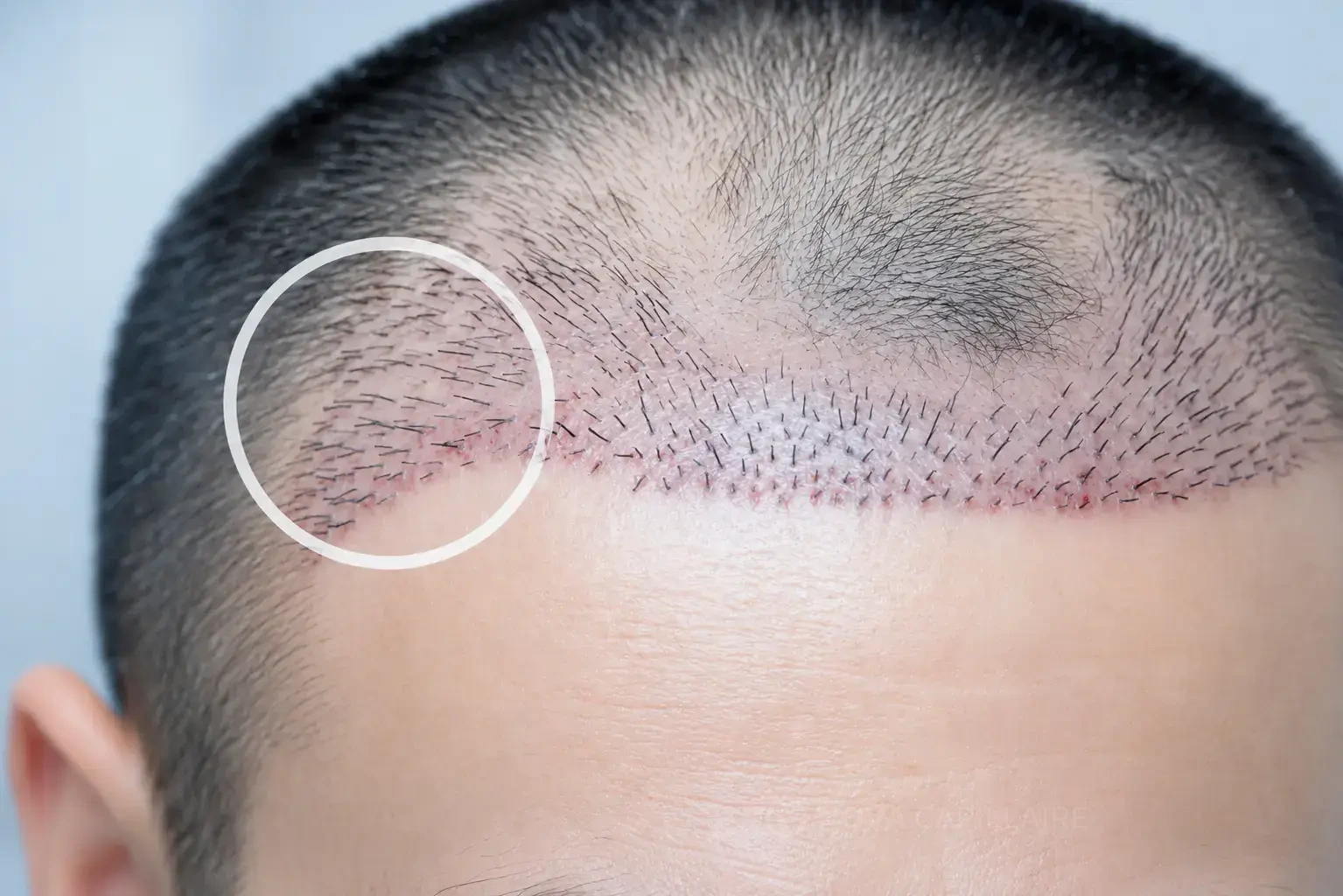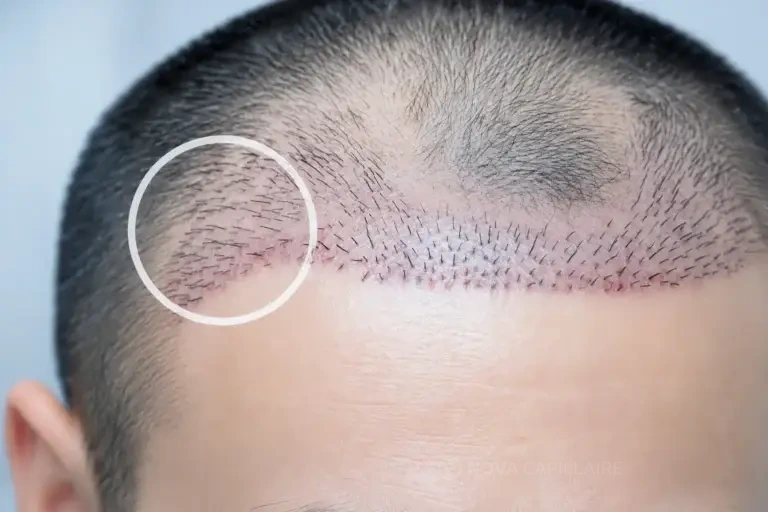
A hair transplant can improve the coverage of baldness but is not without risks. Illegal practices and unscrupulous clinics expose patients to sometimes very disappointing results: visible scars, infections, poor regrowth, or compromised donor area. Understanding these risks helps in choosing your team and knowing whom to turn to.
Recognizing a problem without concluding too early
Insufficient density, an hairline artificial look, hairs implanted in the wrong direction, or a donor area very sparse area may lead to an evaluation. But the appearance in the first weeks is not enough to judge the final result.
An insufficient or poorly managed donor reserve
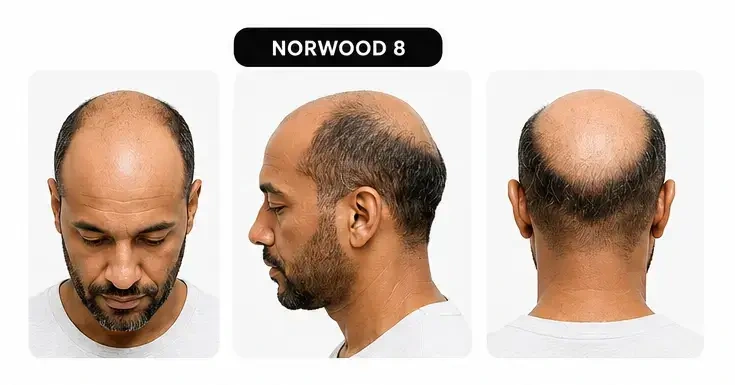
The donor area, usually at the back and sides of the head, supplies the follicles needed to cover thinning areas. If it has limited hair or the clinician overestimates how much is available, the result may be unsatisfactory. Advanced baldness can also limit the coverage that is possible.
A high rate of transection and damaged follicles
Transection corresponds to a cut of the follicle during harvesting. Grafts are living structures: their integrity and quality of the procedure matter for regrowth chances. The following illustrations show different aspects to distinguish during examination.

A · Complete transection
The follicle is completely cut.

B · Partial transection
Part of the follicular structure is cut.
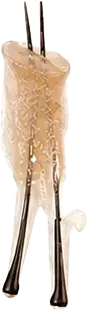
C · Follicle stripping
Cells of the outer sheath are torn off.
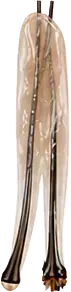
D · Damage to the dermal papilla
The dermal papilla is damaged or absent.

E · Bulb damage
The bulb region shows injury.

F · Follicular fracture
The follicular structure is fractured.

G · Telogen phase
A natural rest phase, to distinguish from lesions.
The telogen phase is a natural resting phase: it alone does not constitute a lesion or proof of a failed transplant. For concepts on follicle, bulb, and follicular unit, see our guide on hair grafts.
Poor handling or preservation of grafts
Once extracted, grafts must be handled carefully, protected from drying, and stored in a suitable medium. Temperature and time spent outside the scalp are part of the team’s protocol. Inappropriate equipment or poor organization can compromise their survival.

Therefore, it is not enough to announce a technique: ask how harvesting, conservation, and implantation actually take place. Also discover our Sapphire FUE protocol.
Equipment and care are not details
Appropriate instruments
Quality, condition, and sterility of instruments are essential. A single-use marked device must not be reused; reusable equipment must follow procedures planned for its processing.
An explained follow-up
The patient must receive clear instructions and be able to contact their team. Following the care guidelines helps recovery, but a complication does not automatically mean the patient did not follow them properly.
Find recommendations after a transplant and our guidelines on pain after the procedure.
A quote must clearly refer to grafts
The announced number may sometimes not correspond to the number actually implanted. Mixing "hair" and "grafts" can artificially inflate the impression of quantity. One hair and one graft are not the same unit of measurement.
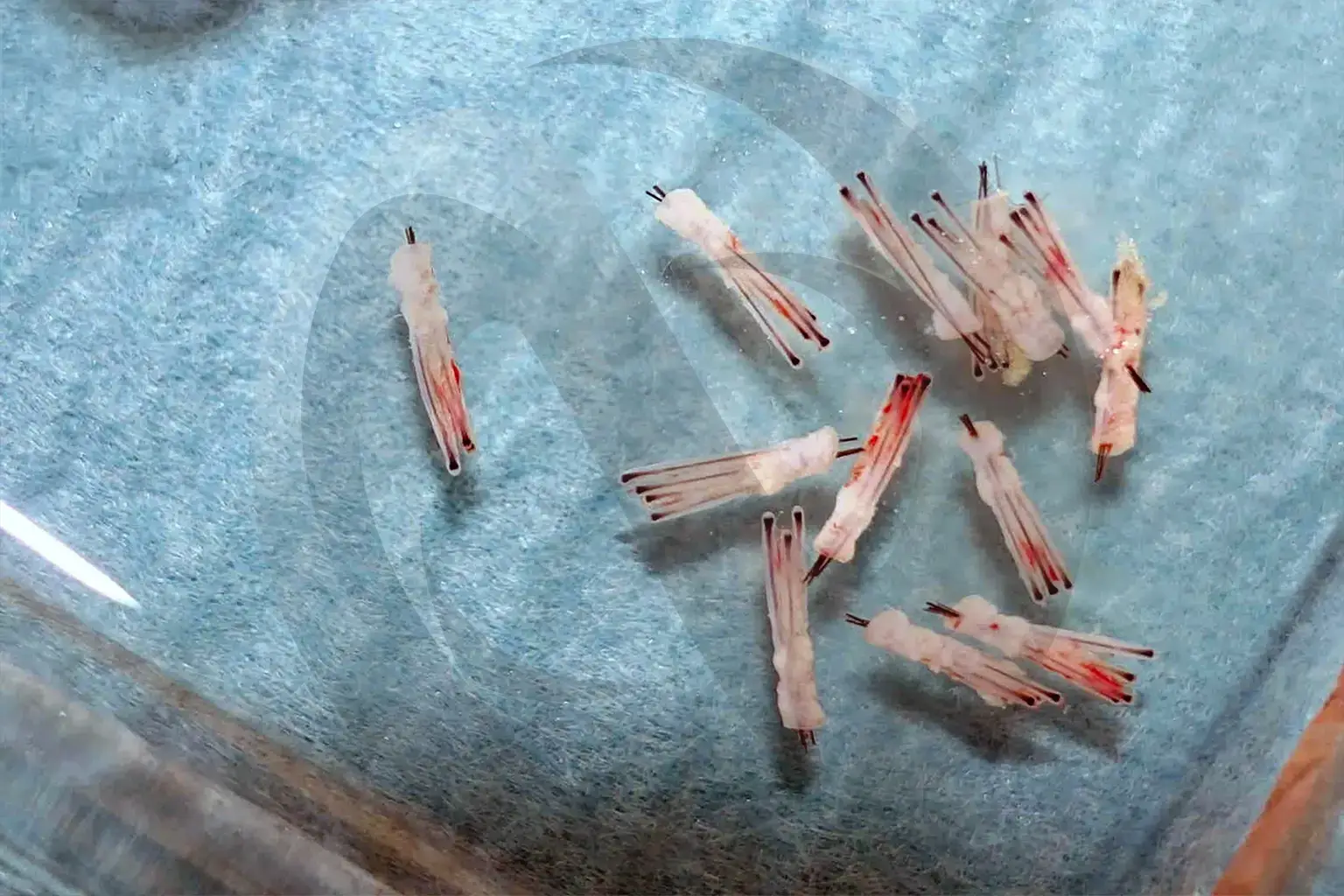
Understanding the counting
Ask what is estimated, harvested, then actually implanted.
Obtaining a report
Request the final report and an explanation if the number differs from the initial estimate.
Documenting without disrupting
You can request photographs taken by the team. A single image does not always allow reliable recounting and should not interfere with care.
How to avoid pitfalls?
Verify qualifications
Find out who is responsible for your care, what experience they have, and who performs each part of the procedure. Ask to see comparable cases and find out what follow-up includes.
Examine the price and its content
A very attractive price should not replace the analysis of the care provided. A high fee does not guarantee better quality: compare content, qualifications, and follow-up.
Ask the right questions
What reserve remains? What number is realistic? What happens if the baldness progresses or if the result is insufficient?
Refuse unrealistic promises
"Unlimited" grafts, guaranteed density or a volume announced before any examination should raise concerns. A high number in one day deserves an explanation but does not alone prove malpractice.
Consult our prices and packages and our comparison of Sapphire FUE and Choi Pen. Whatever technique you choose, you still need to assess the team and the proposed treatment plan.
What to do if the result disappoints you?
Start with an assessment: date of the procedure, progress photographs, report, condition of the donor area and scalp. A second specialist opinion can help understand the situation and real possibilities.
A dermatological opinion
The dermatologist specifically looks for still active hair loss and discusses appropriate treatments. Treatment does not automatically recreate destroyed follicles and does not correct a poorly oriented implantation.
An individualized correction
A corrective procedure can improve some results. Its feasibility depends on the reserve and tissues; multiple steps may be necessary and a new transplant is not always possible.
Camouflage solutions
In some cases, micropigmentation can improve the visual aspect. It does not produce new hair and must also be discussed with an experienced professional.
Psychological support
A disappointing experience can weigh heavily on morale. Support can help, without minimizing the aesthetic issue or replacing its medical evaluation.
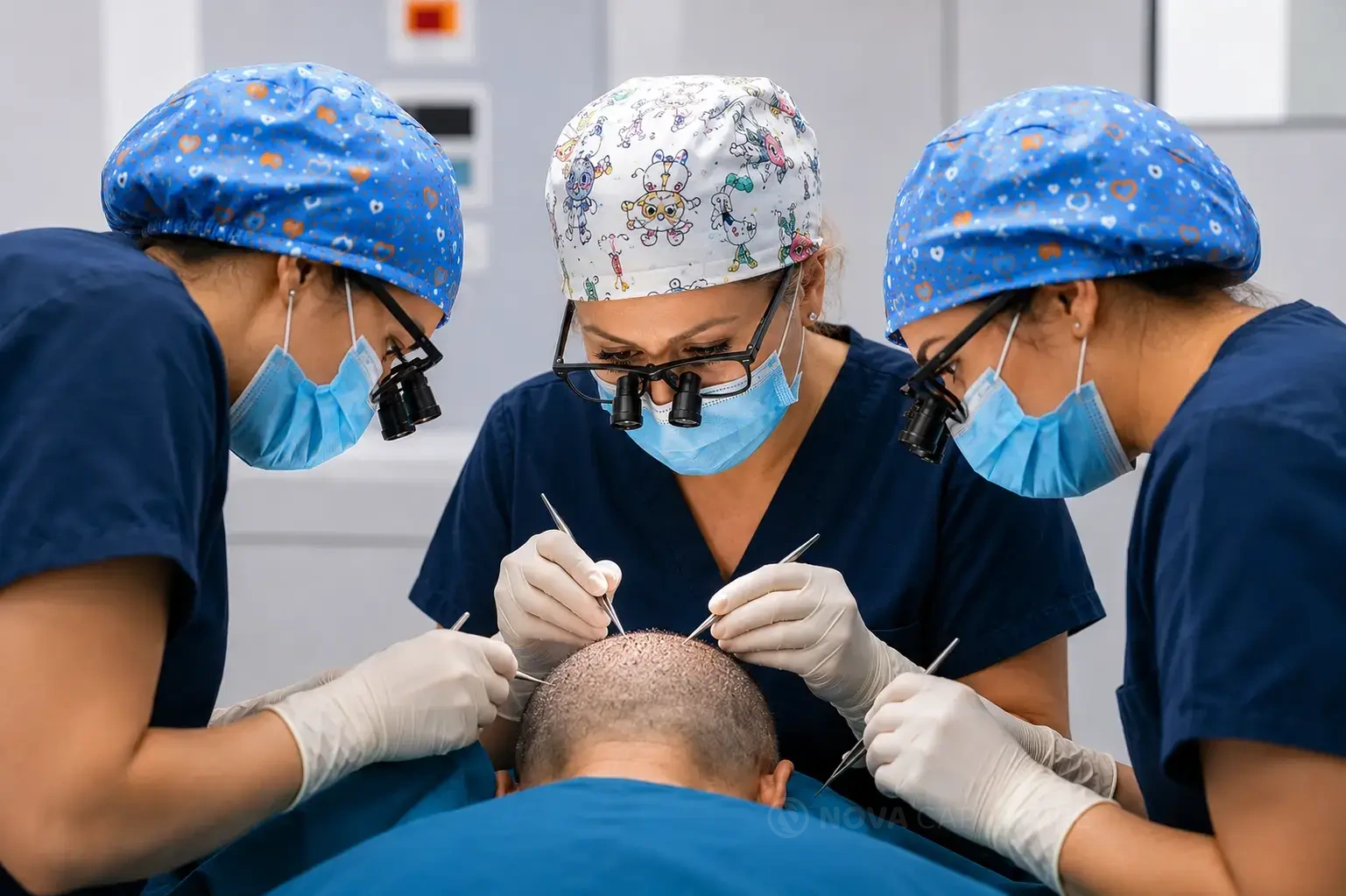
The essential message remains the same: choose a qualified team, demand transparent information, and protect your hair reserve. Serious care reduces risks without guaranteeing a perfect result.
Ask about my optionsSources and guidelines
Hair Transplant Forum International — Graft preservation media and temperature.
MHRA — Risks related to reuse of single-use devices : safety guideline, not a presentation of French regulations.
ISHRS — Correction and revision of previous transplants : indications, limited reserve and camouflage possibilities.
ISHRS — Malpractices and patient risks : qualifications, overexploitation and transparency.
NHS — Hair transplant : recovery, practitioner choice and symptoms to report.