Understanding hair loss and preparing for a possible procedure are two separate questions.
Smoking and hair loss: what studies show
A meta-analysis published in 2024 brought together eight studies on smoking and male pattern hair loss. It found an association between having smoked and androgenetic alopecia. These were observational studies, however: they compared people whose medical histories and other habits could also differ. [1]
That distinction matters. A statistical association does not mean that everyone who smokes will lose their hair, or that smoking caused your own hair loss. Findings in men with pattern hair loss do not describe every form of hair loss in women, either.
Androgenetic alopecia remains a condition involving factors such as genetic predisposition and the follicles’ sensitivity to androgens. Smoking is part of the background to consider, not a diagnosis.
How might smoke affect hair follicles?
Researchers have proposed several mechanisms, including oxidative stress, inflammation, and changes in the small blood vessels around hair follicles. A review published in 2026 discusses these hypotheses and also finds an association between smoking and androgenetic alopecia, with results varying across studies. [2]
These mechanisms make the connection biologically plausible. They do not allow anyone to measure damage to your follicles from the number of cigarettes you smoke. There is no reliable conversion between “one cigarette” and a number of hairs lost.
Quitting smoking: what can change for your hair?
The studies cited here do not establish that quitting smoking alone can restore hair affected by pattern hair loss. Nor do they support a promise of recovery within three, six, or twelve months. Quitting benefits your health; that benefit should not become a promise of hair regrowth. [1, 2]
Hair loss can have several explanations. Recent, widespread shedding, for example, needs to be distinguished from gradual pattern hair loss. Our article on telogen effluvium explains the difference. An examination and the timeline of your hair loss remain more useful than a conclusion based on smoking alone.
Before a transplant: preparing for healing
Smoking increases the risk of poor wound healing and infection after surgery. The World Health Organization reports that quitting approximately four weeks or more before an operation is associated with better postoperative outcomes. These findings concern surgery in general: they do not provide a graft survival rate after FUE. [3]
French SFAR recommendations encourage quitting as early as possible and recommend offering support even when the procedure is approaching. Discuss the timing at your consultation rather than relying on a universal interval copied from the internet. [4]
When preparing a hair transplant plan, tell the team how much you actually smoke, about previous attempts to quit, and about any difficulties you have encountered. The team can clarify the instructions, available support, and whether the date may need to be reconsidered. After the procedure, the aftercare information and NOVA postoperative guide supplement the instructions given to you personally.
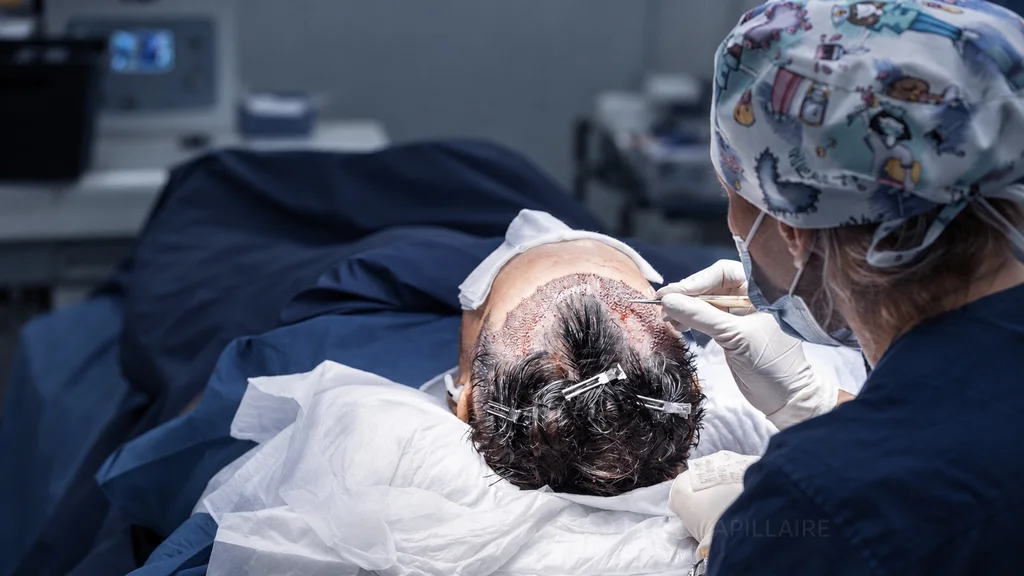
Frontal graft implantation: instructions before and after the procedure are part of transplant preparation.
Cigarettes, vaping, and nicotine replacement are different
A nicotine replacement patch or gum is not a cigarette. French perioperative recommendations include nicotine replacement therapy among the options to offer people who want to quit smoking. A large observational study in general surgery found no association between nicotine replacement received during hospitalization and an increase in complications. This was not a study specifically of hair transplantation. [4, 5]
Do not stop a prescribed smoking cessation aid on your own because you are worried about nicotine. Tell the team about it so that instructions can be coordinated with the healthcare professional supporting you.
An electronic cigarette is another type of product. The sources presented here cannot guarantee that vaping is safe around a hair transplant or establish when it could be resumed. Tell the team about vaping at your consultation as well. In France, Tabac info service provides support with quitting, and Assurance Maladie, the French public health insurance system, explains the available assistance. [6]
Frequently asked questions
Is it too late to discuss smoking if my transplant is already scheduled?
No. Contact the team now. French recommendations encourage offering support with quitting even when the date is close; decisions about the procedure remain individual. [4]
Have I ruined my transplant if I started smoking again?
A return to smoking does not, by itself, establish that the transplant has failed. Tell the team so that support can be adjusted and follow-up can continue. Do not change your aftercare or medications on your own.
How long before a transplant should I quit smoking?
WHO reports better postoperative outcomes when smoking stops around four weeks or more before surgery. This general benchmark does not replace your transplant team’s schedule. Discuss it at your consultation, even if you have less time available. [3, 4]
Should I stop using nicotine patches or gum?
Do not stop them on your own. Nicotine replacement is among the smoking cessation aids included in French recommendations. Tell the team which product and dose you use so instructions can be coordinated with the professional supporting you. [4, 5]
Can I replace cigarettes with vaping around the transplant?
Do not treat this switch as permission to vape during the surgical period. Say whether your liquid contains nicotine and ask for instructions for your procedure. The references presented here do not establish a safe time to resume vaping.
Is cutting down on cigarettes enough?
Recommendations encourage smoking cessation rather than presenting a consumption threshold as risk-free. If quitting feels difficult, tell the team: the aim is to arrange support and prepare for the procedure together. [3, 4, 6]
Sources and further reading
References accessed October 24, 2026.
| Source | Reference and link |
|---|---|
| 1. Gupta et al. · 2024 | Gupta AK, Bamimore MA, Talukder M. A meta-analysis study on the association between smoking and male pattern hair loss. Journal of Cosmetic Dermatology, 2024. PubMed record. |
| 2. Li et al. · 2026 | Li H et al. Risk factors for androgenetic alopecia: a systematic review and meta-analysis. BMC Public Health, 2026. Full text. Observational and heterogeneous data; findings are presented qualitatively here. |
| 3. WHO · 2020 | World Health Organization. Smoking greatly increases risk of complications after surgery, 2020. WHO summary. |
| 4. SFAR · 2016 | SFAR. Recommandations sur la prise en charge du tabagisme en période périopératoire, 2016. Expert recommendations, in French. |
| 5. Stefan et al. · 2020 | Stefan MS et al. The Association of Nicotine Replacement Therapy With Outcomes Among Smokers Hospitalized for a Major Surgical Procedure. Chest, 2020. Study and methods. |
| 6. Assurance Maladie · 2025 | Assurance Maladie. Arrêt du tabac : quelle prise en charge pour les substituts nicotiniques ?, 2025. Smoking cessation support, in French. |
Further reading

Am I a good candidate for a hair transplant?
Donor area, hair loss progression, and expectations: understanding what makes a transplant plan feasible, adaptable, or discouraged, including at Norwood stages VI and VII.
Read the article
Coily hair: why graft count does not tell the whole story
Curl, visible coverage, and donor supply: understanding an individual transplant plan through NOVA before-and-after cases.
Read the article
Scalp numbness after a hair transplant
Why your scalp may feel numb after a hair transplant, how sensation can change over several months, and when to contact your team.
Read the article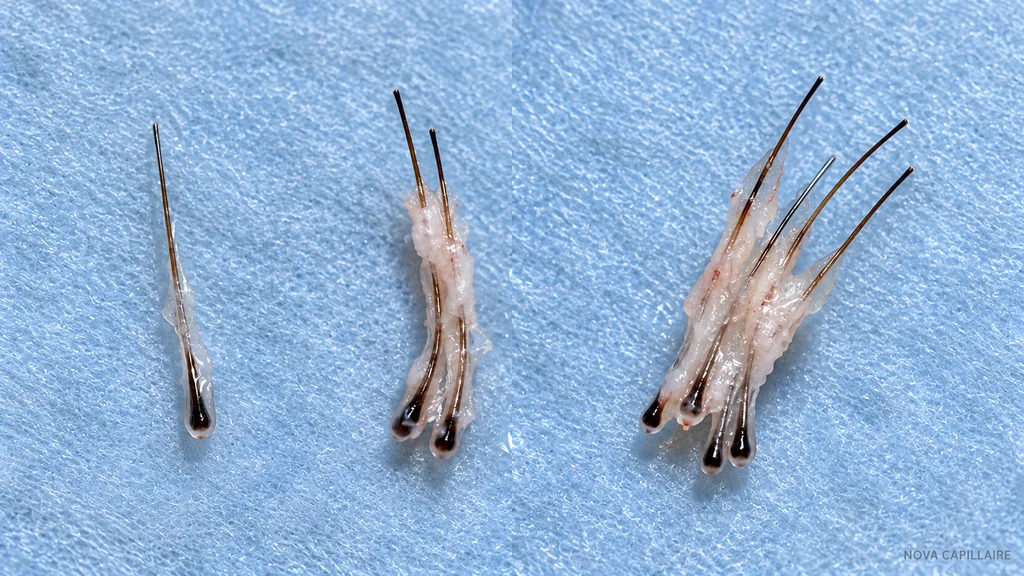
Hairs, follicles and grafts: understanding transplant numbers
One hair, several hairs, one graft: understand what is counted before comparing treatment plans.
Read the article