
Two hair transplant plans with similar graft counts can address very different needs. For coily hair, understanding the numbers also means looking at texture, the area being covered, and the hair that needs to remain in the donor area. Our before-and-after cases put these considerations into perspective.
Two cases, two individual plans
Our gallery includes a hairline reconstruction involving 2,000 grafts, with photographs at 12 months. Another case documents treatment of the hairline and frontal corners using 1,700 grafts, also photographed at 12 months. These are individual experiences. Their graft counts cannot rank the results or predict another patient’s outcome.
Frontal hairline reconstruction
- Grafts implanted
- 2 000
- Result observed at
- 12months


Frontal hairline and temples
- Grafts implanted
- 1 700
- Result observed at
- 12months
Start by looking at the original areas of thinning. Then examine where the hairline was reconstructed and when the follow-up photograph was taken. Hair length, styling, camera angle, and lighting also influence the appearance of coverage. A before-and-after comparison shows a change; it does not replace measurements during an assessment.
Visible coverage is not the same as density
Curl can help conceal the scalp. Hair caliber and the contrast between hair and skin also contribute to an appearance of fullness. Similar graft counts therefore do not necessarily produce similar coverage. This does not mean that all coily hair is thick or that every Afro-textured hair transplant needs fewer grafts. [1]
A hair is also different from a graft. A follicular unit may contain several hairs, so the graft count alone does not describe its composition. Our article on hair, follicles, and grafts explains the distinction. An average estimate does not replace the count specific to an individual procedure.
| Reference point | What it tells you | What it cannot determine alone |
|---|---|---|
| Graft count | The number of follicular units planned or transplanted. | The exact hair count, coverage area, or final outcome. |
| Coily texture | A characteristic considered during harvesting and aesthetic planning. | The exact follicle curvature or an unlimited donor supply. |
| A before-and-after case | One patient’s photographed change at a stated interval. | A guarantee of the same outcome for someone else. |
Graft count
- What it tells you
- The number of follicular units planned or transplanted.
- What it cannot determine alone
- The exact hair count, coverage area, or final outcome.
Coily texture
- What it tells you
- A characteristic considered during harvesting and aesthetic planning.
- What it cannot determine alone
- The exact follicle curvature or an unlimited donor supply.
A before-and-after case
- What it tells you
- One patient’s photographed change at a stated interval.
- What it cannot determine alone
- A guarantee of the same outcome for someone else.
What the visible curl cannot show
A follicle may follow a curved path beneath the skin. Our three views of coily, wavy, and straight hair help illustrate this principle; they are not exact categories for patients. Surface texture alone cannot predict the follicle’s full path. [2]
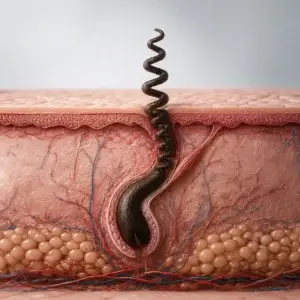
Coily
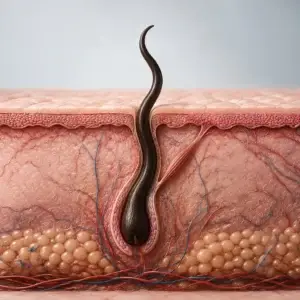
Wavy
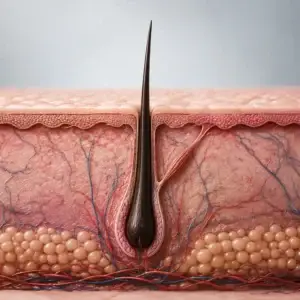
Straight
During FUE harvesting, curvature requires adaptation of the surgical approach. Cutting across a follicle during harvesting is called transection. Published research describes substantial variation among people with Afro-textured hair. It does not support one universal approach or a promise of zero risk. [3]
Punch Contour and coily hair: why its shape matters
The curved follicle: what needs to be preserved
The phrase “curved bulb” is sometimes used. More precisely, the bulb is the enlarged base of a follicle; the follicular course beneath the skin may be curved. Follicles within the same graft may also spread apart. An instrument aligned with the visible shaft therefore does not necessarily follow their entire path.[5]
What the punch actually does
A punch is a small hollow instrument. It surrounds the follicular unit and releases the tissues anchoring it; the graft is then removed. It does not grab the bulb like forceps. The aim is to divide the attachments around the graft without cutting across the follicles within it.
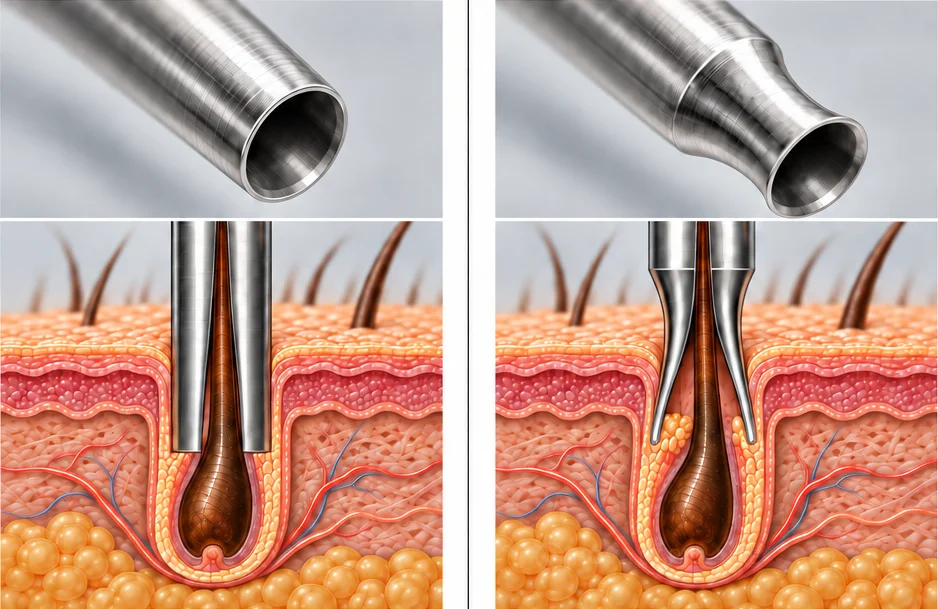
Left: a cylindrical punch. Right: the flared Punch Contour. The tips are shown above and their passage around a follicle below.
Why a flared opening is useful
At NOVA, we favor the Punch Contour, made to our specifications. Its progressively flared, bell-shaped opening is designed to accommodate the follicular unit and its curves. For coily hair, the intended benefit is to facilitate this passage while preserving the graft structures.
Publications on hybrid and flared punches describe a related principle: keeping the cutting edge away from follicles during dissection. A paper on curly hair also emphasizes adapting the approach to follicular curvature. These reports concern the models described by their authors; their results are not measurements of the NOVA Punch Contour.[5][6]
Instrument design works alongside careful technique
Curvature varies between people and sometimes within one donor area. Angle, centering, and depth must be adapted to the findings. At NOVA, inspection of harvested grafts under magnification complements this work. The Punch Contour is our choice for this approach; no punch alone guarantees harvesting without transection.
Full-looking hair does not mean an unlimited donor supply
Curl can make the back of the scalp appear denser than it is when measured. The donor area therefore needs to be examined. Transplantation redistributes follicles; it does not create a new supply where they were removed. [2]
Planning considers the available hair, its distribution, and possible future hair loss. Preserving the appearance of the back and sides is part of the goal, alongside restoring the front. Hair texture alone cannot determine a maximum graft count that applies to everyone. [4]
At NOVA, explain the distribution before the total
Transplanting coily hair is part of our practice. Our approach accounts for follicular curvature during harvesting and the natural direction of hair growth during implantation. Patients should be able to understand which areas will be treated, the intended hairline, and the reasons for the proposed graft count.
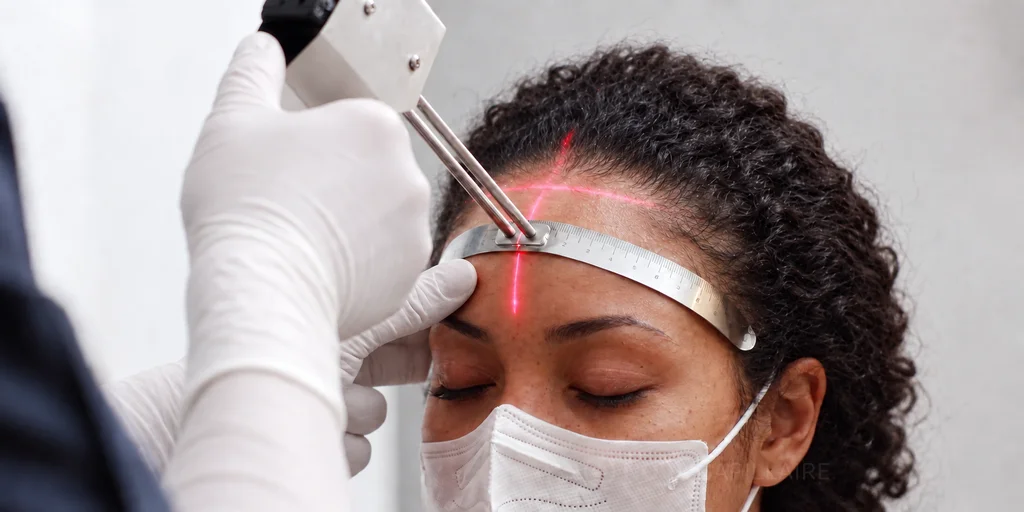
Planning the hairline: this device provides positioning reference points. It does not measure the donor supply.
The cases shown here illustrate our work without guaranteeing a similar outcome. For the procedure, recovery, and pricing, see our page on Afro-textured and coily hair transplants. This article focuses on understanding the plan rather than repeating the stages of surgery.
Questions to ask during your assessment
Ask which findings support the donor-supply estimate and how harvesting will be distributed. Discuss priority areas and what might reasonably be deferred if the donor supply cannot support the entire request.
You can also ask to see photographs of the back of the scalp after healing and cases with starting points similar to yours. The aim is to understand the proposed balance, rather than select the highest number.
Frequently asked questions
Does coily hair always provide better coverage?
Curl can contribute to visible coverage, but it cannot predict the outcome on its own. Caliber, area, distribution, and the starting situation matter too. [1]
Can a photograph establish the donor supply?
A photograph helps prepare a discussion. It cannot independently measure density, hair quality, and safe harvesting limits. A clinical assessment is still needed. [2][4]
Can I request the same graft count as a gallery patient?
A case can help you explain your expectations. However, the proposed count must fit your own plan and donor supply rather than be copied from a before-and-after comparison.
Sources and context
| Source | Relevance |
|---|---|
| [1] ISHRS — Hair Under the Microscope | Hair properties and the contribution of curl to visible coverage. |
| [2] ISHRS — Hair Restoration in African-Americans | Anatomical considerations and donor-density assessment. |
| [3] Umar, 2016 — Comparative Study of a Novel Tool for Follicular Unit Extraction for Individuals with Afro-textured Hair | Technical harvesting study addressing individual variation and transection. Its findings are not NOVA outcomes and do not establish universal superiority. |
| [4] ISHRS — The Donor Site: Savings & Loan of Hair for Transplantation | Donor-supply assessment and planning. |
| [5] Reyes, 2021 — Curly Hair FUE | Curvature and harvesting adjustments; experience with a hybrid punch. |
| [6] Tykocinski, 2017 — Dealing with a Hybrid Trumpet Punch | Mechanics of a flared hybrid punch, distinct from the NOVA Punch Contour. |
This article does not replace a medical consultation. The photographs show individual outcomes.
Further reading
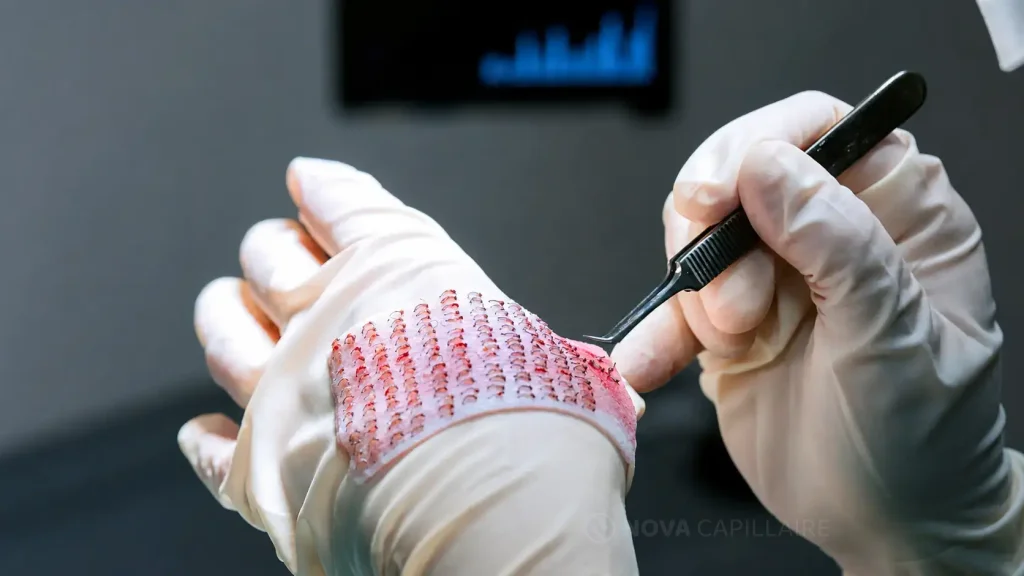
Everything you need to know about grafts in a hair transplant
The graft is the basic unit of hair transplantation. Its quality, conservation, and distribution directly influence density and appearance.
Read the article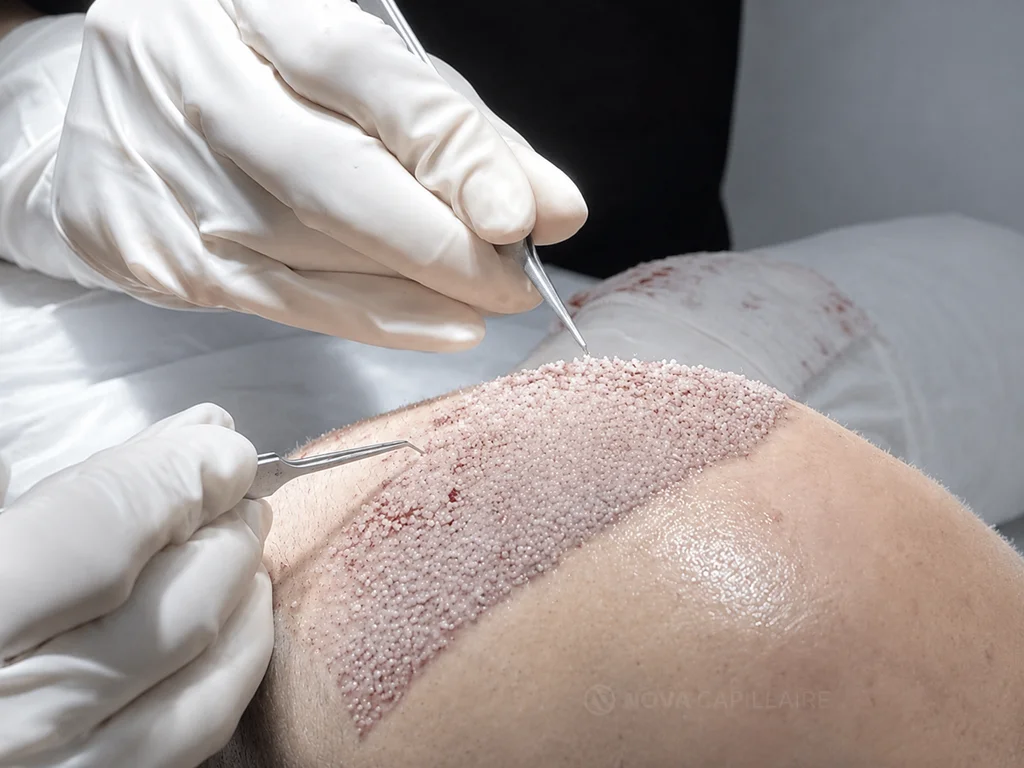
Scalp numbness after a hair transplant
Why your scalp may feel numb after a hair transplant, how sensation can change over several months, and when to contact your team.
Read the article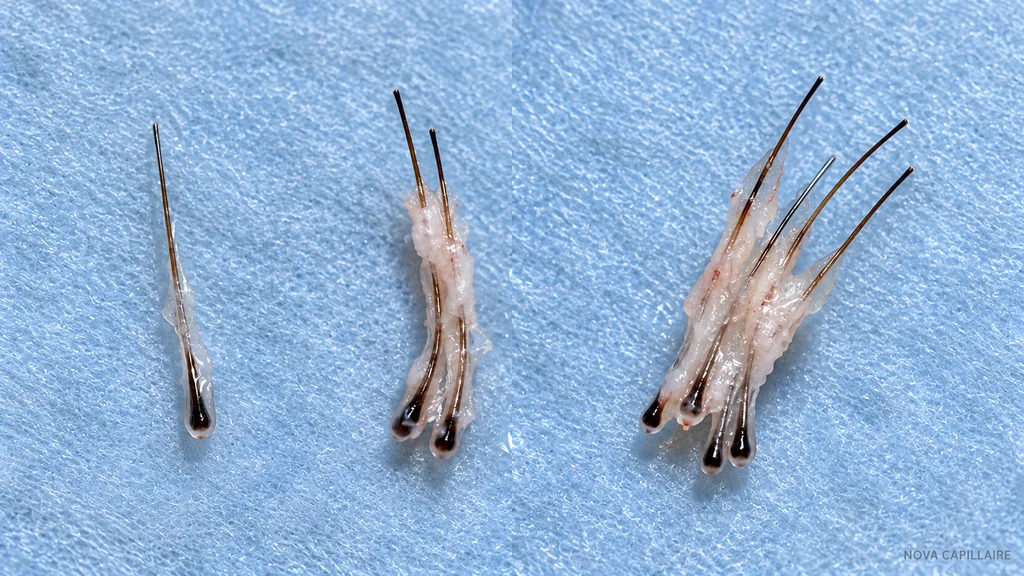
Hairs, follicles and grafts: understanding transplant numbers
One hair, several hairs, one graft: understand what is counted before comparing treatment plans.
Read the article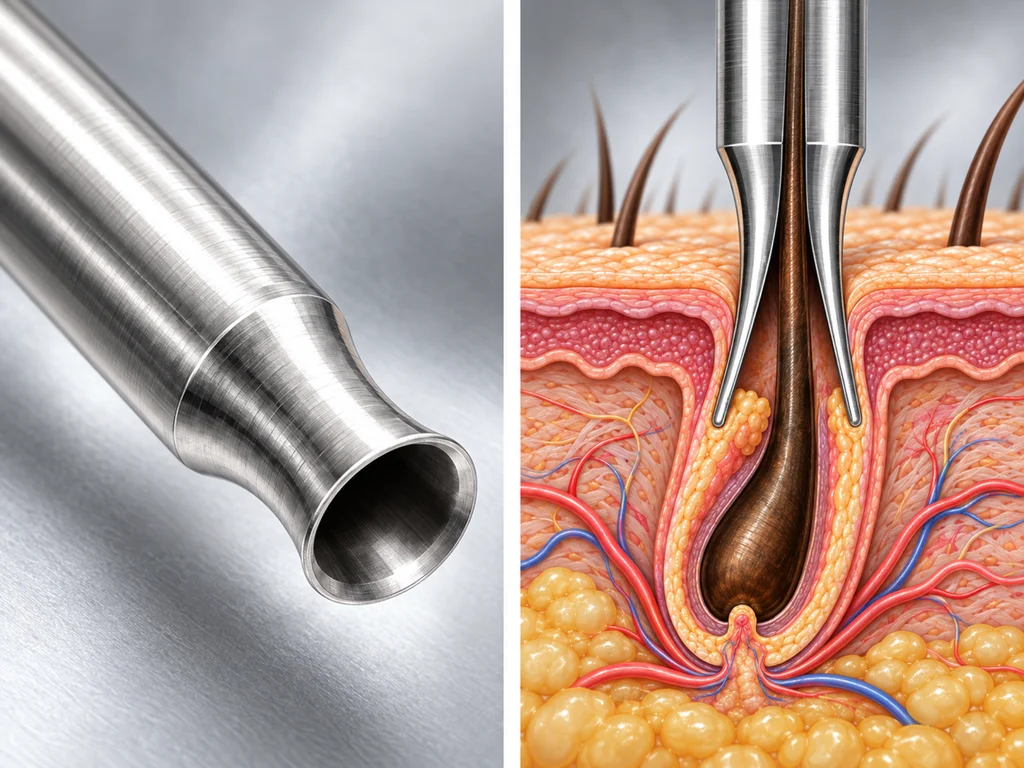
Punch Contour: protecting grafts during FUE harvesting
Punch geometry, graft checks, and donor-area planning: understand how FUE harvesting fits into a NOVA hair transplant.
Read the article