A monthly timeline is a way to organize your follow-up, not a schedule your hair must meet. This guide helps you read photographs and prepare useful questions for your team.
| Stage | Useful focus | Limit |
|---|---|---|
| Day 2 / week 2 | Locate the treated area | Care instructions remain the reference |
| 1 month | Early appearance and possible shedding | No conclusion about final density |
| 3 months | Compare with baseline and describe concerns | An online case is not your deadline |
| 6 months | Review change by treated area | No percentage inferred from a picture |
| 9 months | Compare with six months | No survival rate from a photograph |
| 12 months | Discuss the overall project | Individual assessment remains necessary |
Day 2 / week 2
- Useful focus
- Locate the treated area
- Limit
- Care instructions remain the reference
1 month
- Useful focus
- Early appearance and possible shedding
- Limit
- No conclusion about final density
3 months
- Useful focus
- Compare with baseline and describe concerns
- Limit
- An online case is not your deadline
6 months
- Useful focus
- Review change by treated area
- Limit
- No percentage inferred from a picture
9 months
- Useful focus
- Compare with six months
- Limit
- No survival rate from a photograph
12 months
- Useful focus
- Discuss the overall project
- Limit
- Individual assessment remains necessary
Eight views, one timeline
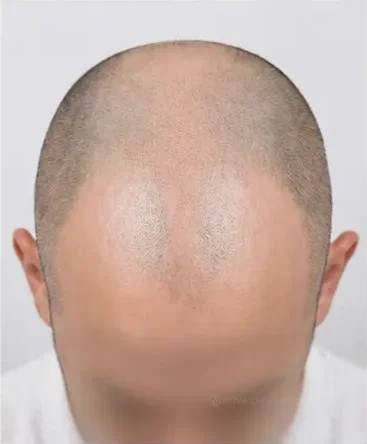
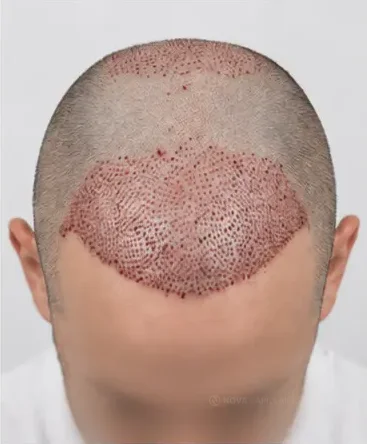
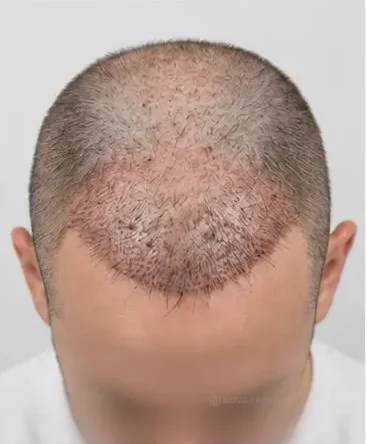
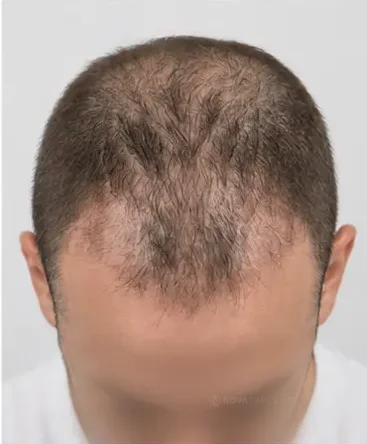
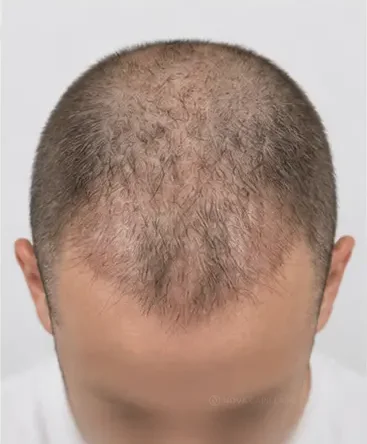
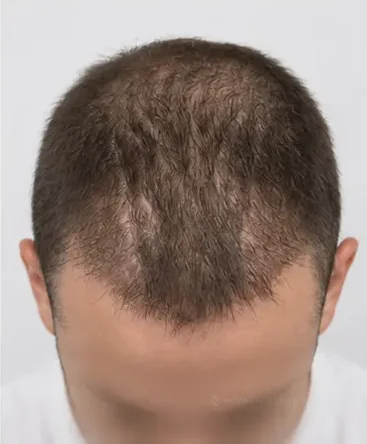
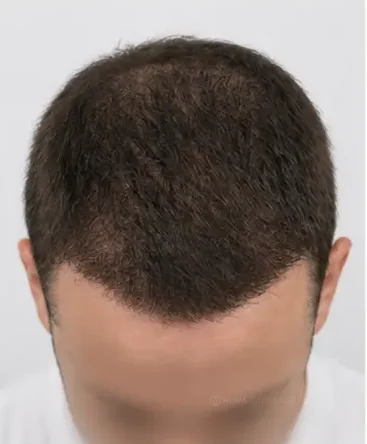
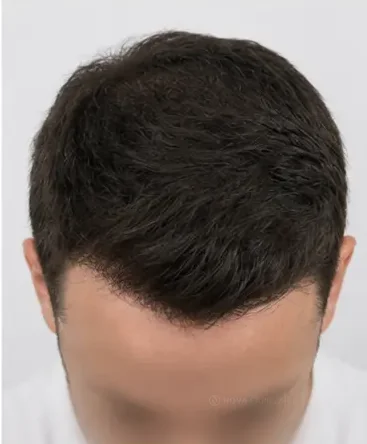
Explore the stages with the arrows or swipe. Individual evolution varies.
Start with a reliable baseline
After surgery, the question often sounds straightforward: when will I see my result? Yet the first photograph, with short transplanted hairs outlining the hairline, does not show your eventual density. It records a recent placement. Photographs taken later need to be read in the context of their stage.
Keep your preoperative views and the plan discussed during consultation. Record which areas were actually treated: the hairline, temples, central scalp or crown. An area outside the agreed plan should not be judged as though it received grafts. The total graft count does not explain their allocation on its own.
In the NOVA postoperative guide, day zero means the last day of transplantation. For a two-day procedure, use that date when locating your early care and photographs on the timeline. Keep the exact date of each photograph so the team can relate it to your procedure.
Day 2 and week 2: read the early views as recovery photographs
The existing NOVA montage starts before surgery, then shows day 2 and week 2. These views give a baseline and show the recently treated area. They do not establish final density. Small visible points and short hairs belong to a different stage than the longer hair in later images.
Use the early record to locate treated areas and describe a concern to your team. It does not give permission to rub away scabs or change your washing routine. NOVA’s individual instructions and postoperative guide determine those steps. If the image looks different from your own scalp, a photograph alone cannot explain the difference.
At 1 month: understand what is disappearing from the pictures
The first month can feel confusing when the newly outlined area starts looking less filled in. The American Academy of Dermatology describes shedding of transplanted hair shafts between two and eight weeks. A missing visible shaft does not, by itself, demonstrate that the implanted follicle has been lost.
At this stage, a photograph documents the appearance of your scalp and the areas involved. It cannot count the follicles that will produce a hair later. Do not touch or scratch the skin to try to locate each graft. Follow your team’s instructions even if a video or another patient describes a different routine.
For washing, scabs, products and returning to activities, use the NOVA care guide rather than changing your routine to match this timeline. Recording what you see and deciding what care to perform are different tasks.
At 3 months: a sparse photograph is not the verdict
Comparing yourself with a three-month picture online leaves many unknowns: the starting point, treated area, hairstyle and lighting. A striking photograph is not a deadline your own hair has to meet.
The AAD notes that hair can still look thinner at the third month than before transplantation. If this worries you, send a current view alongside your baseline photograph. Explain the concern: little change at the temples, a difference between sides, or shedding in an area that was not transplanted.
A specific question is more useful than asking whether everything is normal with a tightly cropped picture. Provide the surgery date, photograph date and any symptoms. The team can decide whether additional views or an examination are needed. An article cannot make that decision remotely.
At 6 months: compare the change with the agreed plan
Recreate your preoperative views. Look at the front from straight ahead, each temple from the side, and the crown from above if it was treated. Complementary angles help explain where change has occurred; a single flattering image cannot answer every question.
A photograph cannot give you a reliable percentage of your eventual result. Statements such as half the result or seventy percent regrowth would need a measurement method and a defined endpoint. Visible volume also depends on hair length, styling and lighting.
Prepare your follow-up around the original plan. Does the hairline outline correspond to the agreed drawing? Does your priority area look different under comparable conditions? What still concerns you? These questions create a useful discussion without turning a visual impression into a graft count.
At 9 months: compare with six months, not just the starting point
The montage includes a nine-month view between six and twelve months. This is useful for examining changes within the same follow-up rather than jumping directly from the baseline to the latest picture. Compare each treated area using similar angles, lighting and styling.
If the change seems limited, identify what you mean: hairline outline, scalp visibility in a particular area or the appearance from above. Document your question for the follow-up team. A nine-month photograph does not provide a survival rate or a universal threshold for deciding whether another procedure is needed.
At 12 months: review the whole project
The twelve-month point is useful for revisiting your goals, baseline views, treated areas and donor area. Compare the current appearance with the agreed project rather than an ideal head of hair discovered later in an advertisement.
Public sources use different endpoints. The AAD describes visible results commonly at six to nine months, sometimes twelve; the NHS places full results in a ten-to-eighteen-month window. Seeing a change and assessing a complete result are not necessarily the same event. These ranges do not set an individual deadline or guarantee density.
If the outcome feels insufficient, document the areas involved, the goal originally agreed and the photographs that illustrate your concern. An additional procedure is not decided by the anniversary date alone. It requires an assessment of the result, remaining hair and donor reserve.
Take photographs your team can compare
Use a location and lighting setup you can reproduce. Direct light from above can expose more scalp than soft light from the front. Switching between them can create an apparent improvement or setback that comes mainly from the photograph.
Keep your hair dry, avoid concealing fibers and filters, and use a comparable hairstyle. Record a major haircut rather than overlooking it in the comparison. Take a front view for the hairline, each side for the temples, and a top view for the central scalp and crown. Add views of the back and sides for the donor area.
For a specific concern, send a wide view and a close-up. One shows the location; the other shows the detail. Avoid heavy digital zoom and blurred images. There is no need to collect daily pictures: organize the record around the follow-ups and requests made by your team.
These images support your care. Sending photographs to the center does not authorize their publication on the blog. No clinical sequence will be presented here with unconfirmed dates or graft counts.
The front, crown and donor area answer different questions
A front view can show the framing of your face without explaining crown coverage. A top view can show distribution without fully describing the hairline design. Match each image to the question you want it to answer.
The donor area needs its own views. It supplied the follicles, and its photographs record the appearance after harvesting. A different haircut at the back can substantially change how visible the scalp looks. Do not assess this area only through pictures of the recipient area.
Also distinguish transplanted hair from the hair already present around it. Transplantation does not automatically stop ongoing hair loss. Changes elsewhere should be discussed during follow-up without assuming that the implantation has failed.
When to contact NOVA before the next photo review
Contact the team promptly about severe or increasing pain, spreading redness, discharge, fever or worsening swelling. Do not wait for a monthly milestone to report a worrying symptom. The NHS advises contacting the treating clinic promptly about severe pain or unexpected symptoms.
Explain when the symptom began, how it has changed and what care or products you have used. A photograph can help but does not replace an examination when one is needed. Do not squeeze a spot or apply a new cream to improve its appearance before sending the picture.
Questions about regrowth can also be raised through follow-up before the final assessment. You do not have to choose between waiting silently and deciding for yourself that the transplant has failed.
Frequently asked questions
Is shedding at one month proof that the transplant failed?
No. A photograph of missing shafts cannot establish follicle survival. Send your question to the team, especially if symptoms accompany the change.
Should I be able to calculate a regrowth percentage at six months?
No. Visible appearance is not a standardized follicle count. Compare dated photographs with the original plan.
Should I start a supplement to speed things up?
Do not add a product automatically. Follow your prescription and discuss any new treatment or supplement with a professional.
Does a twelve-month photograph always show a complete result?
No fixed date applies to everyone. Review your evolution with the treating team and the goals agreed before surgery.
Related guides
Sources and references
Checked October 12, 2026. The NHS page was last reviewed September 29, 2023; its scheduled review date has passed. General timelines are not NOVA outcome statistics. The practical photography suggestions organize follow-up; they are not a validated test of graft survival.
| Source | Reference |
|---|---|
| AAD | Visible results and early shedding |
| NHS | Recovery, full results and unexpected symptoms |
| NOVA | Current postoperative instructions |
Further reading
Everything you need to know about grafts in a hair transplant
The graft is the basic unit of hair transplantation. Its quality, conservation, and distribution directly influence density and appearance.
Read the article
3,000-graft hair transplant: cost, coverage and limits
Understand 3,000 grafts, front-versus-crown priorities, donor preservation and NOVA fees.
Read the article
Choosing a Hair Transplant Center in Paris: Your Guide
Technique, donor area, a clear graft count, results, and follow-up: practical questions for choosing a hair transplant center in Paris.
Read the article
Crown hair transplant: planning for the vertex
Thinning at the top of your head can become an everyday concern. A crown hair transplant may be an option in some situations, following an assessment of your hair loss…
Read the article